

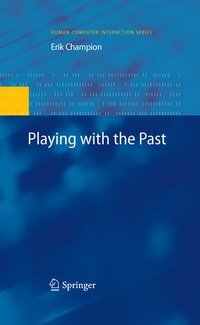
Playing with the Past
Published on 6. October 2010
Book
Hardback
XXII, 214 pages
978-1-84996-500-2 (ISBN)
Description
How can we increase awareness and understanding of other cultures using interactive digital visualizations of past civilizations? In order to answer the above question, this book first examines the needs and requirements of virtual travelers and virtual tourists. Is there a market for virtual travel? Erik Champion examines the overall success of current virtual environments, especially the phenomenon of computer gaming. Why are computer games and simulations so much more successful than other types of virtual environments? Arguments that virtual environments are impeded by technological constraints or by a paucity of evaluation studies can only be partially correct, for computer games and simulations are also virtual environments. Many of the underlying issues are caused by a lack of engagement with the philosophical underpinnings of culture, presence and inhabitation, and there are few exemplars that engage the public with history and heritage using interactive media in a meaningful and relevant manner. The intention of Playing With the Past is to help designers and critics understand the issues involved in creating virtual environments that promote and disseminate historical learning and cultural heritage through a close study of the interactive design principles at work behind both real and virtual places. Topics discussed include the design of virtual environments, and especially virtual heritage environments, virtual place-making, cultural presence, the pros and cons of game-style interaction, augmented reality projects, and appropriate evaluation methods. Virtual heritage environments discussed in the book include projects from Antarctica, Australia, Mexico, Malta, Egypt, Babylon, the Netherlands, Cambodia, and India.
More details
Series
Edition
2011
Language
English
Place of publication
London
United Kingdom
Target group
Professional and scholarly
Research
Illustrations
16 s/w Tabellen
XXII, 214 p.
Dimensions
Height: 24 cm
Width: 16 cm
Weight
1130 gr
ISBN-13
978-1-84996-500-2 (9781849965002)
DOI
10.1007/978-1-84996-501-9
Schweitzer Classification
Other editions
New editions
Erik Champion
Playing with the Past: Into the Future
Book
01/2023
2nd Edition
Springer
€181.89
Shipment within 15-20 days
Additional editions
Person
Erik is Associate Professor at Auckland School of Design, Massey University, and a member of IGDA (International Game Developers Association), DiGRA, and ICIP (ICOMOS International Committee on Interpretation and Presentation of Cultural Heritage Sites). He graduated in architecture, philosophy, and engineering (Geomatics). His doctoral thesis 'Evaluating Cultural Learning in Virtual Environments' (sponsored by an Australian Research Council industry grant) involved the design and evaluation of online virtual environments; the industry partner was Lonely Planet. Since his PhD he has supervised or collaborated on various games and virtual environment projects, mostly based on cultural learning, spatial projection, or physical computing. He has taught game design, interaction design, user experience design, architectural design, digital media and CAD. He is now the Associate Professor, Research and Postgraduate Director, School of Design, College of Creative Arts, Massey University, New Zealand. His research areas include: game design, virtual heritage (digital and online interpretations of culture), architectural visualization, serious gaming (using game engines to teach archaeology), innovative peripherals and physical computing (tangible computing, biofeedback, surround displays), interactive narrative, and evaluation techniques for the user experience of interactive spatial media.
Content
1. Introducing Virtual Travel.- 2. Virtual Environments.- 3.Virtual Places.- 4. Cultural and Social Presence.- 5. Game-Style Interaction.- 6. Playing With The Past.- 7. Augmenting the Present With the Past.- 8. Evaluating Virtual Heritage.- 9. Conclusion.- Index