

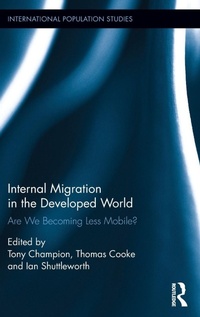
Internal Migration in the Developed World
Are we becoming less mobile?
1st Edition
Published on 24. August 2017
Book
Hardback
306 pages
978-1-4724-7806-1 (ISBN)
Description
The frequency with which people move home has important implications for national economic performance and the well-being of individuals and families. Much contemporary social and migration theory posits that the world is becoming more mobile, leading to the recent 'mobilities turn' within the social sciences. Yet, there is mounting evidence to suggest that this may not be true of all types of mobility, nor apply equally to all geographical contexts. For example, it is now clear that internal migration rates have been falling in the USA since at least the 1980s. To what extent might this trend be true of other developed countries?
Drawing on detailed empirical literature, Internal Migration in the Developed World examines the long-term trends in internal migration in a variety of more advanced countries to explore the factors that underpin these changes. Using case studies of the USA, UK, Australia, Japan, Sweden, Germany and Italy, this pioneering book presents a critical assessment of the extent to which global structural forces, as opposed to national context, influence internal migration in the Global North.
Internal Migration in the Developed World fills the void in this neglected aspect of migration studies and will appeal to a wide disciplinary audience of researchers and students working in Geography, Migration Studies, Population Studies and Development Studies.
Drawing on detailed empirical literature, Internal Migration in the Developed World examines the long-term trends in internal migration in a variety of more advanced countries to explore the factors that underpin these changes. Using case studies of the USA, UK, Australia, Japan, Sweden, Germany and Italy, this pioneering book presents a critical assessment of the extent to which global structural forces, as opposed to national context, influence internal migration in the Global North.
Internal Migration in the Developed World fills the void in this neglected aspect of migration studies and will appeal to a wide disciplinary audience of researchers and students working in Geography, Migration Studies, Population Studies and Development Studies.
Reviews / Votes
Early on in this review, the value of this book as a text for novice migrationresearchers was highlighted. However, this book's readership should extend beyond
students of migration. Understanding changing patterns of internal migration can
inform discussions around economic policy, housing markets, labour markets, social
inequalities and segregation: this book begins to shed light on how. - Frances Darlington-Pollock from Appl. Spatial Analysis and Policy 731-733
More details
Series
Language
English
Place of publication
London
United Kingdom
Publishing group
Taylor & Francis Ltd
Target group
College/higher education
Illustrations
60 s/w Abbildungen, 60 s/w Zeichnungen, 38 s/w Tabellen
38 Tables, black and white; 60 Line drawings, black and white; 60 Illustrations, black and white
Dimensions
Height: 240 mm
Width: 161 mm
Thickness: 22 mm
Weight
658 gr
ISBN-13
978-1-4724-7806-1 (9781472478061)
Copyright in bibliographic data and cover images is held by Nielsen Book Services Limited or by the publishers or by their respective licensors: all rights reserved.
Schweitzer Classification
Other editions
Additional editions
Tony Champion | Thomas Cooke | Ian Shuttleworth
Internal Migration in the Developed World
Are we becoming less mobile?
Book
06/2019
1st Edition
Routledge
€65.90
Shipment within 15-20 days
Tony Champion | Thomas Cooke | Ian Shuttleworth
Internal Migration in the Developed World
Are we becoming less mobile?
E-Book
08/2017
Routledge
€58.99
Available for download
Tony Champion | Thomas Cooke | Ian Shuttleworth
Internal Migration in the Developed World
Are we becoming less mobile?
E-Book
08/2017
Routledge
€59.49
Available for download
Persons
Tony Champion is Emeritus Professor of Population Geography at Newcastle University UK. His research interests include migration and its impact on population distribution in the Developed World, with particular reference to counter-urbanisation and city resurgence. He was President of the British Society for Population Studies in 2013-2015.
Thomas Cooke is a population and urban geographer and Professor in the Department of Geography at the University of Connecticut, USA. His research focuses on internal migration decline in the United States, the spatial distribution of metropolitan poverty and the family dimension of migration behaviour. He is currently an Editor of Urban Geography.
Ian Shuttleworth is Senior Lecturer in Human Geography at Queen's University Belfast, UK. His research interests include migration, labour market mobility, and social segregation. He also has an interest in divided societies with a special focus on Northern Ireland. He is currently director of the Northern Ireland Longitudinal Study Research Support Unit.
Thomas Cooke is a population and urban geographer and Professor in the Department of Geography at the University of Connecticut, USA. His research focuses on internal migration decline in the United States, the spatial distribution of metropolitan poverty and the family dimension of migration behaviour. He is currently an Editor of Urban Geography.
Ian Shuttleworth is Senior Lecturer in Human Geography at Queen's University Belfast, UK. His research interests include migration, labour market mobility, and social segregation. He also has an interest in divided societies with a special focus on Northern Ireland. He is currently director of the Northern Ireland Longitudinal Study Research Support Unit.
Content
Part 1: Setting the Scene 1. Introduction: A More Mobile World, or Not? 2. Understanding the Drivers of Internal Migration 3. Studying Internal Migration in a Cross-National Context 4. Global Trends in Internal Migration Part 2: In-Depth Country Analyses 5. United States: Cohort Effects on the Long-Term Decline in Migration Rates 6. United Kingdom: Temporal Change in Internal Migration 7. Australia: The Long-Run Decline in Internal Migration Intensities 8. Japan: Internal Migration Trends and Processes since the 1950s 9. Sweden: Internal Migration in a High-Mobility Nordic Country 10. Germany: Internal Migration within a Changing Nation 11. Italy: Internal Migration in a Low-Mobility Country Part 3: Commentary and Synthesis 12. Internal Migration: What Does the Future Hold? 13. Sedentary No Longer Seems Apposite: Internal Migration in an Era of Mobilities 14. Conclusions and Reflections