

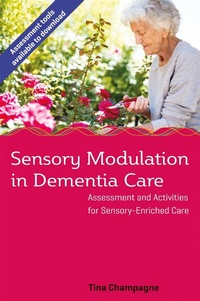
Sensory Modulation in Dementia Care
Assessment and Activities for Sensory-Enriched Care
Published on 19. April 2018
Book
Paperback/Softback
168 pages
978-1-78592-733-1 (ISBN)
Description
Understand and assess the sensory needs of people with dementia, and learn how to implement sensory modulation-based approaches for enriched care.
Drawing on the author's Sensory Modulation Program, this approach aids with self-organization and meaningful participation in life activities. Explaining sensory-processing issues specific to older populations, this book provides a downloadable assessment tool to help review individual sensory-processing patterns. It includes a range of sensory-based activities which can be carried out with people at all stages of dementia, both with individuals and in groups. The book also provides recommendations for modifying physical environments to make care settings sensory-enriched.
Drawing on the author's Sensory Modulation Program, this approach aids with self-organization and meaningful participation in life activities. Explaining sensory-processing issues specific to older populations, this book provides a downloadable assessment tool to help review individual sensory-processing patterns. It includes a range of sensory-based activities which can be carried out with people at all stages of dementia, both with individuals and in groups. The book also provides recommendations for modifying physical environments to make care settings sensory-enriched.
Reviews / Votes
A comprehensive, compassionate guide to helping those with memory loss. Warm, wise and well-researched, it offers essential insights, practical strategies, and sensory-smart solutions that can help our parents, grandparents, and clients feel safe and secure and engage optimally in tasks and activities that give lives meaning and purpose. -- Lindsay Biel, OTR/L, Occupational Therapist, Co-author, Raising a Sensory Smart Child Dr. Champagne presents an innovative and compelling application of sensory integration theory and principles to a growing elderly population. Use of this adaptation of the Sensory Modulation Program provides effective tools to support the daily life functioning and quality of life of adults with dementia. -- Teresa A. May-Benson, ScD, OTR/L, FAOTA, Executive Director, Spiral FoundationMore details
Language
English
Place of publication
London
United Kingdom
Target group
College/higher education
Professional and scholarly
Product notice
Paperback (UK-trade)
Illustrations
15 black and white images
Dimensions
Height: 225 mm
Width: 150 mm
Thickness: 10 mm
Weight
244 gr
ISBN-13
978-1-78592-733-1 (9781785927331)
Copyright in bibliographic data and cover images is held by Nielsen Book Services Limited or by the publishers or by their respective licensors: all rights reserved.
Schweitzer Classification
Other editions
Additional editions
Tina Champagne
Sensory Modulation in Dementia Care
Assessment and Activities for Sensory-Enriched Care
E-Book
04/2018
Jessica Kingsley Publishers
€25.99
Available for download
Person
Tina Champagne is an international consultant, writer and occupational therapist who developed the Sensory Modulation Program. She lives in Massachusetts, USA.
Content
Introduction. 1. Aging and Dementia. 1.1. Types of Dementia. 1.2. Stages of Dementia. 1.3. Hallucinations, Delusions and Paranoia. 1.4. The Stress Response. 1.5. Working with People with Dementia. 1.6. Restraint and Seclusion Reduction. 1.7. Trauma Informed Care. 1.8. International Initiatives in Dementia Care. 2. Aging and Sensory Processing. 2.1. Sensory Systems and Aging. 2.2. Sensory Integration and Processing. 2.3. Sensory Processing Umbrella. 2.4. Evidence-based Practice: Sensory-based Interventions. 3. The Sensory Modulation Program. 3.1. Introduction to the Sensory Modulation Program. 3.2. Sensory Modulation Program Components. 3.3. Sensory Modulation Program Goals. 3.4. Sensory Modulation Program Implementation: Individual & Programmatic Applications. 4. Assessment and Safety Considerations. 4.1. Safety Considerations and Trauma History. 4.2. Sensory-based Assessment and Screening. 4.3. Dementia, Cognitive and Other Assessments. 5. Sensorimotor Activities and Sensory-based Modalities. 5.1. Calming and Alerting Strategies. 5.2. Sensory Strategies Organized by Sensory Systems. 5.3. Safety Considerations. 6. Sensory Diets. 6.1. Sensory Diet: Supporting Safety, Comfort, and Participation. 6.2. Supporting Safety and Relaxation. 6.3. Supporting Self-care Participation. 6.4. Supporting Rest and Sleep. 6.5. Supporting Roles and Social Participation. 6.6. Supporting Fitness and Leisure Participation. 6.7. Individual and Programmatic Applications. 6.8. Sensory Diet Communication. 7. Environmental Modifications and Enhancements. 7.1. Enabling and Empowering Environments. 7.2. Homelike Environment. 7.3. Sensory Rooms. 7.4. Sensory Carts. 7.5. Sensory Kits. 7.6. Sensory Gardens. Resources. Appendix. References.