

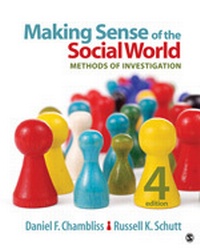
Making Sense of the Social World
Methods of Investigation
4th Edition
Published on 30. January 2012
Book
Paperback/Softback
344 pages
978-1-4522-1771-0 (ISBN)
Description
Making Sense of the Social World, fourth edition is an engaging introduction to social research for students who need to understand methodologies and results, but who may never conduct research themselves. It provides a balanced treatment of qualitative and quantitative methods, integrating substantive examples and research techniques throughout. It is written in a less formal style than many comparable texts, complete with practical examples drawn from everyday experience.
More details
Edition
4th Revised edition
Language
English
Place of publication
Thousand Oaks
United States
Target group
College/higher education
Edition type
Revised edition
Illustrations
Illustrations
Dimensions
Height: 254 mm
Width: 203 mm
ISBN-13
978-1-4522-1771-0 (9781452217710)
Copyright in bibliographic data and cover images is held by Nielsen Book Services Limited or by the publishers or by their respective licensors: all rights reserved.
Schweitzer Classification
Other editions
Previous edition
Book
03/2009
3rd Edition
Pine Forge
€77.49
Article exhausted; check for reprint
Persons
Daniel F. Chambliss, PhD, is the Eugene M. Tobin Distinguished Professor of Sociology at Hamilton College in Clinton, New York, where he has taught since 1981. He received his PhD from Yale University in 1982; later that year, his thesis research received the American Sociological Association's Medical Sociology Dissertation Prize. In 1988, he published the book Champions: The Making of Olympic Swimmers, which received the Book of the Year Prize from the U.S. Olympic Committee. In 1989, he received the American Sociology Association (ASA)'s Theory Prize for work on organizational excellence based on his swimming research. Recipient of both Fulbright and Rockefeller Foundation fellowships, he published his second book, Beyond Caring: Hospitals, Nurses, and the Social Organization of Ethics, in 1996; for that work, he was awarded the ASA's Elliot Freidson Prize in Medical Sociology. In 2014, Harvard University Press published his book, How College Works, coauthored with his former student Christopher G. Takacs. His research and teaching interests include organizational analysis, higher education, social theory, and comparative research methods. Russell K. Schutt, PhD, is professor and chair of sociology at the University of Massachusetts Boston, where he received the 2007 Chancellor's Award for Distinguished Service. Since 1990, he has also been lecturer on sociology in the Department of Psychiatry (Beth Israel Deaconess Medical Center) at the Harvard Medical School. He completed his BA, MA, and PhD degrees at the University of Illinois at Chicago and was a postdoctoral fellow in the Sociology of Social Control Training Program at Yale University. In addition to eight editions of the text on which this brief edition is based, Investigating the Social World: The Process and Practice of Research, and four other coauthored versions-for the fields of social work, criminal justice, psychology, and education-his other books include Homelessness, Housing, and Mental Illness (2011), Social Neuroscience: Brain, Mind, and Society (coedited, 2015), and Organization in a Changing Environment (1986). He has authored and coauthored numerous journal articles, book chapters, and research reports on homelessness, mental health, organizations, law, and teaching research methods. His research has included a mixed-methods investigation of a public health coordinated care program, a study of community health workers and recruitment for cancer clinical trials, a mixed-methods study of a youth violence reduction program, a randomized trial of a peer support program for homeless dually diagnosed veterans, and a randomized evaluation of housing alternatives for homeless persons diagnosed with severe mental illness, with funding from the National Cancer Institute, the Veterans Health Administration, the National Institute of Mental Health, the John E. Fetzer Institute, and state agencies. His current scholarly foci are the impact of the social environment on cognitive and community functioning, the meaning of housing and service preferences, and the value of alternative organizational and occupational structures for service delivery. His prior research has also included investigation of social factors in legal decisions and admission practices and of influences on job and service satisfaction. Details are available at http://rschutt.wikispaces.umb.edu.
Content
Science, Society, and Social Research The Process and Problems of Social Research Ethics in Research Conceptualization and Measurement Sampling Causation and Experimental Design Survey Research Elementary Quantitative Data Analysis Qualitative Methods: Observing, Participating, Listening Qualitative Data Analysis Evaluation Research Reviewing, Proposing, and Reporting Research Appendix A: Finding Information Appendix B: Table of Random Numbers Appendix C: Secondary Data Sources Appendix D: How to Use a Statistical Package