

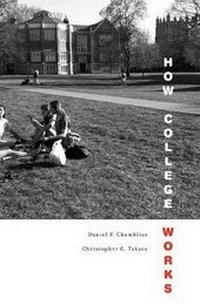
How College Works
Published on 17. February 2014
Book
Hardback
224 pages
978-0-674-04902-4 (ISBN)
Description
Constrained by shrinking budgets, can colleges do more to improve the quality of education? And can students get more out of college without paying higher tuition? Daniel Chambliss and Christopher Takacs conclude that the limited resources of colleges and students need not diminish the undergraduate experience. How College Works reveals the surprisingly decisive role that personal relationships play in determining a student's collegiate success, and puts forward a set of small, inexpensive interventions that yield substantial improvements in educational outcomes.
At a liberal arts college in New York, the authors followed a cluster of nearly one hundred students over a span of eight years. The curricular and technological innovations beloved by administrators mattered much less than the professors and peers whom students met, especially early on. At every turning point in students' undergraduate lives, it was the people, not the programs, that proved critical. Great teachers were more important than the topics studied, and even a small number of good friendships--two or three--made a significant difference academically as well as socially.
For most students, college works best when it provides the daily motivation to learn, not just access to information. Improving higher education means focusing on the quality of a student's relationships with mentors and classmates, for when students form the right bonds, they make the most of their education.
At a liberal arts college in New York, the authors followed a cluster of nearly one hundred students over a span of eight years. The curricular and technological innovations beloved by administrators mattered much less than the professors and peers whom students met, especially early on. At every turning point in students' undergraduate lives, it was the people, not the programs, that proved critical. Great teachers were more important than the topics studied, and even a small number of good friendships--two or three--made a significant difference academically as well as socially.
For most students, college works best when it provides the daily motivation to learn, not just access to information. Improving higher education means focusing on the quality of a student's relationships with mentors and classmates, for when students form the right bonds, they make the most of their education.
Reviews / Votes
The book shares the narrative of the student experience, what happens to students as they move through their educations, all the way from arrival to graduation. This is an important distinction. [Chambliss and Takacs] do not try to measure what students have learned, but what it is like to live through college, and what those experiences mean both during the time at school, as well as going forward. -- John Warner * Inside Higher Ed * There is a lot to like about How College Works. -- Mary Taylor Huber * Change * How College Works is a wonderful book-both rigorous and a pleasure to read. A core insight shines through-the reminder that even with the proliferation of technology, human interactions remain central to most students' college experience. -- Richard Light, author of <i>Making the Most of College</i>More details
Language
English
Place of publication
Cambridge, Mass
United States
Target group
College/higher education
Professional and scholarly
Illustrations
1 line illustration
Dimensions
Height: 235 mm
Width: 156 mm
ISBN-13
978-0-674-04902-4 (9780674049024)
Copyright in bibliographic data and cover images is held by Nielsen Book Services Limited or by the publishers or by their respective licensors: all rights reserved.
Schweitzer Classification
Other editions
Additional editions
Daniel F. Chambliss | Christopher G. Takacs
How College Works
E-Book
05/2014
1st Edition
Harvard University Press
€50.99
Available for download
Daniel F. Chambliss
How College Works
E-Book
02/2014
1st Edition
Harvard University Press
€34.19
Available for download
Persons
Daniel F. Chambliss is Eugene M. Tobin Distinguished Professor of Sociology at Hamilton College. Christopher G. Takacs is a Ph.D. candidate in sociology at the University of Chicago.