

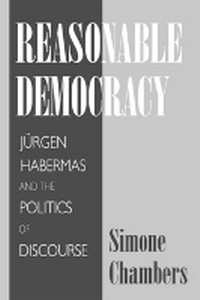
Reasonable Democracy
Juergen Habermas and the Politics of Discourse
Published on 17. July 1996
Book
Hardback
256 pages
978-0-8014-2668-1 (ISBN)
Description
In Reasonable Democracy, Simone Chambers describes, explains, and defends a discursive politics inspired by the work of Juergen Habermas. In addition to comparing Habermas's ideas with other non-Kantian liberal theories in clear and accessible prose, Chambers develops her own views regarding the role of discourse and its importance within liberal democracies.
Beginning with a deceptively simple question-"Why is talking better than fighting?"-Chambers explains how the idea of talking provides a rich and compelling view of morality, rationality, and political stability. She considers talking as a way for people to respect each other as moral agents, as a way to reach reasonable and legitimate solutions to disputes, and as a way to reproduce and strengthen shared understandings. In the course of this argument, she defends modern universalist ethics, communicative rationality, and what she calls a "discursive political culture," a concept that locates the political power of discourse and deliberation not so much in institutions of democratic decision-making as in the type of conversations that go on around these institutions. While discourse and deliberation cannot replace voting, bargaining, or compromise, Chambers argues, it is important to maintain a background moral conversation in which to anchor other activities.
As an extended case study, Chambers examines the conversation about language rights that has been taking place for more than twenty years in Quebec. A culture of dialogue, she shows, has proved a positive and powerful force in resolving some of the disagreements between the two linguistic communities there.
Beginning with a deceptively simple question-"Why is talking better than fighting?"-Chambers explains how the idea of talking provides a rich and compelling view of morality, rationality, and political stability. She considers talking as a way for people to respect each other as moral agents, as a way to reach reasonable and legitimate solutions to disputes, and as a way to reproduce and strengthen shared understandings. In the course of this argument, she defends modern universalist ethics, communicative rationality, and what she calls a "discursive political culture," a concept that locates the political power of discourse and deliberation not so much in institutions of democratic decision-making as in the type of conversations that go on around these institutions. While discourse and deliberation cannot replace voting, bargaining, or compromise, Chambers argues, it is important to maintain a background moral conversation in which to anchor other activities.
As an extended case study, Chambers examines the conversation about language rights that has been taking place for more than twenty years in Quebec. A culture of dialogue, she shows, has proved a positive and powerful force in resolving some of the disagreements between the two linguistic communities there.
Reviews / Votes
An extremely learned, carefully argued defense of Habermas's theory of communicative rationality as a basis for conceptualizing deliberative democracy.(American Political Science Review)
More details
Language
English
Place of publication
Ithaca
United States
Target group
College/higher education
Product notice
Paper over boards
Dimensions
Height: 229 mm
Width: 152 mm
Thickness: 25 mm
Weight
907 gr
ISBN-13
978-0-8014-2668-1 (9780801426681)
Copyright in bibliographic data and cover images is held by Nielsen Book Services Limited or by the publishers or by their respective licensors: all rights reserved.
Schweitzer Classification
Person
Simone Chambers is Professor of Political Science at the University of Toronto.