

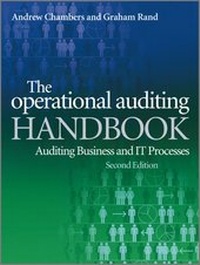
Operational Auditing Handbook
Auditing Business and IT Processes
2nd Edition
Published on 23. April 2010
Book
Hardback
900 pages
978-0-470-74476-5 (ISBN)
Description
This handbook helps auditors evaluate, measure, and check internal management and financial procedures and systems to increase efficiency and prevent fraud. Reflecting the variety of business situations that auditors face, it encourages them to develop creative approaches for dealing with the problems encountered during the operational audit review. This new edition is fully updated to take account of developments in internal control and corporate governance under Sarbanes-Oxley, and in audit processes particular to financial institutions in light of the credit crunch. It also contains new and updated case studies and checklists.
More details
Product info
GB
Edition
2., Auflage
Language
English
Place of publication
New York
United States
Target group
Professional and scholarly
Product notice
sewn/stitched
Cloth over boards
With dust jacket
Dimensions
Height: 254 mm
Width: 195 mm
Thickness: 55 mm
Weight
1846 gr
ISBN-13
978-0-470-74476-5 (9780470744765)
Schweitzer Classification
Other editions
Additional editions
E-Book
12/2011
2nd Edition
Wiley
€130.99
Available for download
E-Book
12/2011
2nd Edition
Wiley
€130.99
Available for download
Previous edition
Book
07/1997
1st Edition
Wiley
€125.00
Article exhausted; check for reprint
Person
Andrew Chambers is professor of internal auditing at London South Bank University and professor emeritus of Cass Business School, London. He runs Management Audit LLP specializing in auditing and corporate governance work, and is a member of the international Internal Audit Standards Board.
Graham Rand specializes in IT auditing, risk management and operational review. His career, in the UK and overseas, has featured involvement in a range of organisations, principally in the electrical retail, financial services and public sectors. Much of his current consultancy is on Information Management, Records Management, IT Security and providing support on the development of Risk Management and Information Security environments.
Content
Preface.
Acknowledgements.
PART I UNDERSTANDING OPERATIONAL AUDITING.
1 Approaches to operational auditing.
2 Business processes.
3 Developing operational review programmes for managerial and audit use.
4 Governance processes.
5 Risk management processes.
6 Internal control processes.
7 Review of the control environment.
8 Reviewing internal control over financial reporting - the Sarbanes-Oxley approach.
9 Business/ management techniques and their impact on control and audit.
10 Control self assessment.
11 Evaluating the internal audit activity.
PART II AUDITING KEY FUNCTIONS.
12 Auditing the finance and accounting functions.
13 Auditing subsidiaries and remote operating units.
14 Auditing contracts and the purchasing function.
15 Auditing operations and resource management.
16 Auditing marketing and sales.
17 Auditing distribution.
18 Auditing human resources.
19 Auditing research and development.
20 Auditing security.
21 Auditing environmental responsibility.
PART III AUDITING INFORMATION TECHNOLOGY.
22 Auditing information technology.
23 IT Strategic Planning.
24 IT Organisation.
25 IT Policy Framework.
26 Information Asset Register*.
27 Capacity Management
28 Information Management (IM)*.
29 Records Management (RM)*.
30 Knowledge Management (KM)*.
31 IT sites and Infrastructure (including physical security).
32 Processing Operations.
33 Back-up and Media Management.
34 Removable media.
35 System and Operating Software (including patch management).
36 System Access Control (or logical security).
37 Personal Computers (including laptops and PDAs).
38 Remote Working.
39 Email.
40 Internet Usage.
41 Software Maintenance (including change management).
42 Networks.
43 Databases.
44 Data Protection.
45 Freedom of Information.
45 Data Transfer and Sharing (Standards and Protocol Guidelines).
47 Legal Responsibilities.
48 Facilities Management.
49 System Development.
50 Software Selection.
51 Contingency Planning.
52 Human Resources information security.
53 Monitoring and Logging.
54 Information Security incidents.
55 Data Retention and Disposal.
56 Electronic Data Interchange (EDI) and the use of secure networks.
57 Viruses.
58 User Support.
59 BACS (i.e. automated cash/funds transfer).
60 Spreadsheet design and good practice.
61 IT Health Checks.
62 IT Accounting.
APPENDICES.
App 1: Index to SAPGs on Wiley;s website.
App 2: SAPGs - use in relation to business processes.
App 3: International data protection legislation.
App 4: International freedom of information legislation.
Bibliography.
Index.