

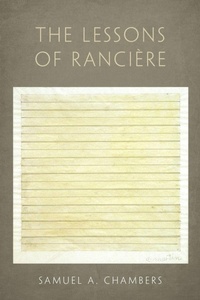
The Lessons of Ranciere
Published on 21. August 2014
Book
Paperback/Softback
240 pages
978-0-19-021326-8 (ISBN)
Description
Liberal democracy is the name given to a regime that much of the world lives in or aspires to, and both liberal and deliberative theorists focus much of their intellectual energy on working to reshape and perfect this regime. But what if "liberal democracy" were a contradiction in terms?
Taking up Jacques Ranciere's polemical claim that democracy is not a regime, Samuel A. Chambers argues that liberalism and democracy are not complementary, but competing forces. By way of the most in-depth and rigorous treatment of Ranciere's writings to date, The Lessons of Ranciere seeks to disentangle democracy from liberalism. Liberalism is a logic of order and hierarchy, of the proper distribution of responsibilities and rights, whereas democratic politics follows a logic of disordering that challenges and disrupts any claims that the allocation of roles could be complete. This book mobilizes a Rancierean understanding of politics as leverage against the tendency to collapse democracy into the broader terms of liberalism. Chambers defends a vision of "impure" politics, showing that there is no sphere proper to politics, no protected political domain. The job of political theory is therefore not to say what is required in order for politics to occur, not to develop ideal "normative" models of politics, and not even to create new political ontologies. Instead, political theory is itself an enactment of politics in Ranciere's sense of dissensus: politics thwarts any social order of domination. Chambers shows that the logic of politics depends on the same principle as Ranciere's radical pedagogy: the presupposition of equality. Like traditional critical theory, traditional pedagogy relies on a model of explanation in which the student is presumed to be blind. But what if anyone can understand without additional explanation from a master? The Lessons of Ranciere uses this pedagogy as a guide to envision a critical theory beyond blindness and to explore a democratic politics beyond liberalism.
Taking up Jacques Ranciere's polemical claim that democracy is not a regime, Samuel A. Chambers argues that liberalism and democracy are not complementary, but competing forces. By way of the most in-depth and rigorous treatment of Ranciere's writings to date, The Lessons of Ranciere seeks to disentangle democracy from liberalism. Liberalism is a logic of order and hierarchy, of the proper distribution of responsibilities and rights, whereas democratic politics follows a logic of disordering that challenges and disrupts any claims that the allocation of roles could be complete. This book mobilizes a Rancierean understanding of politics as leverage against the tendency to collapse democracy into the broader terms of liberalism. Chambers defends a vision of "impure" politics, showing that there is no sphere proper to politics, no protected political domain. The job of political theory is therefore not to say what is required in order for politics to occur, not to develop ideal "normative" models of politics, and not even to create new political ontologies. Instead, political theory is itself an enactment of politics in Ranciere's sense of dissensus: politics thwarts any social order of domination. Chambers shows that the logic of politics depends on the same principle as Ranciere's radical pedagogy: the presupposition of equality. Like traditional critical theory, traditional pedagogy relies on a model of explanation in which the student is presumed to be blind. But what if anyone can understand without additional explanation from a master? The Lessons of Ranciere uses this pedagogy as a guide to envision a critical theory beyond blindness and to explore a democratic politics beyond liberalism.
Reviews / Votes
Jacques Ranciere's work circulates widely these days, but it is rarely well-understood. Sam Chambers' The Lessons of Ranciere will change that. Distinguishing Ranciere's project from the anarchism and Arendtianism with which it is often associated, Chambers gives pride of place to Ranciere's historically-situated emancipatory politics of equality and argues that contemporary queer activism is its best exemplar now. Tracking the contingencies of Ranciere's (mis-)translation into English, the stakes of different approaches to his work, and the debates to which Ranciere is a key contributor (humanism, critical theory, subjectivation, and more), Chambers offers a thoroughgoing analysis of the contribution Ranciere stands to make to political and critical theory now. GPS-like, this book will help all readers of Ranciere get their bearings in the space and time of contemporary political theory. * Bonnie Honig, Sarah Rebecca Roland Professor, Political Science, Northwestern University * This is a remarkably deft engagement with Ranciere and his interpreters. Chambers persistently refuses to let the latter capture Ranciere for their particular projects, stressing rather his distinctiveness and radicality. In fact, we discover that there are no enumerable 'lessons' to be learned; only a set of unruly challenges to established positions in contemporary political theory. This book sparkles with insights. * Stephen White, James Hart Professor of Politics, University of Virginia *More details
Language
English
Place of publication
New York
United States
Target group
College/higher education
Professional and scholarly
Dimensions
Height: 234 mm
Width: 156 mm
Thickness: 14 mm
Weight
409 gr
ISBN-13
978-0-19-021326-8 (9780190213268)
Copyright in bibliographic data and cover images is held by Nielsen Book Services Limited or by the publishers or by their respective licensors: all rights reserved.
Schweitzer Classification
Other editions
Additional editions
Samuel A. Chambers
The Lessons of Rancière
E-Book
09/2012
1st Edition
OUP eBook
€17.49
Available for download
Person
Samuel A. Chambers is Associate Professor of Political Science at Johns Hopkins University.
Content
Introduction ; Chapter One: Politics ; Chapter Two: Police ; Chapter Three: Literarity ; Chapter Four: Critique ; Afterword ; Works Cited ; Index