

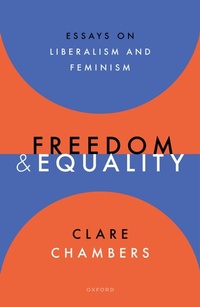
Freedom and Equality
Essays on Liberalism and Feminism
1st Edition
Published on 28. March 2024
Book
Hardback
356 pages
978-0-19-289790-9 (ISBN)
Description
Should the state recognise gender? Can a liberal state discourage traditional family structures? Is women's sport compatible with equality of opportunity? Should feminists defend women's freedom to choose cosmetic surgery? Is genital cutting always wrong, or is it only wrong for girls?
Freedom and Equality investigates the contours of feminist liberalism: a philosophical approach that is appealing but elusive. Its hallmark is a liberalism that prioritises equality and individual autonomy, while offering a rigorous critique of using individuals' choices as the measure of justice. Liberalism without feminism prioritises individual choice, a strategy that has played a crucial role in the liberal defence of freedom against authoritarianism and conformity. However, as feminism shows, relying on individual choice is insufficient to render an outcome just, because people often choose things that harm or disadvantage themselves. From beauty norms to the gendered division of labour, from marriage to religion, women and men choose to arrange their lives in ways that perpetuate inequality. Often, these choices are made in response to social norms, including unjust, unequal, or harmful norms. It follows that relying on individual choice as a measure of justice actually leaves unjust social structures intact. Any defender of autonomy and equality must be prepared to criticise individuals' choices while prioritising individual choosers.
The essays in this collection cover a wide range of issues fundamental to liberalism, to feminism, and to their intersection. They explore the foundational philosophical concepts of choice, equality of opportunity, ideology, and the state, and they engage directly with key political controversies, including women's sport, the state recognition of gender, the regulation of cosmetic and cultural surgeries, and state action to secure equality in the family. Clare Chambers argues that feminist liberalism is both possible and necessary. It is possible because the two doctrines of feminism and liberalism are compatible, their fundamental values of freedom and equality aligned. But feminism is necessary because liberalism has shown that it is simply not up to the task of securing gender equality and women's liberation alone.
Freedom and Equality investigates the contours of feminist liberalism: a philosophical approach that is appealing but elusive. Its hallmark is a liberalism that prioritises equality and individual autonomy, while offering a rigorous critique of using individuals' choices as the measure of justice. Liberalism without feminism prioritises individual choice, a strategy that has played a crucial role in the liberal defence of freedom against authoritarianism and conformity. However, as feminism shows, relying on individual choice is insufficient to render an outcome just, because people often choose things that harm or disadvantage themselves. From beauty norms to the gendered division of labour, from marriage to religion, women and men choose to arrange their lives in ways that perpetuate inequality. Often, these choices are made in response to social norms, including unjust, unequal, or harmful norms. It follows that relying on individual choice as a measure of justice actually leaves unjust social structures intact. Any defender of autonomy and equality must be prepared to criticise individuals' choices while prioritising individual choosers.
The essays in this collection cover a wide range of issues fundamental to liberalism, to feminism, and to their intersection. They explore the foundational philosophical concepts of choice, equality of opportunity, ideology, and the state, and they engage directly with key political controversies, including women's sport, the state recognition of gender, the regulation of cosmetic and cultural surgeries, and state action to secure equality in the family. Clare Chambers argues that feminist liberalism is both possible and necessary. It is possible because the two doctrines of feminism and liberalism are compatible, their fundamental values of freedom and equality aligned. But feminism is necessary because liberalism has shown that it is simply not up to the task of securing gender equality and women's liberation alone.
More details
Language
English
Place of publication
Oxford
United Kingdom
Target group
Professional and scholarly
Product notice
sewn/stitched
Cloth over boards
Dimensions
Height: 237 mm
Width: 162 mm
Thickness: 24 mm
Weight
671 gr
ISBN-13
978-0-19-289790-9 (9780192897909)
Copyright in bibliographic data and cover images is held by Nielsen Book Services Limited or by the publishers or by their respective licensors: all rights reserved.
Schweitzer Classification
Other editions
Additional editions
E-Book
03/2024
1st Edition
OUP eBook
€78.99
Available for download
E-Book
03/2024
1st Edition
OUP eBook
€78.99
Available for download
Person
Clare Chambers is Professor of Political Philosophy at the University of Cambridge and a Fellow of Jesus College, Cambridge. She is the author of Intact: A Defence of the Unmodified Body (Allen Lane / Penguin, 2022), the prize-winning Against Marriage: An Egalitarian Defence of the Marriage-Free State (OUP, 2017), Sex, Culture, and Justice: The Limits of Choice (Penn State University Press, 2008), and Teach Yourself Political Philosophy: A Complete Introduction (with Phil Parvin, Hodder, 2012). She is also the co-editor of The Routledge Handbook of Philosophy of Sex and Sexuality, and the author of numerous articles and chapters on feminist and liberal political philosophy.
Content
Introduction: A Feminist Liberalism PART I FEMINISM & LIBERALISM 1: Feminism 2: Feminism on Liberalism 3: Respect, Religion, and Feminism: Political Liberalism as Feminist Liberalism? PART II THE FAMILY 4: ),The Family as a Basic Institution)`: A Feminist Analysis of the Basic Structure as Subject 5: Liberalism, Feminism, and the Gendered Division of Labour 6: The Marriage-Free State PART III THE LIMITS OF LIBERALISM 7: Should the Liberal State Recognise Gender? 8: Reasonable Disagreement and the Neutralist Dilemma: Abortion and Circumcision in Matthew Kramer's Liberalism with Excellence PART IV EQUALITY OF OPPORTUNITY 9: Each Outcome Is Another Opportunity: Problems with the Moment of Equal Opportunity 10: Equality of Opportunity and Three Justifications for Women's Sport: Fair Competition, Anti-Sexism, and Identity PART V CHOICES 11: Choice and Female Genital Cosmetic Surgery 12: Judging Women: 25 Years Further Toward a Feminist Theory of the State 13: Ideology and Normativity