

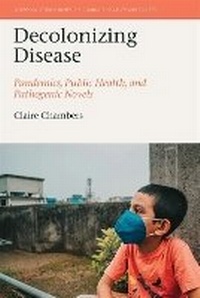
Decolonizing Disease
Pandemics, Public Health, and Pathogenic Novels
Published on 8. May 2026
Book
Hardback
320 pages
978-1-83624-572-8 (ISBN)
Description
Ebook available to libraries exclusively as part of the JSTOR Path to Open initiative.
Decolonizing Disease explores how pandemics both expose and entrench global inequalities. Tracing the environmental, racialized, and (neo)colonial dimensions of public health crises, Claire Chambers examines how pandemics from the 1918 flu to Ebola, HIV/AIDS, and Covid-19 have exacerbated social divisions rather than exerting a levelling effect.
The book interrogates the intersections of disease, the climate crisis, and political fault lines of race, class, and gender. Chambers creates a new framework for understanding 'pathogenic novels', fiction that resists colonial legacies while grappling with pandemic-era anxieties. The term carries dual connotations relating to the emergence of diseases and to innovative narrative forms responding to them.
Chambers brings together a compelling range of authors, from Phaswane Mpe to Hari Kunzru, to illuminate how literature has responded to past and present pandemics from twenty-first century perspectives. The writing confronts xenophobia, misinformation, and ecological collapse while envisioning alternative futures.
Decolonizing Disease argues that literature serves as both a critique and a remedy - offering insight, resistance, and the possibility of re-worlding in times of crisis. In an age of epidemiological neoliberalism and post-West global shifts, this urgent study stakes a claim for the role of fiction in challenging systemic injustices and imagining healthier and more equitable futures.
Decolonizing Disease explores how pandemics both expose and entrench global inequalities. Tracing the environmental, racialized, and (neo)colonial dimensions of public health crises, Claire Chambers examines how pandemics from the 1918 flu to Ebola, HIV/AIDS, and Covid-19 have exacerbated social divisions rather than exerting a levelling effect.
The book interrogates the intersections of disease, the climate crisis, and political fault lines of race, class, and gender. Chambers creates a new framework for understanding 'pathogenic novels', fiction that resists colonial legacies while grappling with pandemic-era anxieties. The term carries dual connotations relating to the emergence of diseases and to innovative narrative forms responding to them.
Chambers brings together a compelling range of authors, from Phaswane Mpe to Hari Kunzru, to illuminate how literature has responded to past and present pandemics from twenty-first century perspectives. The writing confronts xenophobia, misinformation, and ecological collapse while envisioning alternative futures.
Decolonizing Disease argues that literature serves as both a critique and a remedy - offering insight, resistance, and the possibility of re-worlding in times of crisis. In an age of epidemiological neoliberalism and post-West global shifts, this urgent study stakes a claim for the role of fiction in challenging systemic injustices and imagining healthier and more equitable futures.
Reviews / Votes
"Offering a rigorous analysis of how imaginative fiction can both diagnose and resist systemic injustice, Decolonizing Disease draws on a striking range of contemporary international literary voices to trace the racialised, environmental and (neo)colonial dimensions of pandemics mapping continuities between the 'Spanish flu' pandemic, HIV/AIDS, Ebola, and Covid-19. Opening up future-facing narrative possibilities, the analysis will provide readers with a compelling and vital account of literature's power to critique, heal, and reworld public health crises." - Susheila Nasta FRSL MBE, Professor of Modern Literatures and Founding Editor of Wasafiri Magazine "In Decolonizing Disease, Claire Chambers offers a thoughtful re-examination of how we understand pandemics, public health, and the stories we tell about them. By combining literary studies, postcolonial theory, and medical humanities she reveals how narratives of disease are profoundly shaped by - and in turn shape - systems of power, inequality, and colonial legacy." - Amitav Ghosh "With her far-reaching and impassioned new book, Decolonising Disease, Claire Chambers draws bold connections between modern pandemics and their social impacts - from Covid-19 to HIV/AIDS, Ebola, and flu - and explores the leading role fiction can play in understanding and critiquing these shocks. Chambers argues that the power of pathogenic fiction lies in its ability to expose how health crises exacerbate and multiply inequality. At the same time, she persuasively shows how the novel can open up renewed possibilities in an era dominated by racialised capitalism and corporate interest." - Professor Elleke Boehmer, Professor of World Literature in English, University of Oxford, and Director, Oxford Centre for Life Writing 'Rarely does one encounter a book as urgent, gripping, eloquent, original, and necessary as Decolonizing Disease. Writing in the wake of the COVID-19 pandemic, Claire Chambers explores the long history of (neo)colonial inequality, discrimination, and prejudice which has rendered marginalised communities disproportionately vulnerable to illness (Spanish Flu, Ebola, HIV/AIDS, and more besides). Through a series of dazzling readings of recent 'pathogenic novels' drawn eclectically from across the globe, Chambers illuminates the significant literary interrogation of disease as always indexing wider inequities of race, empire and biopolitical control. At the same time, she attends to the speculative futures which such fictions also imagine, confronting disease's imperium with literature's determined decolonial reckoning. In its vibrant engagement across postcolonial studies, the medical humanities, and literary & cultural critique, Decolonizing Disease is interdisciplinary scholarship at its finest.'John McLeod, University of Leeds
More details
Series
Language
English
Place of publication
Liverpool
United Kingdom
Target group
College/higher education
Dimensions
Height: 239 mm
Width: 163 mm
ISBN-13
978-1-83624-572-8 (9781836245728)
Copyright in bibliographic data and cover images is held by Nielsen Book Services Limited or by the publishers or by their respective licensors: all rights reserved.
Schweitzer Classification
Person
Claire Chambers is Professor of Global Literature at the University of York. She is the author of five books, editor of several, and a Fellow of the Royal Society of Arts. Not only is she known for her research on literary representations of Muslims in Britain and South Asia but also on Indian writing in English, especially the Bengali writer Amitav Ghosh. An emerging specialism is the medical humanities. Alongside Decolonizing Disease: Pandemics, Public Health and Pathogenic Novels, she co-edited (with Xiaohui Liang) a special issue of Mosaic: An Interdisciplinary Critical Journal 56(1) entitled 'Prevailing Pandemic'.
Claire has published widely in such journals as Interventions, Journal of Contemporary Chinese Art, Contemporary Women's Writing, and the Journal of Postcolonial Writing. Claire was Editor-in-Chief of Literature, Critique, and Empire Today for over a decade. Her research has been supported by grants from HEFCE, the AHRC, ESRC, British Academy, and Leverhulme Trust. She is a Fellow of the Royal Society of Arts.
Claire has published widely in such journals as Interventions, Journal of Contemporary Chinese Art, Contemporary Women's Writing, and the Journal of Postcolonial Writing. Claire was Editor-in-Chief of Literature, Critique, and Empire Today for over a decade. Her research has been supported by grants from HEFCE, the AHRC, ESRC, British Academy, and Leverhulme Trust. She is a Fellow of the Royal Society of Arts.