

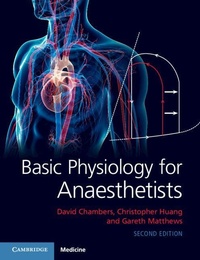
Basic Physiology for Anaesthetists
2nd Edition
Published on 25. July 2019
Book
Paperback/Softback
464 pages
978-1-108-46399-7 (ISBN)
Description
Every trainee in anaesthesia requires a thorough understanding of basic physiology and its application to clinical practice. Now in its second edition, this comprehensively illustrated textbook bridges the gap between medical school and reference scientific texts. It covers the physiology requirements of the Primary FRCA examination syllabus. Chapters are organised by organ system, with particular emphasis given to the respiratory, cardiovascular and nervous systems. The practical question-and-answer format helps the reader prepare for oral examinations, while 'clinical relevance' boxes translate the physiological concepts to clinical practice. This new edition has been thoroughly updated and revised throughout, and includes six new chapters, including the physiology of the eye, upper airway and exercise testing. It provides junior anaesthetists with an essential 'one stop' physiology resource.
More details
Edition
2nd Revised edition
Language
English
Place of publication
Cambridge
United Kingdom
Target group
Professional and scholarly
Edition type
Revised edition
Product notice
Paperback (trade)
Illustrations
Worked examples or Exercises; 7 Tables, black and white; 53 Halftones, black and white; 99 Line drawings, black and white
Dimensions
Height: 246 mm
Width: 189 mm
Thickness: 26 mm
Weight
901 gr
ISBN-13
978-1-108-46399-7 (9781108463997)
Copyright in bibliographic data and cover images is held by Nielsen Book Services Limited or by the publishers or by their respective licensors: all rights reserved.
Schweitzer Classification
Other editions
Additional editions
David Chambers | Christopher Huang | Gareth Matthews
Basic Physiology for Anaesthetists
E-Book
07/2019
2nd Edition
Cambridge University Press
€55.49
Available for download
David Chambers
Basic Physiology for Anaesthetists
E-Book
07/2019
Cambridge University Press
€49.49
Available for download
Previous edition
David Chambers | Christopher Huang | Gareth Matthews
Basic Physiology for Anaesthetists
Book
01/2015
Cambridge University Press
€87.90
Article exhausted; check for reprint
Persons
David Chambers is a Consultant Neuroanaesthetist at Salford Royal NHS Foundation Trust, Salford.
Content
Forward Russell Perkins; Preface to the first edition; Preface to the second edition; Part I. The Basics: 1. General organisation of the body; 2. Cell components and function; 3. Genetics; 4. The cell membrane; 5. Enzymes; Part II. Respiratory Physiology: 6. The upper airways; 7. The lower airways; 8. Oxygen transport; 9. Carbon dioxide transport; 10. Alveolar diffusion; 11. Ventilation and dead space; 12. Static lung volumes; 13. Spirometry; 14. Hypoxia and shunts; 15. Ventilation-perfusion relationships; 16. Ventilation-perfusion zones in the lung; 17. Oxygen delivery and demand; 18. Alveolar gas equation; 19. Oxygen cascade; 20. Lung compliance; 21. Work of breathing; 22. Control of ventilation; 23. Pulmonary circulation; 24. Oxygen toxicity; 25. Ventilatory failure; 26. Anaesthesia and the lung; Part III. Cardiovascular Physiology: 27. Cardiac anatomy and function; 28. Cardiac cycle; 29. Cardiac output and it measurement; 30. Starling's law and cardiac dysfunction; 31. Cardiac pressure-volume loops; 32. Cardiac ischaemia; 33. Systemic circulation; 34. Arterial system; 35. Arterial pressure waveforms; 36. Capillaries and endothelium; 37. Venous system; 38. Venous pressure wave forms; 39. Lymphatics; 40. Cardiovascular reflexes; 41. Valsalva manoeuvre; 42. Exercise physiology; 43. Exercise testing; Part IV. Neurophysiology: 44. Neuronal structure and function; 45. The brain; 46. Cerebrospinal fluid; 47. Blood-brain barrier; 48. Cerebral blood flow; 49. Intracranial pressure and head injury; 50. The spinal cord; 51. Resting membrane potential; 52. Nerve action potential and propagation; 53. Synapses and the neuromuscular junction; 54. Skeletal muscle; 55. Muscle spindles and Golgi tendon organs; 56. Smooth muscle; 57. Cardiac muscle; 58. The electrocardiogram; 59. Autonomic nervous system; 60. Pain physiology; 61. The eye and intraocular pressure; Part V. Gastrointestinal Tract: 62. Saliva, oesophagus and swallowing; 63. Stomach and vomiting; 64. Gastrointestinal digestion and absorption; 65. Liver: anatomy and blood supply; 66. Liver function; Part VI. Kidney and Body Fluids: 67. Renal function, anatomy and blood flow; 68. Renal filtration and reabsorption; 69. Renal regulation of water and electrolyte balance; 70. Acid-base physiology; 71. Micturition; Part VII. Blood and Immune System: 72. Haemostasis; 73. Transfusion; 74. Anaemia and polycythaemia; 75. Immune system; 76. Plasma constituents; Part VIII. Energy Balance: 77. Metabolism; 78. Starvation; 79. Stress response; Part IX. Endocrine Physiology: 80. Hypothalamus and pituitary; 81. Thyroid, parathyriod and adrenal; Part X. Developmental physiology; 82. Maternal physiology during pregnancy; 83. Fetal physiology; 84. Paediatric physiology; 85. Physiology of ageing; 86. Physiology of obesity; Part XI. Environmental Physiology: 87. Altitude; 88. Divide; 89. Temperature regulation; Index.