

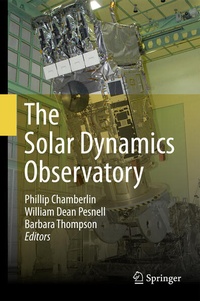
The Solar Dynamics Observatory
Published on 29. March 2012
Book
Hardback
VIII, 408 pages
978-1-4614-3672-0 (ISBN)
Description
This volume is dedicated to the Solar Dynamics Observatory (SDO), which was launched 11 February 2010. The articles focus on the spacecraft and its instruments: the
Atmospheric Imaging Assembly
(AIA), the
Extreme Ultraviolet Variability Experiment
(EVE), and the
Helioseismic and Magnetic Imager
(HMI). Articles within also describe calibration results and data processing pipelines that are critical to understanding the data and products, concluding with a description of the successful Education and Public Outreach activities.
This book is geared towards anyone interested in using the unprecedented data from SDO, whether for fundamental heliophysics research, space weather modeling and forecasting, or educational purposes.
Previously published in Solar Physics journal, Vol. 275/1-2, 2012.
Selected articles in this book are published open access under a CC BY-NC 2.5 license at link.springer.com. For further details, please see the license information in the chapters.
This book is geared towards anyone interested in using the unprecedented data from SDO, whether for fundamental heliophysics research, space weather modeling and forecasting, or educational purposes.
Previously published in Solar Physics journal, Vol. 275/1-2, 2012.
Selected articles in this book are published open access under a CC BY-NC 2.5 license at link.springer.com. For further details, please see the license information in the chapters.
More details
Edition
2012
Language
English
Place of publication
New York
United States
Target group
Professional and scholarly
Research
Illustrations
VIII, 408 p.
Dimensions
Height: 241 mm
Width: 160 mm
Thickness: 28 mm
Weight
783 gr
ISBN-13
978-1-4614-3672-0 (9781461436720)
DOI
10.1007/978-1-4614-3673-7
Schweitzer Classification
Other editions
Additional editions
Phillip Chamberlin | William Dean Pesnell | Barbara Thompson
The Solar Dynamics Observatory
Book
04/2014
Springer
€159.99
Shipment within 15-20 days
Phillip Chamberlin | William Dean Pesnell | Barbara Thompson
The Solar Dynamics Observatory
E-Book
05/2012
Springer
€149.79
Available for download
Persons
W. Dean Pesnell is the Project Scientist and Phillip Chamberlin and Barbara Thompson are the two Deputy Project Scientists for the Solar Dynamics Observatory. Dr. Pesnell and Dr. Thompson have been with SDO since the original idea was proposed more than ten years ago, and Dr. Chamberlin worked throughout the lifetime of the Extreme Ultraviolet Variability Experiment (EVE) instrument before coming to Goddard prior to the launch of SDO.
Dr. Thompson received her B.A. in Physics and Mathematics from the University of Pennsylvania and her Ph.D. in Physics from the University of Minnesota. Dr. Pesnell received his B.S. in Physics from the University of Delaware and his Ph.D. in Physics from the University of Florida. Dr. Chamberlin received his undergraduate degree in Physics from Hanover College and his master's and Ph.D. in Aerospace Engineering Sciences from the University of Colorado at Boulder.
Dr. Thompson received her B.A. in Physics and Mathematics from the University of Pennsylvania and her Ph.D. in Physics from the University of Minnesota. Dr. Pesnell received his B.S. in Physics from the University of Delaware and his Ph.D. in Physics from the University of Florida. Dr. Chamberlin received his undergraduate degree in Physics from Hanover College and his master's and Ph.D. in Aerospace Engineering Sciences from the University of Colorado at Boulder.
Content
From the Contents: The Solar Dynamics Observatory.- The Atmospheric Imaging Assembly (AIA) on the Solar Dynamics Observatory.- Initial Calibration of the Atmospheric Imaging Assembly (AIA) on the Solar Dynamics Observatory.- Heliophysics Event Knowledgebase for the Solar Dynamics Observatory and Beyond.- Computer Vision for the Solar Dynamics Observatory (SDO).- Extreme Ultraviolet Experiment (EVE) on the Solar Dynamics Observatory (SDO): Overview of Science Objectives, Instrument Design, Data Products and Model Developments.