

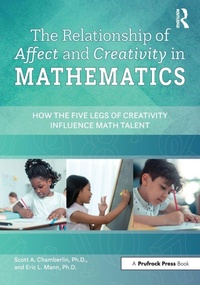
The Relationship of Affect and Creativity in Mathematics
How the Five Legs of Creativity Influence Math Talent
1st Edition
Published on 15. February 2021
Book
Paperback/Softback
168 pages
978-1-64632-074-5 (ISBN)
Description
The Relationship of Affect and Creativity in Mathematics explores the five legs of creativity-Iconoclasm, Impartiality, Investment, Intuition, and Inquisitiveness-as they relate to mathematical giftedness. This book:
Discusses these affective components relevant to mathematical learning experiences.
Shares how affective components impact students' creative processes and products.
Shows the influence of learning facilitators, including teachers, afterschool mentors, and parents.
Describes facilitating environments that may enhance the likelihood that creative process and ultimately product emerge.
Utilizes the expertise of two young scholars to discuss the practical effects of affect and creativity in learning experiences.
This practical, research-based book is a must-read for stakeholders in gifted education, as many advanced students are underidentified in the area of creativity in mathematics.
Discusses these affective components relevant to mathematical learning experiences.
Shares how affective components impact students' creative processes and products.
Shows the influence of learning facilitators, including teachers, afterschool mentors, and parents.
Describes facilitating environments that may enhance the likelihood that creative process and ultimately product emerge.
Utilizes the expertise of two young scholars to discuss the practical effects of affect and creativity in learning experiences.
This practical, research-based book is a must-read for stakeholders in gifted education, as many advanced students are underidentified in the area of creativity in mathematics.
More details
Language
English
Place of publication
Oxford
United States
Publishing group
Taylor & Francis Inc
Target group
Professional and scholarly
Professional Practice & Development
Dimensions
Height: 254 mm
Width: 178 mm
Thickness: 9 mm
Weight
329 gr
ISBN-13
978-1-64632-074-5 (9781646320745)
Copyright in bibliographic data and cover images is held by Nielsen Book Services Limited or by the publishers or by their respective licensors: all rights reserved.
Schweitzer Classification
Other editions
Additional editions
Scott A. Chamberlin | Eric L. Mann
The Relationship of Affect and Creativity in Mathematics
How the Five Legs of Creativity Influence Math Talent
E-Book
09/2021
1st Edition
Routledge
€69.99
Available for download
Scott A. Chamberlin | Eric L. Mann
The Relationship of Affect and Creativity in Mathematics
How the Five Legs of Creativity Influence Math Talent
E-Book
09/2021
1st Edition
Routledge
€69.99
Available for download
Scott Chamberlin
Relationship of Affect and Creativity in Mathematics
How the Five Legs of Creativity Influence Math Talent
E-Book
01/2021
Prufrock Press
€60.49
Available for download
Persons
Scott Chamberlin is an associate professor in Elementary and Early Childhood Education at the University of Wyoming. His content area is mathematics education with a special interest in statistics. His research interests pertain to affect (i.e., feelings, emotions, and dispositions) and creativity during mathematical problem-solving episodes. Scott has a strong interest in mathematical modeling and feels that model-eliciting activities have particular utility with students of advanced intellectual and academic abilities. At the University of Wyoming, Scott teaches mathematics education courses to undergraduate and graduate students and prepares pre-service K-6 teachers to enter the elementary classroom. Scott earned his Ph.D. from Purdue University under the direction of Sidney Moon and his master's degree from the University of Utah under the direction of Don Kauchak.
Eric Mann is an associate professor in the Department of Mathematics and Statistics at Hope College in Holland, Michigan
Eric Mann is an associate professor in the Department of Mathematics and Statistics at Hope College in Holland, Michigan
Content
Foreword Introduction Chapter 1: Iconoclasm Chapter 2: Impartiality Chapter 3: Investment Chapter 4: Intuition Chapter 5: Inquisitiveness Chapter 6: Mathematics Tasks That Promote Creativity Chapter 7: Creativity-Based Mathematical Instruction: Fostering a Holistically Creative Mathematical Environment Chapter 8: Application to Gifted and General Population Students Conclusion Appendix: Discussion Questions About the Authors About the Contributors