

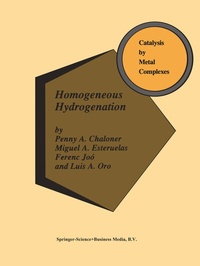
Homogeneous Hydrogenation
Published on 5. December 2010
Book
Paperback/Softback
X, 290 pages
978-90-481-4323-8 (ISBN)
Description
Homogeneous hydrogenation is one of the most thoroughly studied fields of homogeneous catalysis. The results of these studies have proved to be most important for an understanding of the underlying principles of the activation of small molecules by transition metal complexes. During the past three decades homogeneous hydrogenation has found widespread application in organic chemistry, including the production of important pharmaceuticals, especially where a sophisticated degree of selectivity is required.
This volume presents a general account of the main principles and applications of homogeneous hydrogenation by transition metal complexes. Special attention is devoted to the mechanisms by which these processes occur, and the role of the recently discovered complexes of molecular hydrogen is described. Sources of hydrogen, other than H 2 , are also considered (transfer hydrogenation). The latest achievements in highly stereoselective hydrogenations have made possible many new applications in organic synthesis. These applications are documented by giving details of the reduction of important unsaturated substrates (alkenes, alkynes, aldehydes and ketones, nitrocompounds, etc.). Hydrogenation in biphasic and phase transfer catalyzed systems is also described. Finally, a discussion of the biochemical routes of H 2 activation highlights the similarities and differences in performing hydrogenation in both natural and synthetic systems.
For researchers working in the fields of homogeneous catalysis, especially in areas such as pharmaceuticals, plastics and fine chemicals.
This volume presents a general account of the main principles and applications of homogeneous hydrogenation by transition metal complexes. Special attention is devoted to the mechanisms by which these processes occur, and the role of the recently discovered complexes of molecular hydrogen is described. Sources of hydrogen, other than H 2 , are also considered (transfer hydrogenation). The latest achievements in highly stereoselective hydrogenations have made possible many new applications in organic synthesis. These applications are documented by giving details of the reduction of important unsaturated substrates (alkenes, alkynes, aldehydes and ketones, nitrocompounds, etc.). Hydrogenation in biphasic and phase transfer catalyzed systems is also described. Finally, a discussion of the biochemical routes of H 2 activation highlights the similarities and differences in performing hydrogenation in both natural and synthetic systems.
For researchers working in the fields of homogeneous catalysis, especially in areas such as pharmaceuticals, plastics and fine chemicals.
More details
Series
Edition
1st ed. Softcover of orig. ed. 1994
Language
English
Place of publication
Dordrecht
Netherlands
Target group
Professional and scholarly
Research
Product notice
Paperback (trade)
Unsewn / adhesive bound
Illustrations
X, 290 p.
Dimensions
Height: 279 mm
Width: 210 mm
Thickness: 17 mm
Weight
746 gr
ISBN-13
978-90-481-4323-8 (9789048143238)
DOI
10.1007/978-94-017-1791-5
Schweitzer Classification
Other editions
Additional editions
P.A. Chaloner | M.A. Esteruelas | Ferenc Joó
Homogeneous Hydrogenation
E-Book
11/2013
Springer
€223.63
Available for download
P.A. Chaloner | M.A. Esteruelas | Ferenc Joó
Homogeneous Hydrogenation
Book
04/1994
Kluwer Academic Publishers
€235.39
Shipment within 15-20 days
Content
1. Introduction.- 2. The mechanisms of homogeneous hydrogenation.- 3. Homogeneous transfer hydrogenation catalysed by metal complexes.- 4. Homogeneous hydrogenation in organic synthesis.- 5. Hydrogenation in aqueous systems.- 6. Supported metal complexes.- 7. Hydrogen activation in biological systems.- Abbreviations.