


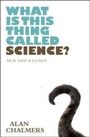
What Is This Thing Called Science? Third Edition
3rd Edition
Published on 16. February 1999
Book
Paperback/Softback
288 pages
978-0-335-20109-9 (ISBN)
Description
Reviews of the previous edition:
"In this academic bestseller - indeed, one of the most widely read books ever written in the history and philosophy of science - Alan Chalmers provides a refreshingly lucid introduction . . . Drawing on illuminating historical examples, he asks and answers some of the most fundamental questions about the nature of science and its methods."
Ronald L. Numbers, William Coleman Professor of the History of Science and Medicine, University of Wisconsin at Madison.
"Crisp, lucid and studded with telling examples . . . As a handy guide to recent alarums and excursions (in the philosophy of science) I find this book vigorous, gallant and useful."
New Scientist
* What is the characteristic that serves to distinguish scientific knowledge from other kinds of knowledge?
* What is the role of experiment in science?
* What is the role of theory in science?
In clear, jargon-free language, the third edition of this highly successful introduction to the philosophy of science surveys the answers of the past hundred years to these central questions.
The previous edition of this book, translated into fifteen foreign languages, has been thoroughly revised in the light of two decades of teaching experience on the part of the author, and has been brought right up to date. The text has been enriched by many new historical examples and the early chapters have been reorganised, re-ordered and amplified to facilitate the introduction of beginners to the field.
The new edition includes new chapters on the following topics:
*the new experimentalism
*the Bayesian approach to science, currently in vogue
*the nature of scientific laws
*recent developments in the
realism/anti-realism debate
These changes will enhance the value of this book as a standard university text in the philosophy of science, not just on science and philosophy courses but also in the social and human sciences such as sociology and psychology, where the need is felt for an introduction to scientific method.
"In this academic bestseller - indeed, one of the most widely read books ever written in the history and philosophy of science - Alan Chalmers provides a refreshingly lucid introduction . . . Drawing on illuminating historical examples, he asks and answers some of the most fundamental questions about the nature of science and its methods."
Ronald L. Numbers, William Coleman Professor of the History of Science and Medicine, University of Wisconsin at Madison.
"Crisp, lucid and studded with telling examples . . . As a handy guide to recent alarums and excursions (in the philosophy of science) I find this book vigorous, gallant and useful."
New Scientist
* What is the characteristic that serves to distinguish scientific knowledge from other kinds of knowledge?
* What is the role of experiment in science?
* What is the role of theory in science?
In clear, jargon-free language, the third edition of this highly successful introduction to the philosophy of science surveys the answers of the past hundred years to these central questions.
The previous edition of this book, translated into fifteen foreign languages, has been thoroughly revised in the light of two decades of teaching experience on the part of the author, and has been brought right up to date. The text has been enriched by many new historical examples and the early chapters have been reorganised, re-ordered and amplified to facilitate the introduction of beginners to the field.
The new edition includes new chapters on the following topics:
*the new experimentalism
*the Bayesian approach to science, currently in vogue
*the nature of scientific laws
*recent developments in the
realism/anti-realism debate
These changes will enhance the value of this book as a standard university text in the philosophy of science, not just on science and philosophy courses but also in the social and human sciences such as sociology and psychology, where the need is felt for an introduction to scientific method.
Reviews / Votes
"Any teacher of history, from primary school to university, can learn much from this articulate book." - Teaching HistoryMore details
Edition
3rd edition
Language
English
Place of publication
Milton Keynes
United Kingdom
Illustrations
illustrations, bibliography, index
Dimensions
Height: 213 mm
Width: 135 mm
Thickness: 18 mm
Weight
363 gr
ISBN-13
978-0-335-20109-9 (9780335201099)
Copyright in bibliographic data and cover images is held by Nielsen Book Services Limited or by the publishers or by their respective licensors: all rights reserved.
Schweitzer Classification
Other editions
New editions
Alan Chalmers
What is This Thing Called Science?
Book
06/2013
4th Edition
Open University Press
€40.00
Shipment within 15-20 days
Previous edition

A.F. Chalmers
What is This Thing Called Science?
Book
12/1982
2nd Edition
Open University Press
€38.56
Article exhausted; check for reprint
Person
Alan Chalmers was born in Bristol, England and has a BSc in physics from the University of Bristol, an MSc in physics from the University of Manchester and a PhD in History and Philosophy of Science from the University of London. He has taught history and philosophy of science at the University of Sydney since 1971 and is now an Associate Professor there. He is the author of Science and its Fabrication (Open University Press, 1990), as well as the previous two editions of What is this Thing Called Science? and many articles on history and philosophy of science.
Content
Preface
Introduction
Science as knowledge derived from the facts of experience
Observation as practical intervention
Experiment
Deriving theories from the facts
induction
Introducing falsificationism
Sophisticated falsificationism
novel predictions and the growth of science
The limitations of falsificationism
Theories as structures I
Kuhn's paradigms
Theories as structures II
research programmes
Feyerabend's anarchistic theory of science
Methodical changes in method
The Bayesian approach
The new experimentalism
Why should the world obey laws?
Realism and anti-realism
Bibliography
Index.
Introduction
Science as knowledge derived from the facts of experience
Observation as practical intervention
Experiment
Deriving theories from the facts
induction
Introducing falsificationism
Sophisticated falsificationism
novel predictions and the growth of science
The limitations of falsificationism
Theories as structures I
Kuhn's paradigms
Theories as structures II
research programmes
Feyerabend's anarchistic theory of science
Methodical changes in method
The Bayesian approach
The new experimentalism
Why should the world obey laws?
Realism and anti-realism
Bibliography
Index.