

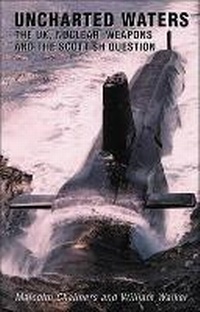
Uncharted Waters
The U.K., Nuclear Weapons and the Scottish Question
Published on 7. November 2001
Book
Paperback/Softback
140 pages
978-1-86232-245-5 (ISBN)
Description
When the Soviet Union broke up, suddenly a unitary state was replaced by 15 new states, four of which inherited large stockpiles of nuclear weapons. By common consent, and after much political energy, ingenuity and luck, only one of the emerging states - Russia - retained its nuclear arms. This achievement immediately raised awareness that other nuclear armed states might suffer the same fate in due course. One such state is the United Kingdom, whose single weapon system - the Royal Navy's Trident submarine system - is based solely in Scotland. The presence of nuclear weapons in Scotland has always been controversial north of the border, not least because no specific Scottish consent has been given for their deployment there. Scotland's nuclear disarmament has been high on the nationalist agenda ever since nuclear weapons were first deployed in the Clyde in the early 1960s. A Scottish declaration of independence which carried a commitment to rid Scotland of nuclear weapons, requiring the closure of the current nuclear bases, could therefore give rise to acute conflicts between Edinburgh and London, potentially jeopardizing efforts to achieve an amicable separation.
There is also the international dimension: the UK nuclear force is "assigned to NATO". Even if Scotland's independence does not happen, the Ministry of Defence's thinking about the future of the nuclear force will be heavily influenced by the recognition that it could happen. Operating the nuclear deterrent out of a devolved Scotland that has attained a very limited autonomy - and no rights to determine defence and foreign policy - is already causing the Ministry of Defence and the Navy considerable discomfort. This book is intended to open up these and other issues for public discussion, and to enable governments and political parties to develop more considered policies.
There is also the international dimension: the UK nuclear force is "assigned to NATO". Even if Scotland's independence does not happen, the Ministry of Defence's thinking about the future of the nuclear force will be heavily influenced by the recognition that it could happen. Operating the nuclear deterrent out of a devolved Scotland that has attained a very limited autonomy - and no rights to determine defence and foreign policy - is already causing the Ministry of Defence and the Navy considerable discomfort. This book is intended to open up these and other issues for public discussion, and to enable governments and political parties to develop more considered policies.
More details
Language
English
Place of publication
Edinburgh
United Kingdom
Publishing group
Birlinn General
Target group
College/higher education
Professional and scholarly
Illustrations
Illustrations, black and white
Dimensions
Height: 220 mm
Width: 232 mm
Thickness: 17 mm
Weight
329 gr
ISBN-13
978-1-86232-245-5 (9781862322455)
Copyright in bibliographic data and cover images is held by Nielsen Book Services Limited or by the publishers or by their respective licensors: all rights reserved.
Schweitzer Classification
Persons
Malcolm Chalmers is Professor of Peace Studies, University of Bradford William Walker is Professor of International Relations, University of St Andrews.