

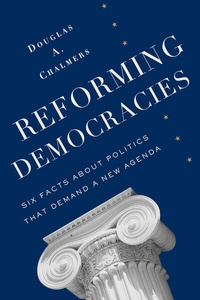
Reforming Democracies
Six Facts About Politics That Demand a New Agenda
Published on 27. January 2014
Book
Paperback/Softback
192 pages
978-0-231-16295-1 (ISBN)
Description
Even well-established democracies need reform, and any successful effort to reform democracies must look beyond conventional institutions-elections, political parties, special interests, legislatures and their relations with chief executives-to do so. Expanding a traditional vision of the institutions of representative democracy, Douglas A. Chalmers examines six aspects of political practice relating to the people being represented, the structure of those who make law and policy, and the links between those structures and the people. Chalmers concludes with a discussion of where successful reform needs to take place: we must pay attention to a democratic ordering of the constant reconfiguration of decision making patterns; we must recognize the crucial role of information in deliberation; and we must incorporate noncitizens and foreigners into the political system, even when they are not the principal beneficiaries.
Reviews / Votes
An important contribution to the study of democracy, Reforming Democracies is sure to appeal to social scientists, policy makers, and activists alike. Douglas A. Chalmer's style is engaging and immanently readable. -- Mark B. Brown, California State University, Sacramento In Reforming Democracies, Douglas A. Chalmers offers a thoughtful and challenging critique of the basic concepts informing our understanding of 'liberal democracy.' He begins with questions about the interests that should be represented, including those of not only citizens but also 'quasi-citizens' who play a critical role in the functioning of the polity. He challenges us to move beyond the conventional analysis of party and interest-group linkages between the people and decision makers and to take into account dynamic and informal relationships outside of these traditional channels. Finally, he urges us to look more directly at decision-making as a deliberative as well as a bargaining process. Underlying all of these challenges is an affirmation that 'democracy' should be conceived not only in terms of procedural norms but also in terms of its capacity to govern in the public interest. In this book, Chalmers builds on decades of teaching and writing as a political scientist, yet with its strong normative perspective, it is a work of political philosophy, too. Not everyone will agree with its conclusions, but it is very important to take them into account. -- Robert Kaufman, Rutgers University After you read this book, I will bet you will add the terms 'quasi-citizens' and 'decision networks' to your vocabulary. Douglas A. Chalmers takes us to neglected places in the democratic decision-making process and argues that we need new institutions to regulate these places, to facilitate action, benefit the people, and adapt continually through linkages that convey information and accountability. These are new ideas that will shake you up and make you think. -- Jane Mansbridge, Kennedy School of Government, Harvard University Well written and thoughtful, this book should provoke conversations among those seeking changes to an imperfect system. Publishers Weekly The rub of conventional writing against novel ideas produces enough friction for some intellectual fire. Kirkus Reviews Reforming Democracies has much to ponder about the modern feel of the political landscape, highly recommended. The Midwest Book Review A well-written and well-organized call for more capacious thinking about the realities of democratic representation in the modern polity. -- Ethan J. Leib Perspectives on Politics [Reforming Democracies] has an elegant, personal and stimulating style, which makes it a very enjoyable read. Survival: Global Politics and Strategy Exceptionally well written, organized and presented... Reforming Democracies is especially commended to the attention of the non-specialist general reader with an interest in political science and democratic processes. Midwest Book ReviewMore details
Series
Language
English
Place of publication
New York
United States
Product notice
Paperback (trade)
Dimensions
Height: 216 mm
Width: 140 mm
Weight
241 gr
ISBN-13
978-0-231-16295-1 (9780231162951)
Copyright in bibliographic data and cover images is held by Nielsen Book Services Limited or by the publishers or by their respective licensors: all rights reserved.
Schweitzer Classification
Other editions
Additional editions
E-Book
08/2015
1st Edition
De Gruyter
from
€24.95
Available for download
Book
01/2013
Columbia University Press
€99.20
Shipment within 10-20 days
Person
Douglas A. Chalmers has written articles and books on German and Latin American politics and is coeditor of The New Politics of Inequality in Latin America: Rethinking Participation and Representation. The former chair of the Department of Political Science and director of the Institute of Latin American Studies at Columbia University, he now teaches in Columbia's Core Curriculum and leads organizations devoted to making retirement the new phase of faculty professional life.
Content
Preface Introduction: Why Do We Need Institutional Reform? Part I. The Concepts 1. Rethinking the Institutions of Representative Democracy Part II. The People 2. Which "People" Are Represented in a Representative Democracy? 3. Quasi-Citizens in the Community Are Represented 4. Quasi-Citizens in Other Jurisdictions Are Represented Part III. The Links 5. Connecting People and Decision Makers 6. Organizations and Their Alliances Change Rapidly 7. Personal Networks Are Important Part IV. The Decision Makers 8. Law- and Policy Making 9. Deliberation Is as Important as Bargaining 10. Decisions Are Made in Multiple Venues Conclusion: A Review Notes Works Cited Suggested Readings Index