

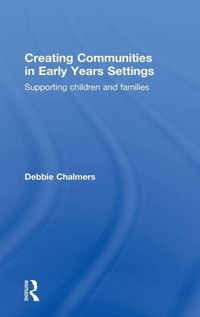
Creating Communities in Early Years Settings
Supporting children and families
1st Edition
Published on 19. October 2015
Book
Hardback
146 pages
978-1-138-91728-6 (ISBN)
Description
Creating Communities in Early Years Settings encourages and supports all early years practitioners who work with children and their families within the Early Years Foundation Stage. Offering advice, ideas and strategies for developing an early learning community, this book provides clear guidance and real world examples that show how practitioners can provide an excellent, inclusive service to meet the needs of young children and their families and help them to thrive.
Debbie Chalmers presents innovative and practical ideas to promote progress, development and inclusion, while outlining potential pitfalls and explaining how to identify and cater for individual needs. Chapters cover key topics such as:
the legal responsibilities of a setting
inclusion
parental participation and parent managed settings
roles and duties of different staff within a setting
effective and sensitive communication with colleagues and caregivers and
managing transitions.
Creating Communities in Early Years Settings is designed to support early years practitioners, teachers, teaching assistants, nannies and childminders working with babies and children within the Early Years Foundation Stage. The book will also be of interest to students on early years childcare and education courses from level 2 upwards.
Debbie Chalmers presents innovative and practical ideas to promote progress, development and inclusion, while outlining potential pitfalls and explaining how to identify and cater for individual needs. Chapters cover key topics such as:
the legal responsibilities of a setting
inclusion
parental participation and parent managed settings
roles and duties of different staff within a setting
effective and sensitive communication with colleagues and caregivers and
managing transitions.
Creating Communities in Early Years Settings is designed to support early years practitioners, teachers, teaching assistants, nannies and childminders working with babies and children within the Early Years Foundation Stage. The book will also be of interest to students on early years childcare and education courses from level 2 upwards.
Reviews / Votes
"Creating Communities...encourages and supports all early years practitioners working the EYFS. It offers advice, ideas and strategies for developing an early learning community, including insights into inclusion and the management of transitions" - Teach Early Years Magazine"This book encourages early years practitioners and supports them in providing advice, ideas and strategies for developing an early years community that is excellent, inclusive, and meets the needs of young children and families, helping everyone to thrive." - Martine Horvath, Early Years Educator
More details
Language
English
Place of publication
London
United Kingdom
Publishing group
Taylor & Francis Ltd
Target group
Professional and scholarly
Professional and Professional Practice & Development
Illustrations
32 s/w Photographien bzw. Rasterbilder
32 Halftones, black and white
Dimensions
Height: 240 mm
Width: 161 mm
Thickness: 13 mm
Weight
405 gr
ISBN-13
978-1-138-91728-6 (9781138917286)
Copyright in bibliographic data and cover images is held by Nielsen Book Services Limited or by the publishers or by their respective licensors: all rights reserved.
Schweitzer Classification
Other editions
Additional editions
Book
10/2015
1st Edition
Routledge
€57.60
Shipment within 10-20 days
E-Book
10/2015
Routledge
€39.49
Available for download
E-Book
10/2015
Routledge
€39.49
Available for download
Person
Debbie Chalmers is an early years practitioner, a drama teacher and consultant, and a freelance early years and primary education writer.
Content
Introduction 1. The Benefits Of Parental Participation 2. Ensuring Inclusion For All Families 3. A Parent Managed Setting As A Part Of The Community 4. Making The Setting A Safe And Supportive Environment 5. Understanding And Promoting Children's Development 6. Recording Children's Progress And Achievements 7. The Responsibilities Of A Key Person 8. The Roles And Duties Of Different Staff Within A Setting 9. Sensitive Management Of Staff, Colleagues And Clients 10. Handling Transitions And Moving On