

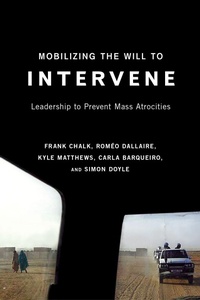
Mobilizing the Will to Intervene
Leadership to Prevent Mass Atrocities
Will be published approx. on 1. October 2010
Book
Paperback/Softback
200 pages
978-0-7735-3804-7 (ISBN)
Description
Despite the handwringing and promises of "never again," the grim recurrences of genocide and crimes against humanity around the world have made it emphatically clear that the international community has been largely ineffective in stopping mass atrocity crimes. Drawing on candid interviews with eighty key figures involved in American and Canadian responses to the Rwandan genocide of 1994 and the Kosovo crisis of 1999, Mobilizing the Will to Intervene explains why and provides a roadmap for change. Since appeals to the "moral law" carry little weight in the political calculations of modern states, the authors argue that civil society must persuade governments that the prevention of mass atrocities around the world is in every country's national interest. In a globalized world, violence, disease, and instability triggered by mass atrocities in one place affect the security, health, and prosperity of all other regions. No nation is an island. Impassioned, insightful, and determined, Mobilizing the Will to Intervene is a direct appeal to American and Canadian politicians, NGOs, journalists, and the public to participate effectively in the prevention of mass atrocities by pressuring their leaders to act. With simple, practical recommendations, this book shows how civil society can participate in preventing future mass atrocities and help repair a ruined system of international aid.
Reviews / Votes
"Mobilizing the Will to Intervene [...] challenges government to think big, for once." The Toronto Star "A major policy initiative in the field of foreign affairs, the Will to Intervene Project has now become a book and deserves Canadians' serious attention." The Literary Review of Canada "Mobilizing the Will to Intervene [...] challenges government to think big, for once." The Toronto Star "It is the kind of book that can change the world." Montreal Review of Books "Mobilizing the Will to Intervene shows that inaction is not inevitable and argues that preventing genocide and mass atrocities is in the national interest of states. This book is a must-read for scholars, activists, policymakers, and concerned citizens e "Mobilizing the Will to Intervene challenges us to take the critical next step in activating the Responsibility to Protect doctrine. Rhetoric rings hollow to victims of mass atrocity in the absence of action. Rights must be mobilized to be real." StephenMore details
Language
English
Place of publication
Montreal
Canada
Target group
College/higher education
Professional and scholarly
Product notice
Paperback (trade)
Unsewn / adhesive bound
Dimensions
Height: 217 mm
Width: 141 mm
Thickness: 17 mm
Weight
284 gr
ISBN-13
978-0-7735-3804-7 (9780773538047)
Copyright in bibliographic data and cover images is held by Nielsen Book Services Limited or by the publishers or by their respective licensors: all rights reserved.
Schweitzer Classification
Other editions
Additional editions
Frank Chalk | Kyle Matthews | Carla Barqueiro
Mobilizing the Will to Intervene
Leadership to Prevent Mass Atrocities
E-Book
05/2014
1st Edition
McGill-Queen's University Press
€18.49
Available for download
Previous edition
Frank Chalk | Lgen Romeo Dallaire | Kyle Matthews
Mobilizing the Will to Intervene
Leadership to Prevent Mass Atrocities
Book
10/2010
McGill-Queen's University Press
€147.07
Article exhausted; check for reprint
Persons
Frank Chalk is professor of history and director of the Montreal Institute for Genocide and Human Rights Studies at Concordia University.
LGen Romeo Dallaire (Ret'd) commanded the United Nations Assistance Mission for Rwanda in 1994 and was appointed to the Senate of Canada in 2005.
Kyle Matthews, the lead researcher, has worked for the United Nations High Commissioner for Refugees and CARE Canada.
Carla Barqueiro holds a PhD in international politics from Aberystwyth University and has written extensively about Canada's human security foreign policy.
Simon Doyle is a journalist who has covered lobbying in Ottawa and the shaping of Canadian government policy.
LGen Romeo Dallaire (Ret'd) commanded the United Nations Assistance Mission for Rwanda in 1994 and was appointed to the Senate of Canada in 2005.
Kyle Matthews, the lead researcher, has worked for the United Nations High Commissioner for Refugees and CARE Canada.
Carla Barqueiro holds a PhD in international politics from Aberystwyth University and has written extensively about Canada's human security foreign policy.
Simon Doyle is a journalist who has covered lobbying in Ottawa and the shaping of Canadian government policy.