

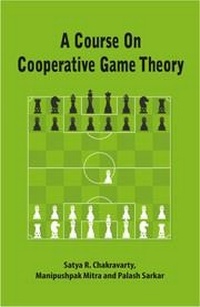
A Course on Cooperative Game Theory
Will be published approx. on 9. February 2015
Book
Hardback
273 pages
978-1-107-05879-8 (ISBN)
Description
Cooperative game theory deals with situations where objectives of participants of the game are partially cooperative and partially conflicting. It is in the interest of participants to cooperate in the sense of making binding agreements to achieve the maximum possible benefit. When it comes to distribution of benefit/payoffs, participants have conflicting interests. Such situations are usually modelled as cooperative games. While the book mainly discusses transferable utility games, there is also a brief analysis of non-transferable utility games. Alternative solution concepts to cooperative game theoretic problems are presented in chapters 1-9 and the next four chapters present issues related to computations of solutions discussed in the earlier chapters. The proofs of all results presented in the book are quite explicit. Additionally the mathematical techniques employed in demonstrating the results will be helpful to those who wish to learn application of mathematics for solving problems in game theory.
More details
Language
English
Place of publication
Cambridge
United Kingdom
Target group
Professional and scholarly
Product notice
sewn/stitched
Cloth over boards
Dimensions
Height: 238 mm
Width: 162 mm
Thickness: 22 mm
Weight
563 gr
ISBN-13
978-1-107-05879-8 (9781107058798)
Copyright in bibliographic data and cover images is held by Nielsen Book Services Limited or by the publishers or by their respective licensors: all rights reserved.
Schweitzer Classification
Other editions
Additional editions
Satya R. Chakravarty | Manipushpak Mitra | Palash Sarkar
A Course on Cooperative Game Theory
E-Book
02/2015
Cambridge University Press
€87.49
Available for download
Satya R. Chakravarty | Manipushpak Mitra | Palash Sarkar
A Course on Cooperative Game Theory
Book
10/2014
Cambridge University Press
€39.50
Shipment within 15-20 days
Persons
Satya R. Chakravarty is a Professor of Economics at the Indian Statistical Institute, Kolkata. He received a bachelor degree in Statistics in 1976, a master degree in economics in 1977 and a doctorate in economics in 1981 from the Indian Statistical Institute. Professor Chakravarty worked as a Visiting Professor at the University of British Columbia, Canada (1984-5), the University of Karlsruhe, Germany (1988-90) with a grant from the German Research Foundation, the Bar Ilan University, Israel (1990, 2004, 2005, 2006 and 2010), the Kagawa University, Japan (1996-7 and 2000), the Paris School of Economics, Paris, France (1997-8) with a grant from the French Ministry of Education, the Chinese University of Hong Kong (1998), the Bocconi University, Milan, Italy (2002-3 and 2006-7) and the Yokohama National University, Japan (2009). Professor Chakravarty's main areas of interest are welfare economics, public economics, mathematical finance, industrial organization and game theory. His work spans theoretical, empirical and policy analysis. Manipushpak Mitra is a Professor of Economics at the Indian Statistical Institute, Kolkata, India. He has articles published in internationally known journals and edited books on cooperative game theory, mechanisms design in allocation problems and in market regulation problems, and industrial organization. Palash Sarkar is a computer scientist and is presently a Professor at the Indian Statistical Institute, Kolkata, India. He has published over one hundred articles in leading journals and conference proceedings. His research and teaching interests range over a wide variety of topics at the interface of computer science and mathematics.
Content
Preface; 1. Introduction and motivation page; 2. Basics and preliminaries; 3. The core and some related solutions; 4. The bargaining set, kernel and nucleolus; 5. The Shapley value; 6. The core, Shapley value and Weber set; 7. Voting games; 8. Mathematical matching; 9. Non-transferable utility cooperative games; 10. Linear programming; 11. Algorithmic aspects of cooperative game theory; 12. Weighted majority games; 13. Stable matching algorithm; References; Index.