

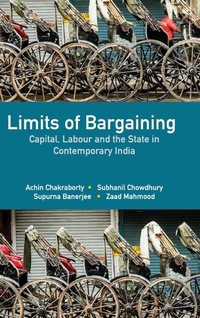
Limits of Bargaining
Capital, Labour and the State in Contemporary India
Published on 23. May 2019
Book
Hardback
170 pages
978-1-108-49224-9 (ISBN)
Description
Limits of Bargaining is an original addition to the political economy analysis of capital-labour relations in the organised industrial sector in the context of economic liberalisation in India. It analyses the dynamics of the capital-labour bargaining process in the context of the changing nature of the state and market as a result of adoption of policies of liberalisation and globalisation for the last two and half decades. It examines the nature of collective bargaining and analyses the underlying structural-political conditions that shape the capital-labour relations. Based on original empirical material from West Bengal, a state long considered pro-labour, the book presents bargaining between capital and labour as endogenous to the interplay of the triad of the market, technology and the institutions of the state. It illustrates everyday interactions between labour and management, different unions and outside actors that shape collective bargaining, and highlights the negotiation, appropriations and compromises that shape bargaining at the operational level.
More details
Language
English
Place of publication
Cambridge
United Kingdom
Target group
Professional and scholarly
Illustrations
Worked examples or Exercises
Dimensions
Height: 235 mm
Width: 157 mm
Thickness: 13 mm
Weight
387 gr
ISBN-13
978-1-108-49224-9 (9781108492249)
Copyright in bibliographic data and cover images is held by Nielsen Book Services Limited or by the publishers or by their respective licensors: all rights reserved.
Schweitzer Classification
Other editions
Additional editions
Achin Chakraborty | Subhanil Chowdhury | Supurna Banerjee
Limits of Bargaining
Capital, Labour and the State in Contemporary India
E-Book
04/2019
Cambridge University Press
€88.99
Available for download
Persons
Achin Chakraborty is Professor and Director at the Institute of Development Studies Kolkata, India. He has co-authored, with Anthony D'Costa, The Land Question in India: State, Dispossession, and Capitalist Transition (2017). His research interests are development economics, poverty, inequality and human development. Subhanil Chowdhury is Assistant Professor at the Institute of Development Studies Kolkata, India. His primary research interests are labour economics and trade and development. Supurna Banerjee is Assistant Professor at the Institute of Development Studies Kolkata, India. Her research interests are labour, migration, social space and activism. Zaad Mahmood is Assistant Professor at Presidency University, Kolkata. His research interests are globalisation, public policy, labour and politics in India.
Content
List of tables; List of figures; Preface; 1. Contextualising trade unions and collective bargaining; 2. Collective bargaining in India: an overview; 3. Everyday processes of collective bargaining in West Bengal; 4. Industrial stagnation due to 'labour militancy'? A critical look at the macro evidence; 5. Trade unions and working-class politics in contemporary West Bengal; 6. The state and collective bargaining; 7. Conclusion; References; Index.