

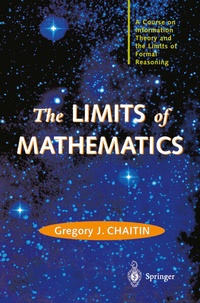
The LIMITS of MATHEMATICS
A Course on Information Theory and the Limits of Formal Reasoning
Published on 28. October 2002
Book
Hardback
XII, 150 pages
978-1-85233-668-4 (ISBN)
Description
As a teenager, Greg created independently of Kolmogorov and Solomonoff, what we call today algorithmic information theory, a sub ject of which he is the main architect. His 1965 paper on gedanken experiments on automata, which he wrote when he was in high school, is still of interest today. He was also heavily involved in IBM, where he has worked for almost thirty years, on the development of RISC technology. Greg's results are widely quoted. My favorite portrait of Greg can be found in John Horgan's-a writer for Scientific American-1996 book The End 01 Science. Greg has gotten many honors. He was a guest of distinguished people like Prigogine, the King and Queen of Belgium, and the Crown Prince of Japan. Just to be brief, allow me to paraphrase Bette Davis in All About Eve. She said, "Fasten your seat belts, it's going to be a bumpy talk!" Ladies and Gentlemen, Greg Chaitin! [Laughter & Applause] CRISTIAN CALUDE introducing GREGORY CHAITIN at the DMTCS'96 meeting at the University of Auckland.
More details
Series
Edition
1st ed. 1997. 2nd printing 2002
Language
English
Place of publication
London
United Kingdom
Target group
Professional and scholarly
Professional/practitioner
Edition type
New edition
Illustrations
XII, 150 p.
Dimensions
Height: 241 mm
Width: 160 mm
Thickness: 14 mm
Weight
424 gr
ISBN-13
978-1-85233-668-4 (9781852336684)
DOI
10.1007/978-1-4471-0015-7
Schweitzer Classification
Other editions
Additional editions
Gregory J. Chaitin
The LIMITS of MATHEMATICS
A Course on Information Theory and the Limits of Formal Reasoning
Book
11/2012
Springer
€96.29
Shipment within 15-20 days
Previous edition
Gregory J. Chaitin
The Limits of Mathematics
A course on information theory and the limits of formal reasoning
Book
12/1997
Springer
€45.42
Article exhausted; check for reprint
Content
Randomness in arithmetic and the decline and fall of reductionism in pure mathematics.- Elegant LISP programs.- An invitation to algorithmic information theory.- The limits of mathematics.- Appendix. LISP interpreter in Mathematica.