

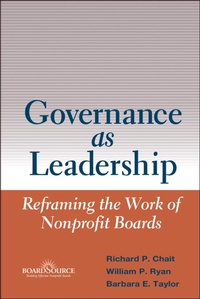
Governance as Leadership
Reframing the Work of Nonprofit Boards
1st Edition
Published on 9. November 2004
Book
Hardback
224 pages
978-0-471-68420-6 (ISBN)
Description
A new framework for helping nonprofit organizations maximize the effectiveness of their boards.
Written by noted consultants and researchers attuned to the needs of practitioners, Governance as Leadership redefines nonprofit governance. It provides a powerful framework for a new covenant between trustees and executives: more macrogovernance in exchange for less micromanagement.
Informed by theories that have transformed the practice of organizational leadership, this book sheds new light on the traditional fiduciary and strategic work of the board and introduces a critical third dimension of effective trusteeship: generative governance. It serves boards as both a resource of fresh approaches to familiar territory and a lucid guide to important new territory, and provides a road map that leads nonprofit trustees and executives to governance as leadership.
Governance as Leadership was developed in collaboration with BoardSource, the premier resource for practical information, tools and best practices, training, and leadership development for board members of nonprofit organizations. Through its highly acclaimed programs and services, BoardSource enables organizations to fulfill their missions by helping build effective nonprofit boards and offering credible support in solving tough problems. For the latest in nonprofit governance, visit www.boardsource.org, or call us at 1-800-883-6262.
Written by noted consultants and researchers attuned to the needs of practitioners, Governance as Leadership redefines nonprofit governance. It provides a powerful framework for a new covenant between trustees and executives: more macrogovernance in exchange for less micromanagement.
Informed by theories that have transformed the practice of organizational leadership, this book sheds new light on the traditional fiduciary and strategic work of the board and introduces a critical third dimension of effective trusteeship: generative governance. It serves boards as both a resource of fresh approaches to familiar territory and a lucid guide to important new territory, and provides a road map that leads nonprofit trustees and executives to governance as leadership.
Governance as Leadership was developed in collaboration with BoardSource, the premier resource for practical information, tools and best practices, training, and leadership development for board members of nonprofit organizations. Through its highly acclaimed programs and services, BoardSource enables organizations to fulfill their missions by helping build effective nonprofit boards and offering credible support in solving tough problems. For the latest in nonprofit governance, visit www.boardsource.org, or call us at 1-800-883-6262.
Reviews / Votes
"Governance as Leadership remains necessary reading for its intended audience as well as for the academic audience at large." (The Journal of Higher Education; Nov/Dec 2007)More details
Language
English
Place of publication
New York
United States
Target group
Professional and scholarly
Product notice
sewn/stitched
Cloth over boards
With dust jacket
Dimensions
Height: 236 mm
Width: 164 mm
Thickness: 21 mm
Weight
467 gr
ISBN-13
978-0-471-68420-6 (9780471684206)
Copyright in bibliographic data and cover images is held by Nielsen Book Services Limited or by the publishers or by their respective licensors: all rights reserved.
Schweitzer Classification
Other editions
Additional editions
Richard P. Chait | William P. Ryan | Barbara E. Taylor
Governance as Leadership
Reframing the Work of Nonprofit Boards
E-Book
01/2011
Wiley
€69.99
Available for download
Richard P. Chait | William P. Ryan | Barbara E. Taylor
Governance as Leadership
Reframing the Work of Nonprofit Boards
E-Book
10/2004
Wiley
€69.99
Available for download
Persons
RICHARD P. CHAIT is a professor at the Harvard Graduate School of Education. His research and consulting focus is on nonprofit governance and college and university management. He was recently honored as one of Harvard University's "outstanding teachers."
WILLIAM P. RYAN is a research fellow at the Hauser Center for Nonprofit Organizations at Harvard University, and a consultant to foundations and non-profit organizations. His work focuses on nonprofit organizational effectiveness and foundation strategy.
BARBARA E. TAYLOR is a researcher and consultant to nonprofit organizations whose work focuses on trusteeship, executive search, and organizational planning and assessment. She is a senior consultant with the Academic Search Consultation Service and a former vice president of the Association of Governing Boards of Universities and Colleges.
WILLIAM P. RYAN is a research fellow at the Hauser Center for Nonprofit Organizations at Harvard University, and a consultant to foundations and non-profit organizations. His work focuses on nonprofit organizational effectiveness and foundation strategy.
BARBARA E. TAYLOR is a researcher and consultant to nonprofit organizations whose work focuses on trusteeship, executive search, and organizational planning and assessment. She is a senior consultant with the Academic Search Consultation Service and a former vice president of the Association of Governing Boards of Universities and Colleges.
Content
about boardsource x
about the authors xi
preface xv
acknowledgments xxv
chapter 1 First Principles 1
Principle One: Nonprofit Managers Have Become Leaders 2
Principle Two:Trustees Are Acting More Like Managers 4
Principle Three:There Are Three Modes of Governance, All Created Equal 6
Principle Four:Three Modes Are Better Than Two or One 8
chapter 2 Problem Boards or Board Problems? 11
Problems of Performance 12
From Problems of Performance to Problems of Purpose 15
Some Official Work Is Highly Episodic 17
Some Official Work Is Intrinsically Unsatisfying 18
Some Important Unofficial Work Is Undemanding 20
Some Unofficial Work Is Rewarding but Discouraged 22
The Challenge of Reform 23
chapter 3 Type I Governing: Fiduciary 33
Type I Governing 34
The Type I Mental Map 38
The Type I Board 40
Assessing the Problems 45
Conclusion 49
chapter 4 Type II Governing: Strategic 51
Nonprofits Enter the Marketplace 52
Boards and Formal Strategy: A Type I Approach to Type II Work 54
Strategic Disillusionment 56
Strategic Thinking: Beyond a Type I Mindset 62
Governing in Type II Mode 65
The Evolution of Strategic Governance 66
Processes and Structures for Type II Governing 68
Implementing Strategy 75
Why Not Just Types I and II? 76
chapter 5 Type III: Generative Thinking 79
The Power of Generative Thinking in Organizations 80
Inside the Black Box of Generative Thinking 82
Toward Generative Governing 89
Leadership as Governance: Executives Displace Trustees 90
Governance by Default:Trustees and Executives Disengage 93
Governance by Fiat:Trustees Displace Executives 94
Type III Governance:Trustees and Executives Collaborate 94
Can Boards Do It? 99
chapter 6 Type III: Generative Governing 101
Using a Type III Mental Map of the Organization 104
Recognizing Generative Landmarks 107
Generative Landmarks 107
Embedded Issues 108
Spotting "Triple Helix" Situations 109
Working at the Boundary 111
Working at the Internal Boundary 111
Working at the External Boundary 115
Looking Back:The Future in the Rear-View Mirror 116
Deliberating and Discussing Differently 119
The Cardinal Rule: Suspend the Rules 120
Promoting Robust Dialogue 124
Mind the Mode 130
The Payoffs 131
Chapter 7 Working Capital That Makes Governance Work 137
Intellectual Capital 142
Reputational Capital 146
Political Capital 150
Social Capital 155
Capitalizing on Trustees 161
chapter 8 Where to Next? 163
Is the Game Worth the Candle? 163
Diagnostics 167
"Attractive Nuisances" 174
A New Covenant 179
Coming Full Circle 181
references 183
index 189
about the authors xi
preface xv
acknowledgments xxv
chapter 1 First Principles 1
Principle One: Nonprofit Managers Have Become Leaders 2
Principle Two:Trustees Are Acting More Like Managers 4
Principle Three:There Are Three Modes of Governance, All Created Equal 6
Principle Four:Three Modes Are Better Than Two or One 8
chapter 2 Problem Boards or Board Problems? 11
Problems of Performance 12
From Problems of Performance to Problems of Purpose 15
Some Official Work Is Highly Episodic 17
Some Official Work Is Intrinsically Unsatisfying 18
Some Important Unofficial Work Is Undemanding 20
Some Unofficial Work Is Rewarding but Discouraged 22
The Challenge of Reform 23
chapter 3 Type I Governing: Fiduciary 33
Type I Governing 34
The Type I Mental Map 38
The Type I Board 40
Assessing the Problems 45
Conclusion 49
chapter 4 Type II Governing: Strategic 51
Nonprofits Enter the Marketplace 52
Boards and Formal Strategy: A Type I Approach to Type II Work 54
Strategic Disillusionment 56
Strategic Thinking: Beyond a Type I Mindset 62
Governing in Type II Mode 65
The Evolution of Strategic Governance 66
Processes and Structures for Type II Governing 68
Implementing Strategy 75
Why Not Just Types I and II? 76
chapter 5 Type III: Generative Thinking 79
The Power of Generative Thinking in Organizations 80
Inside the Black Box of Generative Thinking 82
Toward Generative Governing 89
Leadership as Governance: Executives Displace Trustees 90
Governance by Default:Trustees and Executives Disengage 93
Governance by Fiat:Trustees Displace Executives 94
Type III Governance:Trustees and Executives Collaborate 94
Can Boards Do It? 99
chapter 6 Type III: Generative Governing 101
Using a Type III Mental Map of the Organization 104
Recognizing Generative Landmarks 107
Generative Landmarks 107
Embedded Issues 108
Spotting "Triple Helix" Situations 109
Working at the Boundary 111
Working at the Internal Boundary 111
Working at the External Boundary 115
Looking Back:The Future in the Rear-View Mirror 116
Deliberating and Discussing Differently 119
The Cardinal Rule: Suspend the Rules 120
Promoting Robust Dialogue 124
Mind the Mode 130
The Payoffs 131
Chapter 7 Working Capital That Makes Governance Work 137
Intellectual Capital 142
Reputational Capital 146
Political Capital 150
Social Capital 155
Capitalizing on Trustees 161
chapter 8 Where to Next? 163
Is the Game Worth the Candle? 163
Diagnostics 167
"Attractive Nuisances" 174
A New Covenant 179
Coming Full Circle 181
references 183
index 189