

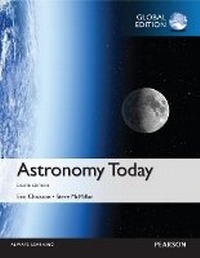
Astronomy Today, Global Edition
8th Edition
Published on 24. September 2014
Book
Paperback/Softback
826 pages
978-1-292-05773-6 (ISBN)
Description
With Astronomy Today, Eighth Edition, trusted authors Eric Chaisson and Steve McMillan communicate their excitement about astronomy, delivering current and thorough science with insightful pedagogy. The text emphasizes critical thinking and visualization, and it focuses on the process of scientific discovery, teaching students "how we know what we know."
Alternate Versions
Astronomy Today, Volume 1: The Solar System, Eighth Edition-Focuses primarily on planetary coverage for a 1-term course. Includes Chapters 1-16, 28.
Astronomy Today, Volume 2: Stars and Galaxies, Eighth Edition-Focuses primarily on stars and stellar evolution for a 1-term course. Includes Chapters 1-5 and 16-28.
Alternate Versions
Astronomy Today, Volume 1: The Solar System, Eighth Edition-Focuses primarily on planetary coverage for a 1-term course. Includes Chapters 1-16, 28.
Astronomy Today, Volume 2: Stars and Galaxies, Eighth Edition-Focuses primarily on stars and stellar evolution for a 1-term course. Includes Chapters 1-5 and 16-28.
More details
Edition
8th edition
Language
English
Place of publication
Harlow
United Kingdom
Target group
College/higher education
Dimensions
Height: 36 mm
Width: 212 mm
Thickness: 274 mm
Weight
1580 gr
ISBN-13
978-1-292-05773-6 (9781292057736)
Copyright in bibliographic data and cover images is held by Nielsen Book Services Limited or by the publishers or by their respective licensors: all rights reserved.
Schweitzer Classification
Other editions
Additional editions
Eric Chaisson | Steve McMillan
Astronomy Today, Global Edition
E-Book
02/2015
8th Edition
Pearson
from
€51.35
Available for download
Previous edition
Eric Chaisson | Steve McMillan
Astronomy Today Pearson New International Edition, plus MasteringAstronomy without eText
Book
09/2013
7th Edition
Pearson Education Limited
€85.41
Article exhausted; check for reprint
Persons
Eric Chaisson received his Ph.D. in astrophysics from Harvard, where he spent 10 years on the faculty; after holding various professorships at Johns Hopkins and Tufts, Eric is back at Harvard teaching and doing research at the Harvard-Smithsonian Center for Astrophysics. He has written 12 books and received a number of literary awards along the way.
Steve McMillan received his Ph.D. in astronomy from Harvard and is a professor of physics at Drexel University. He has published more than 100 articles and scientific papers.
Steve McMillan received his Ph.D. in astronomy from Harvard and is a professor of physics at Drexel University. He has published more than 100 articles and scientific papers.
Content
I. ASTRONOMY AND THE UNIVERSE
1. Charting the Heavens: The Foundations of Astronomy
2. The Copernican Revolution: The Birth of Modern Science
3. Radiation: Information from the Cosmos
4. Spectroscopy: The Inner Workings of Atoms
5. Telescopes: The Tools of Astronomy
II. OUR PLANETARY SYSTEM
6. The Solar System: Comparative Planetology and Formation Models
7. Earth: Our Home in Space
8. The Moon and Mercury: Scorched and Battered Worlds
9. Venus: Earth's Sister Planet
10. Mars: A Near Miss for Life?
11. Jupiter: Giant of the Solar System
12. Saturn: Spectacular Rings and Mysterious Moons
13. Uranus and Neptune: The Outer Worlds of the Solar System
14. Solar System Debris: Keys to Our Origin
15. Exoplanets: Planetary Systems Beyond Our Own.
III. STARS AND STELLAR EVOLUTION
16. The Sun: Our Parent Star
17. The Stars: Giants, Dwarfs, and the Main Sequence
18. The Interstellar Medium: Gas and Dust among the Stars
19. Star Formation: A Traumatic Birth
20. Stellar Evolution: The Life and Death of a Star
21. Stellar Explosions: Novae, Supernovae, and the Formation of the Elements
22. Neutron Stars and Black Holes: Strange States of Matter
IV. GALAXIES AND COSMOLOGY
23. The Milky Way Galaxy: A Spiral in Space
24. Galaxies: Building Blocks of the Universe
25. Galaxies and Dark Matter: The Large-Scale Structure of the Cosmos
26. Cosmology: The Big Bang and the Fate of the Universe
27. The Early Universe: Toward the Beginning of Time
28. Life in the Universe: Are We Alone?
1. Charting the Heavens: The Foundations of Astronomy
2. The Copernican Revolution: The Birth of Modern Science
3. Radiation: Information from the Cosmos
4. Spectroscopy: The Inner Workings of Atoms
5. Telescopes: The Tools of Astronomy
II. OUR PLANETARY SYSTEM
6. The Solar System: Comparative Planetology and Formation Models
7. Earth: Our Home in Space
8. The Moon and Mercury: Scorched and Battered Worlds
9. Venus: Earth's Sister Planet
10. Mars: A Near Miss for Life?
11. Jupiter: Giant of the Solar System
12. Saturn: Spectacular Rings and Mysterious Moons
13. Uranus and Neptune: The Outer Worlds of the Solar System
14. Solar System Debris: Keys to Our Origin
15. Exoplanets: Planetary Systems Beyond Our Own.
III. STARS AND STELLAR EVOLUTION
16. The Sun: Our Parent Star
17. The Stars: Giants, Dwarfs, and the Main Sequence
18. The Interstellar Medium: Gas and Dust among the Stars
19. Star Formation: A Traumatic Birth
20. Stellar Evolution: The Life and Death of a Star
21. Stellar Explosions: Novae, Supernovae, and the Formation of the Elements
22. Neutron Stars and Black Holes: Strange States of Matter
IV. GALAXIES AND COSMOLOGY
23. The Milky Way Galaxy: A Spiral in Space
24. Galaxies: Building Blocks of the Universe
25. Galaxies and Dark Matter: The Large-Scale Structure of the Cosmos
26. Cosmology: The Big Bang and the Fate of the Universe
27. The Early Universe: Toward the Beginning of Time
28. Life in the Universe: Are We Alone?