

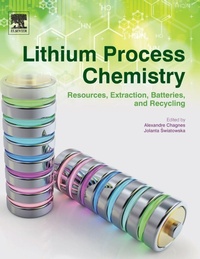
Lithium Process Chemistry
Resources, Extraction, Batteries, and Recycling
Published on 22. June 2015
Book
Hardback
312 pages
978-0-12-801417-2 (ISBN)
Description
Lithium Process Chemistry: Resources, Extraction, Batteries and Recycling presents, for the first time, the most recent developments and state-of-the-art of lithium production, lithium-ion batteries, and their recycling.
The book provides fundamental and theoretical knowledge on hydrometallurgy and electrochemistry in lithium-ion batteries, including terminology related to these two fields. It is of particular interest to electrochemists who usually have no knowledge in hydrometallurgy and hydrometallurgists not familiar with electrochemistry applied to Li-ion batteries.
It is also useful for both teachers and students, presenting an overview on Li production, Li-ion battery technologies, and lithium battery recycling processes that is accompanied by numerous graphical presentations of different battery systems and their electrochemical performances. The book represents the first time that hydrometallurgy and electrochemistry on lithium-ion batteries are assembled in one unique source.
The book provides fundamental and theoretical knowledge on hydrometallurgy and electrochemistry in lithium-ion batteries, including terminology related to these two fields. It is of particular interest to electrochemists who usually have no knowledge in hydrometallurgy and hydrometallurgists not familiar with electrochemistry applied to Li-ion batteries.
It is also useful for both teachers and students, presenting an overview on Li production, Li-ion battery technologies, and lithium battery recycling processes that is accompanied by numerous graphical presentations of different battery systems and their electrochemical performances. The book represents the first time that hydrometallurgy and electrochemistry on lithium-ion batteries are assembled in one unique source.
More details
Language
English
Place of publication
United States
Target group
Professional and scholarly
Chemical engineers, metallurgists, academic researchers in these areas
Scientific library in universities and research institutes
Product notice
Laminated cover
Illustrations
Illustrated
Dimensions
Height: 248 mm
Width: 202 mm
Thickness: 22 mm
Weight
768 gr
ISBN-13
978-0-12-801417-2 (9780128014172)
Copyright in bibliographic data and cover images is held by Nielsen Book Services Limited or by the publishers or by their respective licensors: all rights reserved.
Schweitzer Classification
Other editions
New editions
Book
approx. 07/2026
2nd Edition
Elsevier
€219.50
Not yet published
Additional editions
Alexandre Chagnes | Jolanta Swiatowska
Lithium Process Chemistry
Resources, Extraction, Batteries, and Recycling
E-Book
06/2015
Elsevier
€133.00
Available for download
Persons
Professor Alexandre Chagnes has an extensive background in electrochemistry and hydrometallurgy, having worked in France and Canada before becoming an Associate Professor at Chimie Paristech from 2005 to 2016. Since 2016, he has been a Full Professor at Universite de Lorraine, where he has held several leadership roles, including Director of the national network on extractive metallurgy and Director of the Research Program on Circular Economy. He founded the start-up WEEEMET, focusing on innovative metal recycling processes. His research primarily targets recycling lithium-ion batteries and e-waste, with significant contributions through publications and talks.
Dr. Jolanta Swiatowska is a CNRS Research Director at the Institut de Recherche de Chimie Paris since 2008 and deputy director of the Doctoral School of Physical and Analytical Chemistry. She earned her PhD in Metallurgy in 2003 from AGH University in Poland. A member of several professional societies, she serves as a scientific expert for the European Commission and various national funding institutions. Her research focuses on surface chemistry, corrosion, and electrochemistry, utilizing advanced techniques like X-ray Photoelectron Spectroscopy. She has published over 100 papers and contributed to more than 125 conference presentations, collaborating on projects related to energy storage materials.
Dr. Jolanta Swiatowska is a CNRS Research Director at the Institut de Recherche de Chimie Paris since 2008 and deputy director of the Doctoral School of Physical and Analytical Chemistry. She earned her PhD in Metallurgy in 2003 from AGH University in Poland. A member of several professional societies, she serves as a scientific expert for the European Commission and various national funding institutions. Her research focuses on surface chemistry, corrosion, and electrochemistry, utilizing advanced techniques like X-ray Photoelectron Spectroscopy. She has published over 100 papers and contributed to more than 125 conference presentations, collaborating on projects related to energy storage materials.
Content
1. Global Lithium Resources and Sustainability Issues
Patrice Christmann, Eric Gloaguen, Jean-Francois Labb_e, J_er_emie Melleton, Patrice Piantone
2. Fundamentals in Electrochemistry and Hydrometallurgy
Alexandre Chagnes
1. Fundamentals in Lithium-Ion Batteries
2. Fundamentals in Hydrometallurgy
3. Lithium Production Processes
Tam Tran, Van T. Luong
1. Introduction
2. Lithium Production Processes
3. New Project Development
4. Conclusions
4. Lithium Battery Technologies: From the Electrodes to the Batteries
Jolanta _Swiatowska, Philippe Barboux
1. Introduction
2. Battery Components and Electrode Limitations
3. Positive Electrode (Cathode) Materials
4. Negative Electrode (Anode) Materials
5. Separator and Current Collectors
6. Interface Chemistry in LiBs
5. Lithium Battery Technologies: Electrolytes
Alexandre Chagnes
1. Introduction
2. Liquid Electrolytes
3. Polymer Electrolytes
4. Anodic Stability of Liquid Electrolytes
5. Electrolyte Wettability
6. Conclusion
6. Perspectives in Lithium Batteries
Philippe Poizot, Franck Dolhem, Joel Gaubicher, St_even Renault
1. Introduction
2. Potential of Li-sulfur Batteries
3. Li-oxygen System for Ultrahigh-energy Density Batteries
4. Li-aqueous Batteries
5. Greener Opportunities Offered by Organic Batteries
7. Lithium Batteries Recycling
Christian Ekberg, Martina Petranikova
1. Introduction
2. Characterization of Spent LIBs Waste
3. Recycling of Spent Portable LiBs
4. Industrial Technologies for Spent LIBs Recycling
5. Conclusion
8. Life Cycle and Sustainability
Daniel Belchi Lorente, Guillaume Mandil, Lenka Svecova, Pierre-Xavier Thivel,
Peggy Zwolinski
1. Introduction
2. LCA Applied to LIBs "Concept, Method, and Key Results"
3. From Recycling Process Definition to Sustainable Industrial Solutions
Patrice Christmann, Eric Gloaguen, Jean-Francois Labb_e, J_er_emie Melleton, Patrice Piantone
2. Fundamentals in Electrochemistry and Hydrometallurgy
Alexandre Chagnes
1. Fundamentals in Lithium-Ion Batteries
2. Fundamentals in Hydrometallurgy
3. Lithium Production Processes
Tam Tran, Van T. Luong
1. Introduction
2. Lithium Production Processes
3. New Project Development
4. Conclusions
4. Lithium Battery Technologies: From the Electrodes to the Batteries
Jolanta _Swiatowska, Philippe Barboux
1. Introduction
2. Battery Components and Electrode Limitations
3. Positive Electrode (Cathode) Materials
4. Negative Electrode (Anode) Materials
5. Separator and Current Collectors
6. Interface Chemistry in LiBs
5. Lithium Battery Technologies: Electrolytes
Alexandre Chagnes
1. Introduction
2. Liquid Electrolytes
3. Polymer Electrolytes
4. Anodic Stability of Liquid Electrolytes
5. Electrolyte Wettability
6. Conclusion
6. Perspectives in Lithium Batteries
Philippe Poizot, Franck Dolhem, Joel Gaubicher, St_even Renault
1. Introduction
2. Potential of Li-sulfur Batteries
3. Li-oxygen System for Ultrahigh-energy Density Batteries
4. Li-aqueous Batteries
5. Greener Opportunities Offered by Organic Batteries
7. Lithium Batteries Recycling
Christian Ekberg, Martina Petranikova
1. Introduction
2. Characterization of Spent LIBs Waste
3. Recycling of Spent Portable LiBs
4. Industrial Technologies for Spent LIBs Recycling
5. Conclusion
8. Life Cycle and Sustainability
Daniel Belchi Lorente, Guillaume Mandil, Lenka Svecova, Pierre-Xavier Thivel,
Peggy Zwolinski
1. Introduction
2. LCA Applied to LIBs "Concept, Method, and Key Results"
3. From Recycling Process Definition to Sustainable Industrial Solutions