

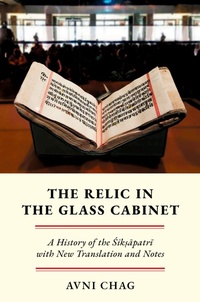
The Relic in the Glass Cabinet
A History of the Sik?apatri with New Translation and Notes
Will be published approx. on 25. August 2026
Book
Hardback
320 pages
978-0-19-782763-5 (ISBN)
Description
The Shikshapatri (1826) is a scripture presented as a letter to devotees from Swaminarayan (1781-1830), the founder and principal deity of the eponymous Swaminarayan tradition. Designated by millions as a revelatory scripture down to the belief of its divine authorship, the text is treated as a succinct and authoritative index of Swaminarayan beliefs and practices. Early manuscripts of the text are so cherished that some, like the one enclosed in a glass cabinet in the Oxford Bodleian libraries, are treated as relics.
For the first time, Avni Chag's thorough text and historical analysis of the Shikshapatri adds nuance to the story of its canonization. Featuring the first English translation of an earlier, shorter version of the text (1823), The Relic in the Glass Cabinet submits the text's authorship, intent, and historical development to critical scrutiny. Based on a comparative study of two Shikshapatri recensions, Chag demonstrates that the text did not originally align with the specific Vaisnava theological identity it now claims. Instead, doctrinal commitments were added after Swaminarayan's passing, fundamentally reshaping how the text, its author, and his tradition have been understood.
The Relic in the Glass Cabinet offers novel dimensions to existing scholarly interpretations of early Swaminarayan history, theology, and literature. It tells an untold story of the complex histories of textual production, exploring the interplay between historically contingent circumstances and inherited, albeit negotiated, religious ideas and practices, all at the formative moment of a tradition's inception in early nineteenth-century western India, present day Gujarat.
For the first time, Avni Chag's thorough text and historical analysis of the Shikshapatri adds nuance to the story of its canonization. Featuring the first English translation of an earlier, shorter version of the text (1823), The Relic in the Glass Cabinet submits the text's authorship, intent, and historical development to critical scrutiny. Based on a comparative study of two Shikshapatri recensions, Chag demonstrates that the text did not originally align with the specific Vaisnava theological identity it now claims. Instead, doctrinal commitments were added after Swaminarayan's passing, fundamentally reshaping how the text, its author, and his tradition have been understood.
The Relic in the Glass Cabinet offers novel dimensions to existing scholarly interpretations of early Swaminarayan history, theology, and literature. It tells an untold story of the complex histories of textual production, exploring the interplay between historically contingent circumstances and inherited, albeit negotiated, religious ideas and practices, all at the formative moment of a tradition's inception in early nineteenth-century western India, present day Gujarat.
More details
Series
Language
English
Place of publication
New York
United States
Target group
College/higher education
Product notice
sewn/stitched
Cloth over boards
Dimensions
Height: 236 mm
Width: 166 mm
Thickness: 32 mm
Weight
576 gr
ISBN-13
978-0-19-782763-5 (9780197827635)
Copyright in bibliographic data and cover images is held by Nielsen Book Services Limited or by the publishers or by their respective licensors: all rights reserved.
Schweitzer Classification
Person
Avni Chag is Assistant Professor of Religion in the Faculty of Social Sciences and Humanities at Vrije Universiteit Amsterdam. She works extensively with early modern and modern South Asian primary sources in Sanskrit, Hindi, and Gujarati, employing both archival and community-driven approaches to historical preservation. She has led curatorial and research projects at the British Library, the British Museum, and the Wellcome Collection, exploring how religious manuscripts and visual traditions shape historical narratives, religious authority, and cultural memory in South Asia.
Content
- List of Figures
- List of Tables
- Note on Terms, Transliteration, and Translation
- PART 1
- Introduction: Under Lock and Key
- Chapter 1: Unlocking the Shikshapatri's Composition History
- Chapter 2: Reflecting Vaisnavism
- Chapter 3: Colonial Reception
- Chapter 4: A Manual of Living
- Conclusion
- PART 2
- A Comparative Annotated Translation of the
- Shikshapatri's Two Recensions
- Introduction
- Translation
- PART 3
- A Comparative Edition of the Shikshapatri's Two Recensions
- Introduction
- Witnesses Used
- Edition
- Bibliography