

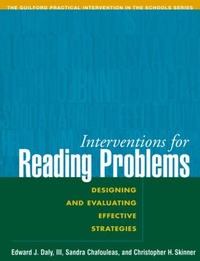
Interventions for Reading Problems
Designing and Evaluating Effective Strategies
1st Edition
Published on 23. December 2004
Book
Paperback/Softback
192 pages
978-1-59385-081-4 (ISBN)
Description
This comprehensive, user-friendly guide meets a growing need for school psychologists and other practitioners called on to work with struggling readers and their teachers. Presented are a systematic framework and a wealth of step-by-step strategies for targeting key areas of literacy development: phonological awareness, fluency, and comprehension. Particular emphasis is placed on scientifically based assessment and intervention practices that do not require major curricular change and can be applied with students of varying ages and ability levels. Featuring over 35 reproducible assessment and instructional tools--in a large-size format with lay-flat binding for ease of photocopying and use--the book also offers practical pointers for establishing an effective consultation relationship and documenting student progress over time.
This book is in The Guilford Practical Intervention in the Schools Series.
This book is in The Guilford Practical Intervention in the Schools Series.
Reviews / Votes
"This book is a 'must' for anyone working to help children acquire early to advanced literacy skills. It should be included as required reading in undergraduate- and graduate-level courses in linking academic assessment to intervention. Provided is the most useful, scientifically based discussion to date of how to assess children's performance levels in the context of the literacy instructional environment, apply empirically supported strategies for improving teaching and learning, and evaluate student responsiveness to types of literacy instruction. A wonderful and timely book." - Laurice M. Joseph, Ohio State University"An exciting and powerful book! The volume provides a clear and concise overview of how to help any child who is having difficulty learning to read, with explicit and systematic guidelines for designing and delivering curriculum-based interventions at all levels. Strategies for solving reading problems are scientifically based and presented in the context of the developmental process of acquiring reading skills. Emphasizing the importance of data-based decision making, this book is a unique, comprehensive, best-practice guide. It is an essential text for any course addressing reading difficulties within school psychology and teacher education programs." - Christine E. McCormick, Eastern Illinois University
"This practical guide draws on relevant and robust research on language and literacy development and intervention in order to provide a concise and competent handbook for instruction with readers experiencing difficulties. Bringing a breadth and depth of knowledge to their task, the authors outline a map of the field-a way of organizing the 'big picture' of literacy-and then assist the reader to flesh out the details of instruction and intervention." - Diane Beals, University of Tulsa This book is a 'must' for anyone working to help children acquire early to advanced literacy skills. It should be included as required reading in undergraduate- and graduate-level courses in linking academic assessment to intervention. Provided is the most useful, scientifically based discussion to date of how to assess children's performance levels in the context of the literacy instructional environment, apply empirically supported strategies for improving teaching and learning, and evaluate student responsiveness to types of literacy instruction. A wonderful and timely book. - Laurice M. Joseph, Ohio State University
An exciting and powerful book! The volume provides a clear and concise overview of how to help any child who is having difficulty learning to read, with explicit and systematic guidelines for designing and delivering curriculum-based interventions at all levels. Strategies for solving reading problems are scientifically based and presented in the context of the developmental process of acquiring reading skills. Emphasizing the importance of data-based decision making, this book is a unique, comprehensive, best-practice guide. It is an essential text for any course addressing reading difficulties within school psychology and teacher education programs. - Christine E. McCormick, Eastern Illinois University
This practical guide draws on relevant and robust research on language and literacy development and intervention in order to provide a concise and competent handbook for instruction with readers experiencing difficulties. Bringing a breadth and depth of knowledge to their task, the authors outline a map of the field-a way of organizing the 'big picture' of literacy-and then assist the reader to flesh out the details of instruction and intervention. - Diane Beals, University of Tulsa
More details
Series
Language
English
Place of publication
New York
United States
Target group
Postgraduate and Professional
Weight
486 gr
ISBN-13
978-1-59385-081-4 (9781593850814)
Copyright in bibliographic data and cover images is held by Nielsen Book Services Limited or by the publishers or by their respective licensors: all rights reserved.
Schweitzer Classification
Content
List of Tables, Figures, and Worksheets. Introduction and Overview. Where Do You Start as a Consultant? Selecting and Monitoring Early Literacy Interventions. Producing Measurable Increases in Reading Fluency. Reading Comprehension. Service Accountability: The Measure of Performance.