

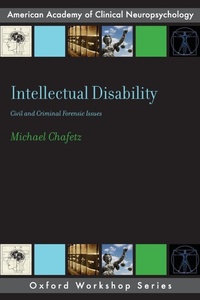
Intellectual Disability
Criminal and Civil Forensic Issues
Published on 14. May 2015
Book
Paperback/Softback
224 pages
978-0-19-999811-1 (ISBN)
Description
Courts recognize that those who are involved in medico-legal proceedings have a stake in the outcome of their psychological assessment, regardless of whether they are high- or low-functioning individuals. Accounting for the validity of the evaluation in low-functioning examinees is frequently made more difficult by impairment; when evaluating testimony from people with intellectual disability (ID), neuropsychologists and psychologists must acknowledge the differences between the medico-legal evaluation and the clinical evaluation. This book provides helpful guidelines for assessing validity in low-functioning claimants. It charts recent advances in psychological and neuropsychological assessment pertaining to civil and criminal proceedings while examining issues such as validity and motivation, assessments of disability, criminal and civil capacities, capital cases, Miranda waiver cases, and others.
In disability cases, the Social Security Administration has had a long-standing policy that prevents neuropsychologists and psychologists from using validity instruments--yet, using this book, an accurate and valid assessment can still be obtained. Evaluators who perform assessments in capital cases will find up-to-date discussions of the Flynn Effect, measurement of intellectual functioning, problems associated with the assessment of adaptive functioning, and the challenge of validity assessment. Miranda waiver evaluations for those with low IQ are discussed concerning issues of capacity measurement, including reading and language analysis for the Miranda advisement in the particular jurisdiction in question. Testamentary capacity is discussed at length, showing how understanding of the legal standard is helpful in guiding the examination. Competency to stand trial, or adjudicative competence, is the main topic in the area of criminal competencies, with exploration of the Dusky standard and the various tests used to evaluate this competence, focusing on individuals with ID.
In disability cases, the Social Security Administration has had a long-standing policy that prevents neuropsychologists and psychologists from using validity instruments--yet, using this book, an accurate and valid assessment can still be obtained. Evaluators who perform assessments in capital cases will find up-to-date discussions of the Flynn Effect, measurement of intellectual functioning, problems associated with the assessment of adaptive functioning, and the challenge of validity assessment. Miranda waiver evaluations for those with low IQ are discussed concerning issues of capacity measurement, including reading and language analysis for the Miranda advisement in the particular jurisdiction in question. Testamentary capacity is discussed at length, showing how understanding of the legal standard is helpful in guiding the examination. Competency to stand trial, or adjudicative competence, is the main topic in the area of criminal competencies, with exploration of the Dusky standard and the various tests used to evaluate this competence, focusing on individuals with ID.
Reviews / Votes
An excellent offering that continues in the rich tradition of the AACN Workshop Series. Readers will find the information illuminating for clinical practice, helpful for avoiding regulatory or forensic pitfalls, and easy to reference in a book * Doody's notes *More details
Series
Language
English
Place of publication
New York
United States
Target group
College/higher education
Professional and scholarly
Illustrations
With illustrations
Dimensions
Height: 234 mm
Width: 156 mm
Thickness: 12 mm
Weight
348 gr
ISBN-13
978-0-19-999811-1 (9780199998111)
Copyright in bibliographic data and cover images is held by Nielsen Book Services Limited or by the publishers or by their respective licensors: all rights reserved.
Schweitzer Classification
Other editions
Additional editions
E-Book
03/2015
1st Edition
OUP eBook
€45.99
Available for download
E-Book
03/2015
1st Edition
OUP eBook
€45.99
Available for download
Person
Dr. Michael Chafetz is a Board Certified Clinical Neuropsychologist whose research focuses on the validity of Social Security Disability examinations. His work has been instrumental in changing the nature of the psychological consultative examination for Social Security disability, particularly involving the analysis of validity in low-IQ examinations. Dr. Chafetz was recognized as the Distinguished Psychologist by the Louisiana Psychological Association in 2012, and received the Courage Community Award by the Psychology Times in January, 2013.
Content
Preface ; Chapter 1: Introduction and History ; Chapter 2: Through the Lens of Validity ; Chapter 3: Social Security Disability ; Chapter 4: Capital Cases ; Chapter 5: Miranda Waiver Capacity ; Chapter 6: Other Competencies/Capacities - Civil and Criminal