

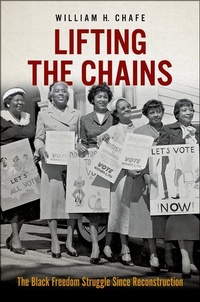
Lifting the Chains
The Black Freedom Struggle Since Reconstruction
Published on 29. November 2023
Book
Hardback
368 pages
978-0-19-761645-1 (ISBN)
Description
All-Black institutions and local community groups have been at the forefront of the freedom struggle since the beginning.
Lifting the Chains is a history of the Black experience in America since the Civil War, told by one of our most
distinguished historians of modern America, William H. Chafe. He argues that, despite the wishes and arguments of many whites to the contrary, the struggle for freedom has been carried out primarily by Black Americans, with only occasional assistance from whites. Chafe highlights the role of all-black institutions--especially the churches, lodges, local gangs, neighborhood women's groups, and the Black college clubs that gathered at local pool halls--that talked up the issues, examined different courses of action, and then put their lives on the line to make change happen.
The book draws heavily on the tremendous oral history archives at Duke that Chafe founded and nurtured, much of which is previously unpublished. The the archives are now a collection of more than 3,600 oral histories tracing the evolution of Black activism, managed under the auspices of the Duke Center for Documentary History. Taking its title from a phrase coined by W.E.B. DuBois in 1903, the project uncovered the degree to which Blacks never gave up the struggle against racism, even during the height of Jim Crow segregation from 1900 to 1950. Chafe draws on these valuable resources to build this definitive history of African American activism, a history that can and should inform Black Lives Matter and other contemporary social justice movements.
Lifting the Chains is a history of the Black experience in America since the Civil War, told by one of our most
distinguished historians of modern America, William H. Chafe. He argues that, despite the wishes and arguments of many whites to the contrary, the struggle for freedom has been carried out primarily by Black Americans, with only occasional assistance from whites. Chafe highlights the role of all-black institutions--especially the churches, lodges, local gangs, neighborhood women's groups, and the Black college clubs that gathered at local pool halls--that talked up the issues, examined different courses of action, and then put their lives on the line to make change happen.
The book draws heavily on the tremendous oral history archives at Duke that Chafe founded and nurtured, much of which is previously unpublished. The the archives are now a collection of more than 3,600 oral histories tracing the evolution of Black activism, managed under the auspices of the Duke Center for Documentary History. Taking its title from a phrase coined by W.E.B. DuBois in 1903, the project uncovered the degree to which Blacks never gave up the struggle against racism, even during the height of Jim Crow segregation from 1900 to 1950. Chafe draws on these valuable resources to build this definitive history of African American activism, a history that can and should inform Black Lives Matter and other contemporary social justice movements.
Reviews / Votes
Bill Chafe's Lifting the Chains tells the powerful story of men, women, and children who wrote themselves into history, battled the contradictions of slavery and freedom, strove to end the hurts of racism, and in the process made the nation better. A fitting addition to a long and distinguished career. * Earl Lewis, Thomas C. Holt Distinguished University Professor of History, Afroamerican and African Studies and Public Policy, University of Michigan * Written by one of the nation's most distinguished scholars, Lifting the Chains is a vivid, highly readable yet also well researched survey of African American history in the post-slavery era. * Clayborne Carson, Martin Luther King Jr., Centennial Professor of History, Emeritus, Stanford University * The distinguished historian William Chafe has offered another gem to the growing body of knowledge on Black-led freedom campaigns, and the importance of Black leadership in establishing liberatory institutions. By making unrelenting demands on an often unresponsive government, and by building and creating independent projects, Black historical actors have been in the forefront of the fight to make 'freedom' real and tangible for all. Lifting the Chains eloquently reminds us of these important truths, and their relevance to contemporary struggles for Black freedom. * Barbara Ransby, John D. MacArthur University Chair and Distinguished Professor of Black Studies and History, University of Illinois at Chicago, author of Ella Baker and the Black Freedom Movement and Making All Black Lives Matter * Recommended. All readers. * Choice * Key strengths of the book include its demonstration of continuities from the nineteenth century to the present, and the intersection of political, economic, and social issues in the ongoing struggle for equality, shown through the centring of Black voices. Microhistorical details - individual, familial, and community experiences, heartening successes tempered by accounts of violence and oppression - elevate the book from familiar retelling to a timely new synthesis of unique and irreplaceable archives. Ultimately, Lifting the Chains paints an invaluable picture of a people who, though consistently victimised, have rarely, if ever, allowed themselves to be victims. * Eleanor Morecrof, Studies in Oral History *More details
Language
English
Place of publication
New York
United States
Target group
Professional and scholarly
Product notice
sewn/stitched
Cloth over boards
Illustrations
10 b/w halftones
Dimensions
Height: 243 mm
Width: 169 mm
Thickness: 30 mm
Weight
682 gr
ISBN-13
978-0-19-761645-1 (9780197616451)
Copyright in bibliographic data and cover images is held by Nielsen Book Services Limited or by the publishers or by their respective licensors: all rights reserved.
Schweitzer Classification
Other editions
Additional editions
E-Book
08/2023
OUP eBook
€25.99
Available for download
E-Book
08/2023
OUP eBook
€25.99
Available for download
Person
William H. Chafe graduated from Harvard College in 1962, received his Ph.D from Columbia University in 1971, and has taught at Duke Universitr for the past fifty years. Former Chair of the History Department and Dean of the Faculty of Arts and Sciences, he has published 13 books, been selected as president of the Organization of American Historians, is a Phi Beta Kappa Fellow, and has been awarded two Fulbright Awards. He is married to Lorna Chafe, and they have two children, Christopher and Jennifer.
Content
Chapter One: Present at the Creation: 1863-1877
Chapter Two: The Twilight Years, 1877-1898
Chapter Three: Family, Church and Community
Chapter Four: Education and Work
Chapter Five: Politics and Resistance: From 1900 to World War I
Chapter Six: World War I
Chapter Seven: The 1920s and 30s
Chapter Eight: The Persistence of Struggle, the Beginning of Hope: African-Americans and World War II
Chapter Nine: Postwar Protest
Chapter Ten: A New Language of Protest, a New Generation of Activists
Chapter Eleven: Winning the Right to Vote, Coming Apart in the Process
Chapter Twelve: Triumph and Division
Chapter Thirteen: The Struggle Continues
Chapter Fourteen: Conclusion
Chapter Two: The Twilight Years, 1877-1898
Chapter Three: Family, Church and Community
Chapter Four: Education and Work
Chapter Five: Politics and Resistance: From 1900 to World War I
Chapter Six: World War I
Chapter Seven: The 1920s and 30s
Chapter Eight: The Persistence of Struggle, the Beginning of Hope: African-Americans and World War II
Chapter Nine: Postwar Protest
Chapter Ten: A New Language of Protest, a New Generation of Activists
Chapter Eleven: Winning the Right to Vote, Coming Apart in the Process
Chapter Twelve: Triumph and Division
Chapter Thirteen: The Struggle Continues
Chapter Fourteen: Conclusion