


Hydraulics in Civil and Environmental Engineering
5th Edition
Published on 19. February 2013
Book
Paperback/Softback
648 pages
978-0-415-67245-0 (ISBN)
Description
Now in its fifth edition, Hydraulics in Civil and Environmental Engineering combines thorough coverage of the basic principles of civil engineering hydraulics with wide-ranging treatment of practical, real-world applications.
This classic text is carefully structured into two parts to address principles before moving on to more advanced topics. The first part focuses on fundamentals, including hydrostatics, hydrodynamics, pipe and open channel flow, wave theory, physical modeling, hydrology, and sediment transport. The second part illustrates the engineering applications of these fundamental principles to pipeline system design; hydraulic structures; and river, canal, and coastal engineering-including up-to-date environmental implications. A chapter on computational hydraulics demonstrates the application of computational simulation techniques to modern design in a variety of contexts.
What's New in This Edition
Substantive revisions of the chapters on hydraulic machines, flood hydrology, and computational modeling
New material added to the chapters on hydrostatics, principles of fluid flow, behavior of real fluids, open channel flow, pressure surge in pipelines, wave theory, sediment transport, river engineering, and coastal engineering
The latest recommendations on climate change predictions, impacts, and adaptation measures
Updated references
Hydraulics in Civil and Environmental Engineering, Fifth Edition is an essential resource for students and practitioners of civil, environmental, and public health engineering and associated disciplines. It is comprehensive, fully illustrated, and contains many worked examples. Spreadsheets and useful links to other web pages are available on an accompanying website, and a solutions manual is available to lecturers.
This classic text is carefully structured into two parts to address principles before moving on to more advanced topics. The first part focuses on fundamentals, including hydrostatics, hydrodynamics, pipe and open channel flow, wave theory, physical modeling, hydrology, and sediment transport. The second part illustrates the engineering applications of these fundamental principles to pipeline system design; hydraulic structures; and river, canal, and coastal engineering-including up-to-date environmental implications. A chapter on computational hydraulics demonstrates the application of computational simulation techniques to modern design in a variety of contexts.
What's New in This Edition
Substantive revisions of the chapters on hydraulic machines, flood hydrology, and computational modeling
New material added to the chapters on hydrostatics, principles of fluid flow, behavior of real fluids, open channel flow, pressure surge in pipelines, wave theory, sediment transport, river engineering, and coastal engineering
The latest recommendations on climate change predictions, impacts, and adaptation measures
Updated references
Hydraulics in Civil and Environmental Engineering, Fifth Edition is an essential resource for students and practitioners of civil, environmental, and public health engineering and associated disciplines. It is comprehensive, fully illustrated, and contains many worked examples. Spreadsheets and useful links to other web pages are available on an accompanying website, and a solutions manual is available to lecturers.
Reviews / Votes
"This book is an excellent standalone reference for education in the field of hydraulics and fundamentals of fluid mechanics. The book gives theoretical considerations and encourages students to learn by inspiring them with insights into the real world of engineering. The book is also useful for practical engineers, providing a good overview of realistic hydraulic engineering problems and their solutions."-Miroslav Marence, Proceedings of the Institution of Civil Engineers: Water Management
"Outstanding coverage of practical engineering applications that is accessible to students."
-John W Davies, Coventry University, UK
"I have found this book to be an ideal standalone reference to the teaching of hydraulics and basic fluid mechanics, as part of engineering undergraduate degree schemes. It is useful, also, in graduate study and applications. "Part II" provides a good overview of hydraulic engineering applications, which does a great job in motivating students to learn and inspiring them with insights of the engineering world."
-Dr William Bonino Rauen, Universidade Positivo, Brazil
More details
Edition
5th New edition
Language
English
Place of publication
London
United Kingdom
Publishing group
Taylor & Francis Ltd
Target group
College/higher education
Undergraduates and graduate students in civil engineering and environmental engineering, particularly courses in hydraulic engineering and coastal engineering.
Edition type
New edition
Illustrations
238 s/w Abbildungen, 38 s/w Tabellen
Approx 1300 equations; 38 Tables, black and white; 238 Illustrations, black and white
Dimensions
Height: 254 mm
Width: 178 mm
Weight
1225 gr
ISBN-13
978-0-415-67245-0 (9780415672450)
Copyright in bibliographic data and cover images is held by Nielsen Book Services Limited or by the publishers or by their respective licensors: all rights reserved.
Schweitzer Classification
Other editions
New editions
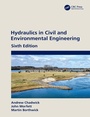
Andrew Chadwick | John Morfett | Martin Borthwick
Hydraulics in Civil and Environmental Engineering
Book
06/2021
6th Edition
CRC Press
€152.00
Shipment within 15-20 days
Additional editions

Andrew Chadwick | John Morfett | Martin Borthwick
Hydraulics in Civil and Environmental Engineering
Book
03/2013
5th Edition
CRC Press
€190.15
The article will not be published
Previous edition
Andrew Chadwick | John Morfett | Martin Borthwick
Hydraulics in Civil and Environmental Engineering
Book
05/2004
4th Edition
Spon Press
€85.60
Article exhausted; check for reprint
Persons
Andrew Chadwick is a visiting professor at the University of Plymouth, UK, and former Professor of Coastal Engineering at the University of the West Indies, Trinidad.
John Morfett was head of hydraulics research and taught at the University of Brighton, UK.
Martin Borthwick is a senior lecturer at the University of Plymouth, UK, and teaches hydraulics, hydrology, and water resources.
John Morfett was head of hydraulics research and taught at the University of Brighton, UK.
Martin Borthwick is a senior lecturer at the University of Plymouth, UK, and teaches hydraulics, hydrology, and water resources.
Content
Short History of Hydraulics
Introductory Notes
Principal Symbols
Principles and Basic Applications
Hydrostatics
Principles of Fluid Flow
Behaviour of Real Fluids
Flow in Pipes and Closed Conduits
Open Channel Flow
Pressure Surge in Pipelines
Hydraulic Machines
Wave Theory
Sediment Transport
Flood Hydrology
Dimensional Analysis and the Theory of Physical Models
Aspects of Hydraulic Engineering
Pipeline Systems
Hydraulic Structures
Computational Hydraulics
River and Canal Engineering
Coastal Engineering
Postscript
Appendix: Moments of Area
Index
Introductory Notes
Principal Symbols
Principles and Basic Applications
Hydrostatics
Principles of Fluid Flow
Behaviour of Real Fluids
Flow in Pipes and Closed Conduits
Open Channel Flow
Pressure Surge in Pipelines
Hydraulic Machines
Wave Theory
Sediment Transport
Flood Hydrology
Dimensional Analysis and the Theory of Physical Models
Aspects of Hydraulic Engineering
Pipeline Systems
Hydraulic Structures
Computational Hydraulics
River and Canal Engineering
Coastal Engineering
Postscript
Appendix: Moments of Area
Index