

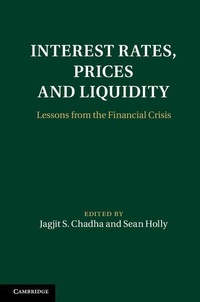
Interest Rates, Prices and Liquidity
Lessons from the Financial Crisis
Published on 27. October 2011
Book
Hardback
292 pages
978-1-107-01473-2 (ISBN)
Description
Many of the assumptions that underpin mainstream macroeconomic models have been challenged as a result of the traumatic events of the recent financial crisis. Thus, until recently, it was widely agreed that although the stock of money had a role to play, in practice it could be ignored as long as we used short-term nominal interest rates as the instrument of policy because money and other credit markets would clear at the given policy rate. However, very early on in the financial crisis interest rates effectively hit zero percent and so central banks had to resort to a wholly new set of largely untested instruments to restore order, including quantitative easing and the purchase of toxic financial assets. This book brings together contributions from economists working in academia, financial markets and central banks to assess the effectiveness of these policy instruments and explore what lessons have so far been learned.
Reviews / Votes
'Many failings were revealed by the on-going financial crisis. The reputations of bankers and regulators have been shredded. But the reputation of academic macro-economists also joined them in the dust-bin. In this important new book Chadha and Holly take stock of the lessons of the financial crisis and the unconventional measures that have had to be adopted, in order to bring academic analysis to bear on the extraordinary events of recent years, and to restore dignity to our profession.' Charles Goodhart , Emeritus Professor of Banking and Finance, London School of Economics and Political Science 'A wide-ranging examination of central bank actions during the financial crisis using state-of-the-art methods.' Glenn Rudebusch, Executive Vice President and Director of Research, Federal Reserve Bank of San Francisco 'This is an excellent first installment in a series of books that examines the implications of the financial crisis for the field of macroeconomics. The various chapters, written by a blend of top academics and central bank economists who are in the frontline, cover both the theory and the practice of how monetary policy ought to respond to financial crises.' Frank Smets, Director General of the Directorate General Research, European Central BankMore details
Series
Language
English
Place of publication
Cambridge
United Kingdom
Target group
Professional and scholarly
Illustrations
20 Tables, black and white; 55 Line drawings, unspecified
Dimensions
Height: 235 mm
Width: 157 mm
Thickness: 20 mm
Weight
580 gr
ISBN-13
978-1-107-01473-2 (9781107014732)
Copyright in bibliographic data and cover images is held by Nielsen Book Services Limited or by the publishers or by their respective licensors: all rights reserved.
Schweitzer Classification
Other editions
Additional editions
Book
01/2015
Cambridge University Press
€57.70
Shipment within 15-20 days
E-Book
11/2011
1st Edition
Cambridge University Press
€36.99
Available for download
E-Book
10/2011
Cambridge University Press
€31.99
Available for download
Persons
Jagjit S. Chadha is Professor of Economics, University of Kent. Sean Holly is Professional Fellow at Fitzwilliam College and Director of Research at the Faculty of Economics, University of Cambridge.
Content
1. New instruments of monetary policy Jagjit S. Chadha and Sean Holly; 2. Liquidity and monetary policy Douglas Gale; 3. Interest rate policies and the stability of banking systems Hans Gersbach and Jan Wenzelberger; 4. Handling liquidity shocks: QE and Tobin's q Marcus Miller and John Driffill; 5. Asset purchase policies and portfolio effects: a DSGE analysis Richard Harrison; 6. Financial intermediaries in an estimated DSGE model for the UK Stefania Villa and Jing Yang; 7. Unconventional monetary policy, central bank balance sheets and long term forward rates Sharon Kozicki, Eric Santor and Lena Suchanek; 8. Non-standard monetary policy measures and monetary developments Domenico Giannone, Michele Lenza, Huw Pill and Lucrezia Reichlin; 9. Quantitative easing: one year on Spencer Dale; 10. What saved the banks: unconventional monetary or fiscal policy? Mike Wickens; 11. Non-conventional monetary policies: three views from the DSGE literature Evren Caglar, Jack Meaning, Alex Waters, James Warren and Jagjit Chadha.