

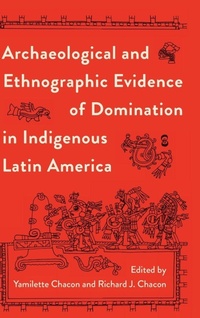
Archaeological and Ethnographic Evidence of Domination in Indigenous Latin America
Published on 31. July 2023
Book
Hardback
262 pages
978-0-8130-6970-8 (ISBN)
Description
New data and interpretations that shed light on the nature of power relations in prehistoric and contemporary Indigenous societies
This volume explores the nature of power relations and social control in Indigenous societies of Latin America. Its chapters focus on instances of domination in different contexts as reflected in archaeological, osteological, and ethnohistorical records, beginning with prehistoric case studies to examples from the ethnographic present.
Ranging from the development of nautical and lacustrine warfare technology in pre-contact Mesoamerica to the psychological functions of domestic violence among contemporary Amazonian peoples, these investigations shed light on how leaders often use violence or the threat of violence to advance their influence. The essays show that while social control can be overt, it may also be veiled in the form of monumental architecture, fortresses or pukara, or rituals that signal to friends and foes alike the power of those in control. Contributors challenge many widely accepted conceptions of violence, warfare, and domination by presenting new evidence, and they also offer novel interpretations of power relations at the domestic, local, and regional spheres.
Encompassing societies from tribal to state levels of sociopolitical complexity, the studies in this volume present different dimensions of conflict and power found among the prehistoric and contemporary Indigenous peoples of Latin America.
This volume explores the nature of power relations and social control in Indigenous societies of Latin America. Its chapters focus on instances of domination in different contexts as reflected in archaeological, osteological, and ethnohistorical records, beginning with prehistoric case studies to examples from the ethnographic present.
Ranging from the development of nautical and lacustrine warfare technology in pre-contact Mesoamerica to the psychological functions of domestic violence among contemporary Amazonian peoples, these investigations shed light on how leaders often use violence or the threat of violence to advance their influence. The essays show that while social control can be overt, it may also be veiled in the form of monumental architecture, fortresses or pukara, or rituals that signal to friends and foes alike the power of those in control. Contributors challenge many widely accepted conceptions of violence, warfare, and domination by presenting new evidence, and they also offer novel interpretations of power relations at the domestic, local, and regional spheres.
Encompassing societies from tribal to state levels of sociopolitical complexity, the studies in this volume present different dimensions of conflict and power found among the prehistoric and contemporary Indigenous peoples of Latin America.
More details
Language
English
Place of publication
Florida
United States
Target group
Professional and scholarly
Product notice
Paper over boards
Illustrations
67 b&w illus, 5 tables
Dimensions
Height: 235 mm
Width: 157 mm
Thickness: 19 mm
Weight
535 gr
ISBN-13
978-0-8130-6970-8 (9780813069708)
Copyright in bibliographic data and cover images is held by Nielsen Book Services Limited or by the publishers or by their respective licensors: all rights reserved.
Schweitzer Classification
Other editions
Additional editions
Yamilette Chacon | Richard J. Chacon
Archaeological and Ethnographic Evidence of Domination in Indigenous Latin America
E-Book
07/2023
University Press of Florida
€178.99
Available for download
Persons
Yamilette Chacon is a lecturer in sociology at James Madison University.
Richard J. Chacon, professor of anthropology at Winthrop University and is coeditor of Feast, Famine or Fighting? Multiple Pathways to Social Complexity.
Richard J. Chacon, professor of anthropology at Winthrop University and is coeditor of Feast, Famine or Fighting? Multiple Pathways to Social Complexity.