

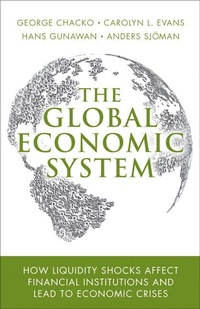
Global Economic System, The
How Liquidity Shocks Affect Financial Institutions and Lead to Economic Crises
Will be published approx. on 19. January 2015
Book
Paperback/Softback
288 pages
978-0-13-411971-7 (ISBN)
Description
Written for financial professionals, the authors thoroughly explain the modern global credit system; the roles of banks, hedge funds, insurers, central banks, mortgage markets, and other participants; and the credit-related instruments they rely on. In particular, the authors illuminate the crucial importance of liquidity, and show why liquidity failures have been the key cause of all major market crashes for the past several decades. The Global Financial System thoroughly examines economic environments in which slow de-leveraging leads to prolonged sluggish growth, and compares today's environment to other periods of deleveraging, such as the Great Depression and the Japanese economic meltdown of the '90s and '00s. It predicts potential pathways for the current crisis, and offers essential guidance to both policymakers and investment decision-makers.
More details
Language
English
Place of publication
Boston
United States
Publishing group
Pearson Education (US)
Target group
Professional and scholarly
Product notice
Paperback (trade)
Unsewn / adhesive bound
Dimensions
Height: 210 mm
Width: 136 mm
Thickness: 15 mm
Weight
322 gr
ISBN-13
978-0-13-411971-7 (9780134119717)
Schweitzer Classification
Other editions
Additional editions
George Chacko | Carolyn L. Evans | Hans Gunawan
Global Economic System, The
How Liquidity Shocks Affect Financial Institutions and Lead to Economic Crises
E-Book
06/2011
1st Edition
Pearson Education
€15.49
Available for download
Persons
George Chacko is Associate Professor of Finance at Santa Clara University's Leavey School of Business and formerly Associate Professor at Harvard Business School, Managing Director at State Street Bank, and Chief Investment Officer at Auda Alternative Investments. He holds a Ph.D. and M.A. in Business Economics from Harvard University and a B.S. from MIT.
Carolyn L. Evans is Associate Professor of Economics at Santa Clara University. She has worked at the Federal Reserve Bank of New York, the Federal Reserve Board of Governors, and the White House Council of Economic Advisers. She holds a Ph.D. and M.A. in Economics and a B.A. in East Asian Languages and Civilizations, all from Harvard University.
Hans Gunawan is Senior Financial Analyst at Skyline Solar and formerly a manager of financial planning and analysis at JAPFA. He holds an MBA from Santa Clara University and a B.S. from University of California, Berkeley.
Anders Sjoeman is Vice President of Communications at Voddler. He was formerly Senior Researcher for Harvard Business School's Paris-based Europe Research Center. He holds an M.Sc. from the Stockholm School of Economics.
Carolyn L. Evans is Associate Professor of Economics at Santa Clara University. She has worked at the Federal Reserve Bank of New York, the Federal Reserve Board of Governors, and the White House Council of Economic Advisers. She holds a Ph.D. and M.A. in Economics and a B.A. in East Asian Languages and Civilizations, all from Harvard University.
Hans Gunawan is Senior Financial Analyst at Skyline Solar and formerly a manager of financial planning and analysis at JAPFA. He holds an MBA from Santa Clara University and a B.S. from University of California, Berkeley.
Anders Sjoeman is Vice President of Communications at Voddler. He was formerly Senior Researcher for Harvard Business School's Paris-based Europe Research Center. He holds an M.Sc. from the Stockholm School of Economics.
Content
Chapter 1: Motivation for Understanding Liquidity Risk 1
Chapter 2: Liquidity Risk: Concepts 11
Chapter 3: The Great Depression 59
Chapter 4: Japan's Lost Decade 105
Chapter 5: The Great Recession 173
Chapter 6: Conclusion 247
Index 261
Chapter 2: Liquidity Risk: Concepts 11
Chapter 3: The Great Depression 59
Chapter 4: Japan's Lost Decade 105
Chapter 5: The Great Recession 173
Chapter 6: Conclusion 247
Index 261