

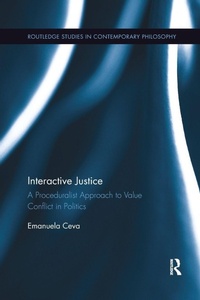
Interactive Justice
A Proceduralist Approach to Value Conflict in Politics
1st Edition
Published on 10. December 2019
Book
Paperback/Softback
196 pages
978-0-367-87856-6 (ISBN)
Description
Contemporary societies are riddled with moral disputes caused by conflicts between value claims competing for the regulation of matters of public concern. This familiar state of affairs is relevant for one of the most important debates within liberal political thought: should institutions seek to realize justice or peace? Justice-driven philosophers characterize the normative conditions for the resolution of value conflicts through the establishment of a moral consensus on an order of priority between competing value claims. Peace-driven philosophers have concentrated, perhaps more modestly, on the characterization of the ways in which competing value claims should be balanced, with a view to establishing a modus vivendi aimed at containing the conflict.
Interactive Justice addresses an important question related to this debate: on what terms should the parties interact during their conflict for their interaction to be morally acceptable to them? Although largely unexplored by political philosophers, this is a main area of concern in conflict management. Building on a proceduralist interpretation of "relational" concerns of justice, the author develops a liberal normative theory of interactive justice for the management of value conflict in politics grounded in the fundamental values of fair hearing and procedural equality. This book innovatively builds a bridge between works in political philosophy and peace studies to propose a fresh lens through which to view the normative responses liberal institutions ought to give to value conflict in politics, and moves beyond the apparent dichotomy between pursuing end-state justice through conflict resolution or peace through conflict containment.
Interactive Justice addresses an important question related to this debate: on what terms should the parties interact during their conflict for their interaction to be morally acceptable to them? Although largely unexplored by political philosophers, this is a main area of concern in conflict management. Building on a proceduralist interpretation of "relational" concerns of justice, the author develops a liberal normative theory of interactive justice for the management of value conflict in politics grounded in the fundamental values of fair hearing and procedural equality. This book innovatively builds a bridge between works in political philosophy and peace studies to propose a fresh lens through which to view the normative responses liberal institutions ought to give to value conflict in politics, and moves beyond the apparent dichotomy between pursuing end-state justice through conflict resolution or peace through conflict containment.
Reviews / Votes
"Ceva offers a unique and needed contribution to discussions of justice as well as to the existing literature on peace studies...[She] succeeds in showing the plausibility of ways to handle conflicts that move us away from common and simple attempts to defeat opponents, that the methods we use can be just as important morally as the outcomes we reach, and that value conflicts run deeper than the political disputes they are symptoms of (and therefore require different kinds of considerations). Furthermore, her command of and deep engagement with a broad and diverse body of relevant literature is impressive."-Notre Dame Philosophical Reviews"Ceva's book is short and concise, her writing style is clear and the topic is interesting. Interactive Justice provides a welcome new philosophical perspective on value conflicts in contemporary democracies, asking us to recognize the justice dimension in conflict management."-Ethical Theory and Moral Practice
More details
Series
Language
English
Place of publication
London
United Kingdom
Publishing group
Taylor & Francis Ltd
Target group
College/higher education
Postgraduate and Undergraduate
Dimensions
Height: 229 mm
Width: 152 mm
Thickness: 12 mm
Weight
315 gr
ISBN-13
978-0-367-87856-6 (9780367878566)
Copyright in bibliographic data and cover images is held by Nielsen Book Services Limited or by the publishers or by their respective licensors: all rights reserved.
Schweitzer Classification
Other editions
Additional editions
Book
05/2016
1st Edition
Routledge
€231.20
Shipment within 10-20 days
E-Book
05/2016
Routledge
€63.49
Available for download
E-Book
05/2016
Routledge
€63.49
Available for download
Person
Emanuela Ceva is Professor of Political Theory at the University of Geneva. She is the author of Is Whistleblowing a Duty? (2018). She has held visiting positions at Harvard, Leuven, Oxford, St. Andrews, Montreal. She works on value conflict, democracy, and corruption. Recent articles have appeared in Journal of Political Philosophy, Social Philosophy and Policy, Philosophy Compass, and Politics, Philosophy & Economics.
Content
Introduction
Part I: Justice and Value Conflict in Politics
1. Value Conflict in Politics as a Circumstance of Interactive Justice
2. Normative Responses to Value Conflict: Resolving, Containing, Managing
Part II: Conflict Management and the Procedural Theorization about Justice
3. Procedural and Outcome Theories of Justice
4. Proceduralism and the Management of Value Conflict
Part III: Interactive Justice for the Management of Value Conflict: A Procedural Conception
5. Just Conflict Management in Theory: Egalitarian Procedures of Adversary Argumentation
6. Just Conflict Management in Practice: The Role of Understanding
Conclusion
Part I: Justice and Value Conflict in Politics
1. Value Conflict in Politics as a Circumstance of Interactive Justice
2. Normative Responses to Value Conflict: Resolving, Containing, Managing
Part II: Conflict Management and the Procedural Theorization about Justice
3. Procedural and Outcome Theories of Justice
4. Proceduralism and the Management of Value Conflict
Part III: Interactive Justice for the Management of Value Conflict: A Procedural Conception
5. Just Conflict Management in Theory: Egalitarian Procedures of Adversary Argumentation
6. Just Conflict Management in Practice: The Role of Understanding
Conclusion