

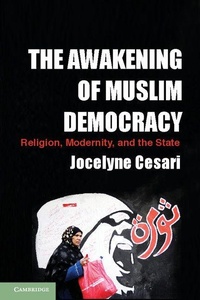
The Awakening of Muslim Democracy
Religion, Modernity, and the State
Published on 21. April 2014
Book
Paperback/Softback
440 pages
978-1-107-66482-1 (ISBN)
Description
Why and how did Islam become such a political force in so many Muslim-majority countries? In this book, Jocelyne Cesari investigates the relationship between modernization, politics, and Islam in Muslim-majority countries such as Egypt, Iraq, Pakistan, Tunisia, and Turkey - countries that were founded by secular rulers and have since undergone secularized politics. Cesari argues that nation-building processes in these states have not created liberal democracies in the Western mold, but have instead spurred the politicization of Islam by turning it into a modern national ideology. Looking closely at examples of Islamic dominance in political modernization, this study provides a unique overview of the historical and political developments from the end of World War II to the Arab Spring that have made Islam the dominant force in the construction of the modern states, and discusses Islam's impact on emerging democracies in the contemporary Middle East.
Reviews / Votes
'An indispensable guide to the understanding of political Islam by one of Europe's leading analysts. Theoretically sophisticated, this book answers all the big questions.' Roger Owen, Emeritus Professor, Harvard University, Massachusetts 'Jocelyne Cesari not only combines historically rich analysis with admirable geographical breadth and coverage of recent events, she also forces us to view familiar questions through some very new lenses. Rather than approaching political Islam through the prism of social movements and opposition, her starting point is the state and formal institutions. But that is not always her ending point: she shows how and why democracy - if it emerges - is often likely to take some unfamiliar forms in political systems in which political Islam is deeply entrenched.' Nathan Brown, George Washington University 'One of the dominant scholarly assumptions regarding political Islam is the dichotomy between state and religion and between modernization and Islamization. The Awakening of Muslim Democracy turns this dominant hypothesis on its head. It argues that state actions and politics have played a key role in politicizing Islam and that the modernization of Muslim societies did not lead to privatization of religion but rather to the politicization of Islam. By bringing the state back and integrating an institutional approach with the social and individual levels, this book makes a critical contribution to our understanding of religion, modernity, and the state in the Muslim world.' Fawaz A. Gerges, London School of Economics and Political Science, and author of The New Middle East: Protest and Revolution in the Arab World (Cambridge University Press, 2014)More details
Language
English
Place of publication
Cambridge
United Kingdom
Target group
Professional and scholarly
College/higher education
Product notice
Paperback (trade)
Dimensions
Height: 229 mm
Width: 152 mm
Thickness: 24 mm
Weight
633 gr
ISBN-13
978-1-107-66482-1 (9781107664821)
Copyright in bibliographic data and cover images is held by Nielsen Book Services Limited or by the publishers or by their respective licensors: all rights reserved.
Schweitzer Classification
Other editions
Additional editions
Book
04/2014
Cambridge University Press
€130.30
Shipment within 15-20 days
E-Book
11/2013
1st Edition
Cambridge University Press
€26.49
Available for download
Person
Jocelyne Cesari is visiting professor of government and senior research fellow at the Berkley Center for Religion, Peace and World Affairs at Georgetown University.
Content
Part I. The Making of Islam as a Modern Religion: 1. Modernization and politicization of religion; 2. Nation-state building and the inclusion of Muslim polities within the Westphalian order; 3. Islam in the constitution; 4. Nationalization of Islamic institutions and clerics; 5. Islam in the legal system; 6. Teaching Islam in public schools; Part II. Islamism as the Central Political Force Pre- and Post-Arab Spring: 7. Political opposition through Islamic institutions; 8. Ideological strength of Islamist opposition; 9. From martyrs to rulers; Part III. The Disjunction of Democracy and Secularism - Lessons Learned from the Arab Spring: 10. The rise of unsecular democracies: the conundrum of religious freedom in Muslim democracies; 11. The way forward: the role of Islam in future democratizations; Conclusion. The tragedy of modernity.