

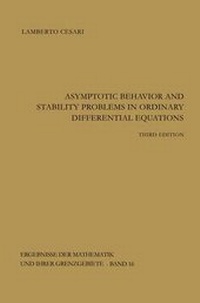
Asymptotic Behavior and Stability Problems in Ordinary Differential Equations
3rd Edition
Published on 1. January 1971
Book
Hardback
274 pages
978-3-540-05435-1 (ISBN)
Description
In the last few decades the theory of ordinary differential equations has grown rapidly under the action of forces which have been working both from within and without: from within, as a development and deepen- ing of the concepts and of the topological and analytical methods brought about by LYAPUNOV, POINCARE, BENDIXSON, and a few others at the turn of the century; from without, in the wake of the technological development, particularly in communications, servomechanisms, auto- matic controls, and electronics. The early research of the authors just mentioned lay in challenging problems of astronomy, but the line of thought thus produced found the most impressive applications in the new fields. The body of research now accumulated is overwhelming, and many books and reports have appeared on one or another of the multiple aspects of the new line of research which some authors call" qualitative theory of differential equations". The purpose of the present volume is to present many of the view- points and questions in a readable short report for which completeness is not claimed.
The bibliographical notes in each section are intended to be a guide to more detailed expositions and to the original papers. Some traditional topics such as the Sturm comparison theory have been omitted. Also excluded were all those papers, dealing with special differential equations motivated by and intended for the applications.
The bibliographical notes in each section are intended to be a guide to more detailed expositions and to the original papers. Some traditional topics such as the Sturm comparison theory have been omitted. Also excluded were all those papers, dealing with special differential equations motivated by and intended for the applications.
More details
Series
Edition
3rd Revised edition
Language
English
Place of publication
Berlin
Germany
Publishing group
Springer-Verlag Berlin and Heidelberg GmbH & Co. KG
Target group
Professional and scholarly
Edition type
Revised edition
Weight
570 gr
ISBN-13
978-3-540-05435-1 (9783540054351)
Copyright in bibliographic data and cover images is held by Nielsen Book Services Limited or by the publishers or by their respective licensors: all rights reserved.
Schweitzer Classification
Other editions
Additional editions
Book
04/2012
3rd Edition
Springer
€53.49
Shipment within 7-9 days
Previous edition
Book
01/1963
2nd Edition
Springer
€18.00
Article exhausted; check for reprint
Content
I. The concept of stability and systems with constant coefficients.- 1. Some remarks on the concept of stability.- 1.1. Existence, uniqueness, continuity.- 1.2. Stability in the sense of Lyapunov.- 1.3. Examples.- 1.4. Boundedness.- 1.5. Other types of requirements and comments.- 1.6. Stability of equilibrium.- 1.7. Variational systems.- 1.8. Orbital stability.- 1.9. Stability and change of coordinates.- 1.10. Stability of the m-th order in the sense of G. D. Birkhoff.- 1.11. A general remark and bibliographical notes.- 2. Linear systems with constant coefficients.- 2.1. Matrix notations.- 2.2. First applications to differential systems.- 2.3. Systems with constant coefficients.- 2.4. The Routh-Hurwitz and other criteria.- 2.5. Systems of order 2.- 2.6. Nonhomogeneous systems.- 2.7. Linear resonance.- 2.8. Servomechanisms.- 2.9. Bibliographical notes.- II. General linear systems.- 3. Linear systems with variable coefficients.- 3.1. A theorem of Lyapunov.- 3.2. A proof of (3.1.i).- 3.3. Boundedness of the solutions.- 3.4. Further conditions for boundedness.- 3.5. The reduction to L-diagonal form and an outline of the proofs of (3.4. iii) and (3.4. iv).- 3.6. Other conditions.- 3.7. Asymptotic behavior.- 3.8. Linear asymptotic equilibrium.- 3.9. Systems with variable coefficients.- 3.10. Matrix conditions.- 3.11. Nonhomogeneous systems.- 3.12. Lyapunov's type numbers.- 3.13. First application of type numbers to differential equations.- 3.14. Normal systems of solutions.- 3.15. Regular differential systems.- 3.16. A relation between type numbers and generalized characteristic roots.- 3.17. Bibliographical notes.- 4. Linear systems with periodic coefficients.- 4.1. Floquet theory.- 4.2. Some important applications.- 4.3. Further results concerning equation (4.2.1) and extensions.- 4.4. Mathieu equation.- 4.5. Small periodic perturbations.- 4.6. Bibliographical notes.- 5. The second order linear differential equation and generalizations.- 5.1. Oscillatory and non-oscillatory solutions.- 5.2. Fubini's theorems.- 5.3. Some transformations.- 5.4. Bellman's and Prodi's theorems.- 5.5. The case f(t) ? + ?.- 5.6. Solutions of class L2.- 5.7. Parseval relation for functions of class L2.- 5.8. Some properties of the spectrum S.- 5.9. Bibliographical notes.- III. Nonlinear systems.- 6. Some basic theorems on nonlinear systems and the first method of Lyapunov.- 6.1. General considerations.- 6.2. A theorem of existence and uniqueness.- 6.3. Periodic solutions of periodic systems.- 6.4. Periodic solutions of autonomous systems.- 6.5. A method of successive approximations and the first method of Lyapunov.- 6.6. Some results of Bylov and Vinograd.- 6.7. The theorems of Bellman.- 6.8. Invariant measure.- 6.9. Differential equations on a torus.- 6.10. Bibliographical notes.- 7. The second method of Lyapunov.- 7.1. The function V of Lyapunov.- 7.2. The theorems of Lyapunov.- 7.3. More recent results.- 7.4. A particular partial differential equation.- 7.5. Autonomous systems.- 7.6. Bibliographical notes.- 8. Analytical methods.- 8.1. Introductory considerations.- 8.2. Method of Lindstedt.- 8.3. Method of Poincare.- 8.4. Method of Krylov and Bogolyubov, and of van der Pol.- 8.5. A convergent method for periodic solutions and existence theorems.- 8.6. The perturbation method.- 8.7. The Lienard equation and its periodic solutions.- 8.8. An oscillation theorem for the equation (8.7.1).- 8.9. Existence of a periodic solution of equation (8.7.1).- 8.10. Nonlinear free oscillations.- 8.11. Invariant surfaces.- 8.12. Bibliographical notes.- 8.13. Nonlinear resonance.- 8.14. Prime movers.- 8.15. Relaxation oscillation.- 9. Analytical-topological methods.- 9.1. Poincare theory of the critical points.- 9.2. Poincare-Bendixson theory.- 9.3. Indices.- 9.4. A configuration concerning Lienard's equation.- 9.5. Another existence theorem for the Lienard equation.- 9.6. The method of the fixed point.- 9.7. The method of M. L. Cartwright.- 9.8. The method of T. Wazewski.- IV. Asymptotic developments.- 10. Asymtotic developments in general.- 10.1. Poincare's concept of asymptotic development.- 10.2. Ordinary, regular and irregular singular points.- 10.3. Asymptotic expansions for an irregular singular point of finite type.- 10.4. Asymptotic developments deduced from Taylor expansions.- 10.5. Equations containing a large parameter.- 10.6. Turning points and the theory of R. E. Langer.- 10.7. Singular perturbation.