

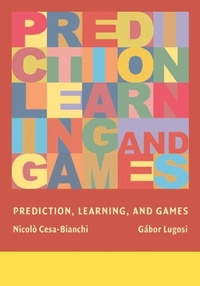
Prediction, Learning, and Games
Published on 13. March 2006
Book
Hardback
408 pages
978-0-521-84108-5 (ISBN)
Description
This important text and reference for researchers and students in machine learning, game theory, statistics and information theory offers a comprehensive treatment of the problem of predicting individual sequences. Unlike standard statistical approaches to forecasting, prediction of individual sequences does not impose any probabilistic assumption on the data-generating mechanism. Yet, prediction algorithms can be constructed that work well for all possible sequences, in the sense that their performance is always nearly as good as the best forecasting strategy in a given reference class. The central theme is the model of prediction using expert advice, a general framework within which many related problems can be cast and discussed. Repeated game playing, adaptive data compression, sequential investment in the stock market, sequential pattern analysis, and several other problems are viewed as instances of the experts' framework and analyzed from a common nonstochastic standpoint that often reveals new and intriguing connections.
Reviews / Votes
'This book is a comprehensive treatment of current results on predicting using expert advice.' Mathematical ReviewsMore details
Language
English
Place of publication
Cambridge
United Kingdom
Target group
Professional and scholarly
Illustrations
Worked examples or Exercises; 2 Tables, unspecified
Dimensions
Height: 260 mm
Width: 183 mm
Thickness: 26 mm
Weight
959 gr
ISBN-13
978-0-521-84108-5 (9780521841085)
Copyright in bibliographic data and cover images is held by Nielsen Book Services Limited or by the publishers or by their respective licensors: all rights reserved.
Schweitzer Classification
Other editions
Additional editions
Nicolo Cesa-Bianchi | Gabor Lugosi
Prediction, Learning, and Games
E-Book
05/2006
1st Edition
Cambridge University Press
€67.99
Available for download
Persons
Nicolo Cesa-Bianchi is Professor of Computer Science at the University of Milan, Italy. His research interests include learning theory, pattern analysis, and worst-case analysis of algorithms. He is the acting editor of The Machine Learning Journal. Gabor Lugosi has been working on various problems in pattern classification, nonparametric statistics, statistical learning theory, game theory, probability, and information theory. He is co-author of the monographs, A Probabilistic Theory of Pattern Recognition and Combinatorial Methods of Density Estimation. He has been an associate editor of various journals including The IEEE Transactions of Information Theory, Test, ESAIM: Probability and Statistics and Statistics and Decisions.
Content
1. Introduction; 2. Prediction with expert advice; 3. Tight bounds for specific losses; 4. Randomized prediction; 5. Efficient forecasters for large classes of experts; 6. Prediction with limited feedback; 7. Prediction and playing games; 8. Absolute loss; 9. Logarithmic loss; 10. Sequential investment; 11. Linear pattern recognition; 12. Linear classification; 13. Appendix.