

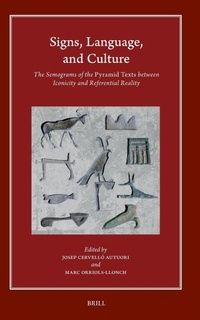
Signs, Language, and Culture: The Semograms of the Pyramid Texts between Iconicity and Referential Reality
Published on 24. April 2025
Book
Hardback
760 pages
978-90-04-72103-6 (ISBN)
Description
The signs of Egyptian hieroglyphic writing are pictograms, i.e. images that represent beings and objects of reality. The main characteristic of pictograms is their iconicity. An icon conveys meaning through the image, which distinctly refers to a real referent by depicting several of its defining features. This volume focuses on semograms, which are lexical or semantic pictograms, meaning the image itself participates directly in the encoding of the linguistic message. The Pyramid Texts of the late 3rd millennium BCE constitute the oldest corpus of funerary texts in Egyptian and human history. Their semograms iconically reflect cultural realities of Old Kingdom Egypt and perhaps earlier. The studies you will find in this book are devoted to the dialectics between text, sign, iconicity, and referential reality.
More details
Series
Language
English
French
Place of publication
Leiden
Netherlands
Target group
College/higher education
Product notice
sewn/stitched
Cloth over boards
Dimensions
Height: 240 mm
Width: 162 mm
Thickness: 40 mm
Weight
1216 gr
ISBN-13
978-90-04-72103-6 (9789004721036)
Copyright in bibliographic data and cover images is held by Nielsen Book Services Limited or by the publishers or by their respective licensors: all rights reserved.
Schweitzer Classification
Persons
Josep Cervello Autuori, PhD (1995) is Professor of Egyptology at the Universitat Autonoma de Barcelona (Spain) and Director of the Institut d'Estudis del Proxim Orient Antic (IEPOA) of the same university. He co-leads the Spanish-Egyptian Archaeological Mission in Saqqara (SEAMS). He has published monographs, book chapters, and articles mainly on the history, archaeology, and epigraphy of early and Old Kingdom Egypt.
Marc Orriols-Llonch, PhD 2010, Universitat Autonoma de Barcelona, is an Egyptologist and an associate professor at that university. His main line of research is gender studies in Egyptology, specifically sexual relations and masculinities, topics on which he has published several articles and book chapters.
Marc Orriols-Llonch, PhD 2010, Universitat Autonoma de Barcelona, is an Egyptologist and an associate professor at that university. His main line of research is gender studies in Egyptology, specifically sexual relations and masculinities, topics on which he has published several articles and book chapters.
Content
List of Figures and Tables
Notes on Contributors
Introduction
?Josep Cervello Autuori and Marc Orriols-Llonch
1 The Bird Semograms of the God Dedun in the Pyramid Texts and the Coffin Texts
?Heri AbrunaMarti
2 Round, Square or Both? The Skyscape in the Pyramid Texts as Expressed by Semograms
?M.Victoria Almansa-Villatoro
3 The Offering of the Eye of Horus in the Pyramid Texts: Performativity and Symbolic Credit
?Lucas Baque-Manzano
4 Les lits determinatifs de s?r, <<?se coucher?>>, dans les textes de la pyramide de Teti: Les criteres stylistiques comme indices de datation
?Elise Bene
5 The Falcon Classifiers in the Pyramid Texts of the Old Kingdom
?FranciscoL. BorregoGallardo
6 Some Remarks on Kinship Determinatives in the Pyramid Texts
?Marcelo Campagno
7 La graphie de l'??.t dans les Textes des Pyramides et les Textes des Sarcophages
?Cloe Caron et Valerie Angenot
8 The Root j?r and Its Determinatives in the Royal and Private Funerary Texts of the Old Kingdom
Reflections on the Afterlife in Egypt at the End of the Third Millennium
?Josep CervelloAutuori
9 Deserts and Mountains on the Walls: Hieroglyphs Related to Desert Areas and Foreign Countries in the Pyramid Texts
?AndresDiego Espinel
10 Modulating Semograms: Some Procedures for Semantic Specification and Re-categorization in the Pyramid Texts and Other Mortuary Texts
?Carlos GraciaZamacona
11 Quelle continuite graphique entre l'iconographie predynastique et les Textes des Pyramides?
Ou, comment etablit-on des categories dans le reel entre le IVe et le IIIe millenaire?
?Gwenola Graff
12 Le <<?sceptre?>> hetes dans les Textes des Pyramides
?Nadine Guilhou?
13 Sit on Osiris's Chair: Uses, Meanings and Graphic Forms of ?msi? in the Pyramid Texts
?Francesca Iannarilli
14 Nedi, "nouveau" dieu de l'Egypte protodynastique, et la normalisation des effigies cultuelles
Codification graphique, referent plastique et fonction ideologique
?Bernard Mathieu
15 Panther, Panther, Burning (Not so) Bright... The Impact of Iconicity on Sign Identity, Evolution and Obsolescence in the Pyramid Texts
?Angela McDonald
16 External Male Genitalia Semograms ?? [D52], ?? [D53] in the Pyramid Texts
?Marc Orriols-Llonch
17 De signes en aiguilles: A propos de quelques signes de vetements et de parures dans les Textes des Pyramides
?Jennifer Romion
18 Quand l'homme descend du boeuf: De l'utilisation des parties bovines pour designer le corps humain dans les Textes des Pyramides
?Simon Thuault
Table of Signs Discussed
Table of Passages Discussed
General Index
Notes on Contributors
Introduction
?Josep Cervello Autuori and Marc Orriols-Llonch
1 The Bird Semograms of the God Dedun in the Pyramid Texts and the Coffin Texts
?Heri AbrunaMarti
2 Round, Square or Both? The Skyscape in the Pyramid Texts as Expressed by Semograms
?M.Victoria Almansa-Villatoro
3 The Offering of the Eye of Horus in the Pyramid Texts: Performativity and Symbolic Credit
?Lucas Baque-Manzano
4 Les lits determinatifs de s?r, <<?se coucher?>>, dans les textes de la pyramide de Teti: Les criteres stylistiques comme indices de datation
?Elise Bene
5 The Falcon Classifiers in the Pyramid Texts of the Old Kingdom
?FranciscoL. BorregoGallardo
6 Some Remarks on Kinship Determinatives in the Pyramid Texts
?Marcelo Campagno
7 La graphie de l'??.t dans les Textes des Pyramides et les Textes des Sarcophages
?Cloe Caron et Valerie Angenot
8 The Root j?r and Its Determinatives in the Royal and Private Funerary Texts of the Old Kingdom
Reflections on the Afterlife in Egypt at the End of the Third Millennium
?Josep CervelloAutuori
9 Deserts and Mountains on the Walls: Hieroglyphs Related to Desert Areas and Foreign Countries in the Pyramid Texts
?AndresDiego Espinel
10 Modulating Semograms: Some Procedures for Semantic Specification and Re-categorization in the Pyramid Texts and Other Mortuary Texts
?Carlos GraciaZamacona
11 Quelle continuite graphique entre l'iconographie predynastique et les Textes des Pyramides?
Ou, comment etablit-on des categories dans le reel entre le IVe et le IIIe millenaire?
?Gwenola Graff
12 Le <<?sceptre?>> hetes dans les Textes des Pyramides
?Nadine Guilhou?
13 Sit on Osiris's Chair: Uses, Meanings and Graphic Forms of ?msi? in the Pyramid Texts
?Francesca Iannarilli
14 Nedi, "nouveau" dieu de l'Egypte protodynastique, et la normalisation des effigies cultuelles
Codification graphique, referent plastique et fonction ideologique
?Bernard Mathieu
15 Panther, Panther, Burning (Not so) Bright... The Impact of Iconicity on Sign Identity, Evolution and Obsolescence in the Pyramid Texts
?Angela McDonald
16 External Male Genitalia Semograms ?? [D52], ?? [D53] in the Pyramid Texts
?Marc Orriols-Llonch
17 De signes en aiguilles: A propos de quelques signes de vetements et de parures dans les Textes des Pyramides
?Jennifer Romion
18 Quand l'homme descend du boeuf: De l'utilisation des parties bovines pour designer le corps humain dans les Textes des Pyramides
?Simon Thuault
Table of Signs Discussed
Table of Passages Discussed
General Index