

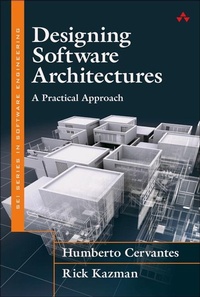
Designing Software Architectures
A Practical Approach
Published on 24. May 2016
Book
Hardback
320 pages
978-0-13-439078-9 (ISBN)
Description
Designing Software Architectures will teach you how to design any software architecture in a systematic, predictable, repeatable, and cost-effective way.
This book introduces a practical methodology for architecture design that any professional software engineer can use, provides structured methods supported by reusable chunks of design knowledge, and includes rich case studies that demonstrate how to use the methods.
Using realistic examples, you'll master the powerful new version of the proven Attribute-Driven Design (ADD) 3.0 method and will learn how to use it to address key drivers, including quality attributes, such as modifiability, usability, and availability, along with functional requirements and architectural concerns.
Drawing on their extensive experience, Humberto Cervantes and Rick Kazman guide you through crafting practical designs that support the full software life cycle, from requirements to maintenance and evolution. You'll learn how to successfully integrate design in your organizational context, and how to design systems that will be built with agile methods.
Comprehensive coverage includes
Understanding what architecture design involves, and where it fits in the full software development life cycle
Mastering core design concepts, principles, and processes
Understanding how to perform the steps of the ADD method
Scaling design and analysis up or down, including design for pre-sale processes or lightweight architecture reviews
Recognizing and optimizing critical relationships between analysis and design
Utilizing proven, reusable design primitives and adapting them to specific problems and contexts
Solving design problems in new domains, such as cloud, mobile, or big data
This book introduces a practical methodology for architecture design that any professional software engineer can use, provides structured methods supported by reusable chunks of design knowledge, and includes rich case studies that demonstrate how to use the methods.
Using realistic examples, you'll master the powerful new version of the proven Attribute-Driven Design (ADD) 3.0 method and will learn how to use it to address key drivers, including quality attributes, such as modifiability, usability, and availability, along with functional requirements and architectural concerns.
Drawing on their extensive experience, Humberto Cervantes and Rick Kazman guide you through crafting practical designs that support the full software life cycle, from requirements to maintenance and evolution. You'll learn how to successfully integrate design in your organizational context, and how to design systems that will be built with agile methods.
Comprehensive coverage includes
Understanding what architecture design involves, and where it fits in the full software development life cycle
Mastering core design concepts, principles, and processes
Understanding how to perform the steps of the ADD method
Scaling design and analysis up or down, including design for pre-sale processes or lightweight architecture reviews
Recognizing and optimizing critical relationships between analysis and design
Utilizing proven, reusable design primitives and adapting them to specific problems and contexts
Solving design problems in new domains, such as cloud, mobile, or big data
More details
Series
Language
English
Place of publication
Boston
United States
Publishing group
Pearson Education (US)
Target group
College/higher education
Product notice
sewn/stitched
Cloth over boards
Dimensions
Height: 241 mm
Width: 164 mm
Thickness: 25 mm
Weight
587 gr
ISBN-13
978-0-13-439078-9 (9780134390789)
Copyright in bibliographic data and cover images is held by Nielsen Book Services Limited or by the publishers or by their respective licensors: all rights reserved.
Schweitzer Classification
Other editions
New editions
Humberto Cervantes | Rick Kazman
Designing Software Architectures: A Practical Approach
A Practical Approach
Book
09/2024
2nd Edition
Addison Wesley
€51.49
Shipment within 15-20 days
Additional editions
E-Book
04/2016
1st Edition
Addison Wesley
from
€51.83
Available for download
E-Book
04/2016
1st Edition
Addison Wesley
€45.99
Available for download
Persons
Humberto Cervantes is a professor at Universidad Autonoma Metropolitana Iztapalapa in Mexico City. His primary research interest is software architecture and, more specifically, the development of methods and tools to aid in the design process. He is active in promoting the adoption of these methods and tools in the software industry. Since 2006, Cervantes has been a consultant for software development companies in topics related to software architecture. He has authored numerous research papers and popularization articles, and has also coauthored one of the few books in Spanish on the topic of software architecture. Cervantes received a master's degree and a Ph.D. from Universite Joseph Fourier in Grenoble, France. He holds the Software Architecture Professional and ATAM Evaluator certificates from the SEI.
Rick Kazman is a professor at the University of Hawaii and a principal researcher at the Software Engineering Institute of Carnegie Mellon University. His primary research interests are software architecture, design and analysis tools, software visualization, and software engineering economics. Kazman has created several highly influential methods and tools for architecture analysis, including the SAAM (Software Architecture Analysis Method), the ATAM (Architecture Tradeoff Analysis Method), the CBAM (Cost-Benefit Analysis Method), and the Dali and Titan tools. He is the author of more than one hundred fifty peer-reviewed papers, and is coauthor of several books, including Software Architecture in Practice, Third Edition (Addison-Wesley, 2013), Evaluating Software Architectures (Addison-Wesley, 2002), and Ultra-Large-Scale Systems. Kazman received a B.A. (English/music) and M.Math (computer science) from the University of Waterloo, an M.A. (English) from York University, and a Ph.D. (computational linguistics) from Carnegie Mellon University.
Rick Kazman is a professor at the University of Hawaii and a principal researcher at the Software Engineering Institute of Carnegie Mellon University. His primary research interests are software architecture, design and analysis tools, software visualization, and software engineering economics. Kazman has created several highly influential methods and tools for architecture analysis, including the SAAM (Software Architecture Analysis Method), the ATAM (Architecture Tradeoff Analysis Method), the CBAM (Cost-Benefit Analysis Method), and the Dali and Titan tools. He is the author of more than one hundred fifty peer-reviewed papers, and is coauthor of several books, including Software Architecture in Practice, Third Edition (Addison-Wesley, 2013), Evaluating Software Architectures (Addison-Wesley, 2002), and Ultra-Large-Scale Systems. Kazman received a B.A. (English/music) and M.Math (computer science) from the University of Waterloo, an M.A. (English) from York University, and a Ph.D. (computational linguistics) from Carnegie Mellon University.
Content
Chapter 1: Introduction
Chapter 2: Architectural Design
Chapter 3: The Architecture Design Process
Chapter 4: Case Study: FCAPS System
Chapter 5: Case Study: Big Data System
Chapter 6: Case Study: Banking System
Chapter 7: Other Design Methods
Chapter 8: Analysis in the Design Process
Chapter 9: The Architecture Design Process in the Organization
Chapter 10: Final Words
Appendix A: A Design Concepts Catalog
Appendix B: Tactics-Based Questionnaires
Glossary
About the Authors
Index
Chapter 2: Architectural Design
Chapter 3: The Architecture Design Process
Chapter 4: Case Study: FCAPS System
Chapter 5: Case Study: Big Data System
Chapter 6: Case Study: Banking System
Chapter 7: Other Design Methods
Chapter 8: Analysis in the Design Process
Chapter 9: The Architecture Design Process in the Organization
Chapter 10: Final Words
Appendix A: A Design Concepts Catalog
Appendix B: Tactics-Based Questionnaires
Glossary
About the Authors
Index