

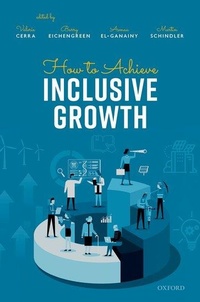
How to Achieve Inclusive Growth
Published on 23. December 2021
Book
Hardback
900 pages
978-0-19-284693-8 (ISBN)
Description
This is an open access title available under the terms of a CC BY-NC-ND 4.0 International licence. It is free to read at Oxford Scholarship Online and offered as a free PDF download from OUP and selected open access locations.
Rising inequality and widespread poverty, social unrest and polarization, gender and ethnic disparities, declining social mobility, economic fragility, unbalanced growth due to technology and globalization, and existential danger from climate change are urgent global concerns of our day. These issues are intertwined. They therefore require a holistic framework to examine their interplay and bring the various strands together.
Leading academic economists have partnered with experts from several international institutions to explain the sources and scale of these challenges. They gather a wide array of empirical evidence and country experiences to lay out practical policy solutions and to devise a comprehensive and unified plan of action for combatting these economic and social disparities.
This authoritative book is accessible to policy makers, students, and the general public interested in how to craft a brighter future by building a sustainable, green, and inclusive society in the years ahead.
Rising inequality and widespread poverty, social unrest and polarization, gender and ethnic disparities, declining social mobility, economic fragility, unbalanced growth due to technology and globalization, and existential danger from climate change are urgent global concerns of our day. These issues are intertwined. They therefore require a holistic framework to examine their interplay and bring the various strands together.
Leading academic economists have partnered with experts from several international institutions to explain the sources and scale of these challenges. They gather a wide array of empirical evidence and country experiences to lay out practical policy solutions and to devise a comprehensive and unified plan of action for combatting these economic and social disparities.
This authoritative book is accessible to policy makers, students, and the general public interested in how to craft a brighter future by building a sustainable, green, and inclusive society in the years ahead.
Reviews / Votes
THE go-to book to translate the goal of inclusive growth into specific policy actions. Impressive array of authors, and a long list of practical ideas. * Olivier Blanchard, Senior Fellow at Peterson Institute for International Economics and former Chief Economist of the IMF * Inclusive, broadly-shared, growth has been an aspiration for many policymakers and commentators, but also turned out to be rather elusive in the age of globalization, automation, and mega corporations. This collection of essays by leading academics and practitioners explains why and provides guidelines for how we can tackle labor market, technology, financial market, and international challenges to make growth more inclusive. Anybody who wants to tackle the problem of inequality and poverty today will find this collection to be an invaluable guide. * Daron Acemoglu, MIT Institute Professor and John Bates Clark Medalist * Rising inequality is widely lamented, but lucid plans for addressing it are scarce. This volume offers an intellectual framework and policy agenda for achieving inclusive growth--and a ton of rigorous research and concrete examples, crafted by the leading scholars of our day, demonstrating the viability of that agenda. Policymakers and practitioners worldwide will find tremendous value in these pages. * David Autor, Ford Professor of Economics at MIT and Co-Director of MIT School Effectiveness and Inequality Initiative * Global trade, growth and technological progress have lifted billions of people out poverty over the past several decades. However, especially over the past two decades, growth has not always been a force for economic convergence, both within countries, and even more so across countries where by far the biggest gaps lie. How to Achieve Inclusive Growth brings together an impressive body of academic research both on best practices and on unsolved challenges. The book takes an admirably global perspective on a problem where altogether too many studies view inequality as mainly a national issue, as if other citizens of the world did not matter. There are no easy answers, but as this book demonstrates, the starting point has to be in asking the right questions. * Kenneth Rogoff, Thomas D. Cabot Professor of Public Policy and Professor of Economics at Harvard University and former Chief Economist of the IMF * This edited volume by the IMF and academic experts provides a foundation to define and achieve inclusive growth, that is growth widely shared and sustainable. A clear marker that the IMF thinks deeply beyond narrow economic growth and a reference for a better future. * Emmanual Saez, Chancellor's Professorship of Tax Policy and Public Finance and Director of the Center for Equitable Growth at UC Berkeley * As the world faces multiple crises, this volume is a timely necessity for scholars and policymakers. We can only hope that they will heed its lessons. Climate change, COVID-19, technological change, financial instability, and globalization (among other disruptive developments) have all raised the need for multilateral governmental action on global public goods. At the same time, failures of policy response have sapped the domestic political cohesion that allows countries to work together. With an all-star cast of authors and a breathtaking scope across policy areas, this book outlines a path to the inclusive growth that is a prerequisite for solving the century's existential challenges. * Maurice Obstfeld, Class of 1958 Professor of Economics at UC Berkeley and former Chief Economist of the IMF * Rising inequality is the defining challenge of our time. This volume brings together renowned experts to present a wide range of potential remedies, reconciling growth with a more sustainable distribution of economic resources. * Gabriel Zucman, Associate Professor of Economics and Director of the Stone Center on Wealth and Income Inequality at UC Berkeley *More details
Language
English
Place of publication
Oxford
United Kingdom
Target group
Professional and scholarly
Product notice
sewn/stitched
Cloth over boards
Dimensions
Height: 236 mm
Width: 163 mm
Thickness: 51 mm
Weight
1397 gr
ISBN-13
978-0-19-284693-8 (9780192846938)
Copyright in bibliographic data and cover images is held by Nielsen Book Services Limited or by the publishers or by their respective licensors: all rights reserved.
Schweitzer Classification
Other editions
Additional editions
Valerie Cerra | Barry Eichengreen | Asmaa El-Ganainy
How to Achieve Inclusive Growth
E-Book
12/2021
1st Edition
OUP eBook
€136.99
Available for download
Valerie Cerra | Barry Eichengreen | Asmaa El-Ganainy
How to Achieve Inclusive Growth
E-Book
12/2021
1st Edition
OUP eBook
€110.99
Available for download
Persons
Valerie Cerra is Assistant Director and Division Chief of the Inclusive Growth and Structural Policies Division in the International Monetary Fund's Institute for Capacity Development. She has been involved in policy advice, lending, and capacity development in the IMF's Western Hemisphere, African, European, and Asia and Pacific departments, and the IMF Institute. She obtained undergraduate degrees in finance and engineering from the University of Pennsylvania, and a Ph.D. in Economics from the University of Washington. She has published widely in leading economics journals on topics related to international macroeconomics, financial crises, economic scarring, and inclusive growth.
Barry Eichengreen is George C. Pardee & Helen N. Pardee Professor of Economics and Political Science, University of California, Berkeley; Research Associate of the National Bureau of Economic Research; and Research Fellow of the Centre for Economic Policy Research.
Asmaa El-Ganainy is a Deputy Division Chief at the IMF's Institute for Capacity Development. Previously, she worked in the European and Fiscal Affairs Departments, contributing to IMF's surveillance, lending, research and capacity development work across a range of countries. Her research interests are in the fields of public finance, sovereign debt, inequality, labor economics, and capital flows.
Martin Schindler is a Deputy Division Chief at the IMF. He has contributed to the IMF's surveillance, lending, and analytical work, covering low-income, emerging and advanced economies on four continents, as well as to capacity development, including as deputy director of the Joint Vienna Institute. He is the lead editor of the IMF book on Jobs and Growth: Supporting the European Recovery and has published in leading economic journals, including the Journal of Monetary Economics, the Journal of International Economics, and the European Economic Review, among others. He holds a Ph.D. in economics from the University of Pennsylvania.
Barry Eichengreen is George C. Pardee & Helen N. Pardee Professor of Economics and Political Science, University of California, Berkeley; Research Associate of the National Bureau of Economic Research; and Research Fellow of the Centre for Economic Policy Research.
Asmaa El-Ganainy is a Deputy Division Chief at the IMF's Institute for Capacity Development. Previously, she worked in the European and Fiscal Affairs Departments, contributing to IMF's surveillance, lending, research and capacity development work across a range of countries. Her research interests are in the fields of public finance, sovereign debt, inequality, labor economics, and capital flows.
Martin Schindler is a Deputy Division Chief at the IMF. He has contributed to the IMF's surveillance, lending, and analytical work, covering low-income, emerging and advanced economies on four continents, as well as to capacity development, including as deputy director of the Joint Vienna Institute. He is the lead editor of the IMF book on Jobs and Growth: Supporting the European Recovery and has published in leading economic journals, including the Journal of Monetary Economics, the Journal of International Economics, and the European Economic Review, among others. He holds a Ph.D. in economics from the University of Pennsylvania.
Editor
Assistant DirectorAssistant Director, IMF
George C. Pardee & Helen N. Pardee Professor of Economics and Political ScienceGeorge C. Pardee & Helen N. Pardee Professor of Economics and Political Science, University of California, Berkeley
Deputy Division ChiefDeputy Division Chief, IMF
Deputy Division ChiefDeputy Division Chief, IMF
Content
Introduction
1: Valerie Cerra: An Inclusive Growth Framework
2: Valerie Cerra, Ruy Lama, Norman Loayza: Links Between Growth, Inequality, and Poverty
Factor and Product Markets
3: Asmaa El-Ganainy, Ekkehard Ernst, Rossana Merola, Richard Rogerson, Martin Schindler: Labor Markets
4: Adolfo Barajas, Thorsten Beck, Mohamed Belhaj, Sami Ben Naceur: Financial Inclusion
5: Anton Korinek, Martin Schindler, Joseph Stiglitz E: Technological Progress and Artificial Intelligence
6: Philippe Aghion, Reda Cherif, Fuad Hasanov: Competition and Innovation
Globalization
7: Marc Bacchetta, Valerie Cerra, Roberta Piermartini, Maarten Smeets: Trade
8: Barry Eichengreen, Balazs Csonto, Asmaa El-Ganainy: Financial Globalization
9: Zsoka Koczan, Giovanni Peri, Magali Pinat, Dmitriy Rozhkov: Migration
Government Policies and Services
10: Maksym Ivanyna, Andrea Salerno: Governance
11: Hamid R. Davoodi, Peter Montiel, Anna Ter-Martirosyan,: Macroeconomic Stability, Adjustment, and Debt
12: Khaled Abdel-Kader, Ruud de Mooij: Tax Policy
13: Younes Zouhar, Jon Jellema, Nora Lustig, Mohamed Trabelsi: Public Expenditure
14: Deon Filmer, Roberta Gatti, Halsey Rogers, Nikola Spatafora, Drilona Emrullahu: Education and Health
15: Barbara Dutzler, Simon Johnson, Priscilla Muthoora: The Political Economy of Inclusive Growth
Disparities in Outcomes
16: Raquel Fernandez, Asel Isakova, Francesco Luna, Barbara Rambousek: Gender Equality
17: Holger Floerkemeier, Nikola Spatafora, Anthony Venables: Regional Disparities
18: Benedicte Baduel, Asel Isakova, Anna Ter-Martirosyan: Generational Aspects of Inclusive Growth
19: Nathalie Pouokam: Sharing Resource Wealth and Addressing Fragility
20: Amar Bhattacharya, Maksym Ivanyna, William Oman, Sir Nicolas Stern: Climate Change
Putting it Together
21: Sriram Balasubramanian, Lahcen Bounader, Jana Bricco, Dmitry Vasilyev: Country Case Studies
22: Valerie Cerra: Conclusions and Resources for Next Steps
1: Valerie Cerra: An Inclusive Growth Framework
2: Valerie Cerra, Ruy Lama, Norman Loayza: Links Between Growth, Inequality, and Poverty
Factor and Product Markets
3: Asmaa El-Ganainy, Ekkehard Ernst, Rossana Merola, Richard Rogerson, Martin Schindler: Labor Markets
4: Adolfo Barajas, Thorsten Beck, Mohamed Belhaj, Sami Ben Naceur: Financial Inclusion
5: Anton Korinek, Martin Schindler, Joseph Stiglitz E: Technological Progress and Artificial Intelligence
6: Philippe Aghion, Reda Cherif, Fuad Hasanov: Competition and Innovation
Globalization
7: Marc Bacchetta, Valerie Cerra, Roberta Piermartini, Maarten Smeets: Trade
8: Barry Eichengreen, Balazs Csonto, Asmaa El-Ganainy: Financial Globalization
9: Zsoka Koczan, Giovanni Peri, Magali Pinat, Dmitriy Rozhkov: Migration
Government Policies and Services
10: Maksym Ivanyna, Andrea Salerno: Governance
11: Hamid R. Davoodi, Peter Montiel, Anna Ter-Martirosyan,: Macroeconomic Stability, Adjustment, and Debt
12: Khaled Abdel-Kader, Ruud de Mooij: Tax Policy
13: Younes Zouhar, Jon Jellema, Nora Lustig, Mohamed Trabelsi: Public Expenditure
14: Deon Filmer, Roberta Gatti, Halsey Rogers, Nikola Spatafora, Drilona Emrullahu: Education and Health
15: Barbara Dutzler, Simon Johnson, Priscilla Muthoora: The Political Economy of Inclusive Growth
Disparities in Outcomes
16: Raquel Fernandez, Asel Isakova, Francesco Luna, Barbara Rambousek: Gender Equality
17: Holger Floerkemeier, Nikola Spatafora, Anthony Venables: Regional Disparities
18: Benedicte Baduel, Asel Isakova, Anna Ter-Martirosyan: Generational Aspects of Inclusive Growth
19: Nathalie Pouokam: Sharing Resource Wealth and Addressing Fragility
20: Amar Bhattacharya, Maksym Ivanyna, William Oman, Sir Nicolas Stern: Climate Change
Putting it Together
21: Sriram Balasubramanian, Lahcen Bounader, Jana Bricco, Dmitry Vasilyev: Country Case Studies
22: Valerie Cerra: Conclusions and Resources for Next Steps