

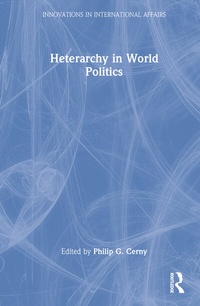
Heterarchy in World Politics
1st Edition
Published on 30. December 2022
Book
Hardback
222 pages
978-1-032-39875-4 (ISBN)
Description
Heterarchy in World Politics challenges the fundamental framing of international relations and world politics. IR theory has always been dominated by the presumption that world politics is, at its core, a system of states. However, this has always been problematic, challengeable, time-bound, and increasingly anachronistic.
In the 21st century, world politics is becoming increasingly multi-nodal and characterized by "heterarchy" - the coexistence and conflict between differently structured micro- and meso quasi-hierarchies that compete and overlap not only across borders but also across economic-financial sectors and social groupings. Thinking about international order in terms of heterarchy is a paradigm shift away from the mainstream "competing paradigms" of realism, liberalism, and constructivism. This book explores how, since the mid-20th century, the dialectic of globalization and fragmentation has caught states and the interstate system in the complex evolutionary process toward heterarchy. These heterarchical institutions and processes are characterized by increasing autonomy and special interest capture. The process of heterarchy empowers strategically situated agents - especially agents with substantial autonomous resources, and in particular economic resources - in multi-nodal competing institutions with overlapping jurisdictions. The result is the decreasing capacity of macro-states to control both domestic and transnational political/economic processes. In this book, the authors demonstrate that this is not a simple breakdown of states and the states system; it is in fact the early stages of a structural evolution of world politics.
This book will interest students, scholars and researchers of international relations theory. It will also have significant appeal in the fields of world politics, security studies, war studies, peace studies, global governance studies, political science, political economy, political power studies, and the social sciences more generally.
In the 21st century, world politics is becoming increasingly multi-nodal and characterized by "heterarchy" - the coexistence and conflict between differently structured micro- and meso quasi-hierarchies that compete and overlap not only across borders but also across economic-financial sectors and social groupings. Thinking about international order in terms of heterarchy is a paradigm shift away from the mainstream "competing paradigms" of realism, liberalism, and constructivism. This book explores how, since the mid-20th century, the dialectic of globalization and fragmentation has caught states and the interstate system in the complex evolutionary process toward heterarchy. These heterarchical institutions and processes are characterized by increasing autonomy and special interest capture. The process of heterarchy empowers strategically situated agents - especially agents with substantial autonomous resources, and in particular economic resources - in multi-nodal competing institutions with overlapping jurisdictions. The result is the decreasing capacity of macro-states to control both domestic and transnational political/economic processes. In this book, the authors demonstrate that this is not a simple breakdown of states and the states system; it is in fact the early stages of a structural evolution of world politics.
This book will interest students, scholars and researchers of international relations theory. It will also have significant appeal in the fields of world politics, security studies, war studies, peace studies, global governance studies, political science, political economy, political power studies, and the social sciences more generally.
More details
Series
Language
English
Place of publication
London
United Kingdom
Publishing group
Taylor & Francis Ltd
Target group
College/higher education
Professional and scholarly
Postgraduate, Professional Reference, and Undergraduate Advanced
Illustrations
3 s/w Abbildungen, 3 s/w Zeichnungen, 1 s/w Tabelle
1 Tables, black and white; 3 Line drawings, black and white; 3 Illustrations, black and white
Dimensions
Height: 234 mm
Width: 156 mm
Weight
509 gr
ISBN-13
978-1-032-39875-4 (9781032398754)
Copyright in bibliographic data and cover images is held by Nielsen Book Services Limited or by the publishers or by their respective licensors: all rights reserved.
Schweitzer Classification
Other editions
Additional editions
Philip G. Cerny
Heterarchy in World Politics
E-Book
12/2022
1st Edition
Routledge
€52.49
Available for download
Philip G. Cerny
Heterarchy in World Politics
E-Book
12/2022
1st Edition
Routledge
€52.49
Available for download
Philip G. Cerny
Heterarchy in World Politics
Book
12/2022
1st Edition
Routledge
€60.20
Shipment within 10-20 days
Person
Philip G. Cerny is Professor Emeritus of Politics and Global Affairs at the University of Manchester, UK, and Rutgers University-Newark, USA. His research interests are the theory of world politics and political economy.
Content
Section I: Theory and History 1. Heterarchy: Toward Paradigm Shift in World Politics 2. From Postinternationalism to Heterarchy: Turbulence and Distance Proximities in a World of Globalization and Fragmentation 3. Heterarchy and Social Theory 4. New Medievalism (Re)Appraised: Framing Heterarchy in World Politics 5. From Empire to Heterarchy 6. Heterarchy and State Transformation 7. Political Power in a Heterarchical World: A Categorization of Extra-state Authorities 8. Globalization, Heterarchy, and the Persistence of Anomie Section II: Issue Areas and Case Studies 9. Nationalism, Capitalism and Heterarchy: Continuity and Change in the 21st Century World Order 10. Heterarchy and the Limits of Global Governance 11. Metropolitan Diplomacy: Global Metropolitan Law and Global Cities Seen from the Heterarchy Perspective 12. Heterarchy in an Age of Intangibles and Financialization 13. WTO Dispute Settlement and the Appellate Body Crisis as a Case Study of Heterarchy 14. Heterarchy and Global Environmental Change 15. Heterarchy and Global Internet Governance: The Case of ICANN 16. Heterarchy in the Mexican Competition Network: The Case of COFECE and IFC 17. Heterarchy in Russia: Paradoxes of Power