

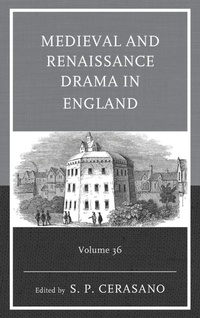
Medieval and Renaissance Drama in England
Volume 36
Published on 6. December 2023
Book
Hardback
330 pages
978-1-68393-381-6 (ISBN)
Description
Medieval and Renaissance Drama in England is an annual volume committed to the publication of essays and reviews related to English drama and theatre history to 1642. An internationally recognized board of scholars oversees the publication of MaRDiE. Readers who wish to deepen their understanding of early drama will find that the journal publishes wide-ranging discussions not only of plays and early performance history, but of topics relating to cultural history, as well as manuscript studies and the history of printing.
More details
Series
Language
English
Place of publication
Cranbury
United States
Publishing group
Associated University Presses
Target group
Professional and scholarly
Illustrations
7 tables
Dimensions
Height: 235 mm
Width: 157 mm
Thickness: 24 mm
Weight
691 gr
ISBN-13
978-1-68393-381-6 (9781683933816)
Copyright in bibliographic data and cover images is held by Nielsen Book Services Limited or by the publishers or by their respective licensors: all rights reserved.
Schweitzer Classification
Other editions
Additional editions
E-Book
12/2023
1st Edition
Fairleigh Dickinson University Press,U.S.
€107.99
Available for download
Persons
S. P. Cerasano is the Edgar W. B. Fairchild Professor of Literature at Colgate University.
Heather Anne Hirschfeld is Kenneth Curry Professor of English at the University of Tennessee.
Edward Gieskes is associate professor of English at the University of South Carolina.
Heather Anne Hirschfeld is Kenneth Curry Professor of English at the University of Tennessee.
Edward Gieskes is associate professor of English at the University of South Carolina.
Content
Foreword
S. P. Cerasano
Articles
"Stigma and Satire in Shakespeare's Troilus and Cressida: Thersites's Deformity and Ajax's Monstrosity"
Jeffrey R. Wilson
"The Masque of Flowers (1614) and Letters
David M. Bergeron
"Self-Deception in Soliloquies in Shakespeare's Plays: An Empirical Investigation"
James Hirsh
"George North's Description of Swedland, Gotland, and Finland: A Courtier's Warning to the Queen"
June Schlueter
"History as Warning: Middleton, Massinger, and the Censors"
Warren Chernaik
"The Transgressive Will in the Plays of Christopher Marlowe and Elizabeth Cary"
Douglas Clark
"Thomas Dekker's Old Fortunatus and the Wisdom Tradition"
Eric Pudney
"Fulgens and Lucres and the Middle English Debate Tradition"
Noah Gene Peterson
"King Lear's Edgar and Early Modern Renderings of the Apostle Peter"
Derek Witten
"'Unkinged' King Richard's Sense of Self in Richard II"
Michael Menase
"'Epitaphs in Glitt'ring Golden Characters': Watery Empathy and The Purity of 'The Real' in Pericles, Prince of Tyre"
Jessica Tooker
"Post-Restoration Adaptations: Is Double FalsehoodCardenio? Versification Analysis"
Marina Tarlinskaja
S. P. Cerasano
Articles
"Stigma and Satire in Shakespeare's Troilus and Cressida: Thersites's Deformity and Ajax's Monstrosity"
Jeffrey R. Wilson
"The Masque of Flowers (1614) and Letters
David M. Bergeron
"Self-Deception in Soliloquies in Shakespeare's Plays: An Empirical Investigation"
James Hirsh
"George North's Description of Swedland, Gotland, and Finland: A Courtier's Warning to the Queen"
June Schlueter
"History as Warning: Middleton, Massinger, and the Censors"
Warren Chernaik
"The Transgressive Will in the Plays of Christopher Marlowe and Elizabeth Cary"
Douglas Clark
"Thomas Dekker's Old Fortunatus and the Wisdom Tradition"
Eric Pudney
"Fulgens and Lucres and the Middle English Debate Tradition"
Noah Gene Peterson
"King Lear's Edgar and Early Modern Renderings of the Apostle Peter"
Derek Witten
"'Unkinged' King Richard's Sense of Self in Richard II"
Michael Menase
"'Epitaphs in Glitt'ring Golden Characters': Watery Empathy and The Purity of 'The Real' in Pericles, Prince of Tyre"
Jessica Tooker
"Post-Restoration Adaptations: Is Double FalsehoodCardenio? Versification Analysis"
Marina Tarlinskaja