

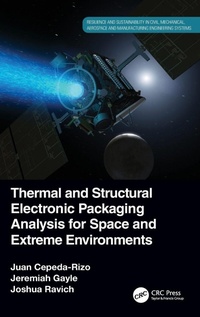
Thermal and Structural Electronic Packaging Analysis for Space and Extreme Environments
1st Edition
Published on 30. December 2021
Book
Hardback
290 pages
978-1-032-16081-8 (ISBN)
Description
Have you ever wondered how NASA designs, builds, and tests spacecrafts and hardware for space? How is it that wildly successful programs such as the Mars Exploration Rovers could produce a rover that lasted over ten times the expected prime mission duration? Or build a spacecraft designed to visit two orbiting destinations and last over 10 years when the fuel ran out? This book was written by NASA/JPL engineers with experience across multiple projects, including the Mars rovers, Mars helicopter, and Dawn ion propulsion spacecraft in addition to many more missions and technology demonstration programs. It provides useful and practical approaches to solving the most complex thermal-structural problems ever attempted for design spacecraft to survive the severe cold of deep space, as well as the unforgiving temperature swings on the surface of Mars. This is done without losing sight of the fundamental and classical theories of thermodynamics and structural mechanics that paved the way to more pragmatic and applied methods such finite element analysis and Monte Carlo ray tracing, for example.
Features:
Includes case studies from NASA's Jet Propulsion Laboratory, which prides itself in robotic exploration of the solar system, as well as flyting the first cubeSAT to Mars.
Enables spacecraft designer engineers to create a design that is structurally and thermally sound, and reliable, in the quickest time afforded.
Examines innovative low-cost thermal and power systems.
Explains how to design to survive rocket launch, the surfaces of Mars and Venus.
Suitable for practicing professionals as well as upper-level students in the areas of aerospace, mechanical, thermal, electrical, and systems engineering, Thermal and Structural Electronic Packaging Analysis for Space and Extreme Environments provides cutting-edge information on how to design, and analyze, and test in the fast-paced and low-cost small satellite environment and learn techniques to reduce the design and test cycles without compromising reliability. It serves both as a reference and a training manual for designing satellites to withstand the structural and thermal challenges of extreme environments in outer space.
Features:
Includes case studies from NASA's Jet Propulsion Laboratory, which prides itself in robotic exploration of the solar system, as well as flyting the first cubeSAT to Mars.
Enables spacecraft designer engineers to create a design that is structurally and thermally sound, and reliable, in the quickest time afforded.
Examines innovative low-cost thermal and power systems.
Explains how to design to survive rocket launch, the surfaces of Mars and Venus.
Suitable for practicing professionals as well as upper-level students in the areas of aerospace, mechanical, thermal, electrical, and systems engineering, Thermal and Structural Electronic Packaging Analysis for Space and Extreme Environments provides cutting-edge information on how to design, and analyze, and test in the fast-paced and low-cost small satellite environment and learn techniques to reduce the design and test cycles without compromising reliability. It serves both as a reference and a training manual for designing satellites to withstand the structural and thermal challenges of extreme environments in outer space.
More details
Series
Language
English
Place of publication
London
United Kingdom
Publishing group
Taylor & Francis Ltd
Target group
Professional and scholarly
College/higher education
Illustrations
217 s/w Abbildungen, 29 s/w Photographien bzw. Rasterbilder, 188 s/w Zeichnungen, 70 s/w Tabellen
70 Tables, black and white; 188 Line drawings, black and white; 29 Halftones, black and white; 217 Illustrations, black and white
Dimensions
Height: 240 mm
Width: 161 mm
Thickness: 21 mm
Weight
622 gr
ISBN-13
978-1-032-16081-8 (9781032160818)
Copyright in bibliographic data and cover images is held by Nielsen Book Services Limited or by the publishers or by their respective licensors: all rights reserved.
Schweitzer Classification
Other editions
New editions

Juan Cepeda-Rizo | Jeremiah Gayle | Joshua Ravich
Thermal and Structural Electronic Packaging Analysis for Space and Extreme Environments
Book
approx. 01/2027
2nd Edition
CRC Press
€148.56
Not yet published
Additional editions
Juan Cepeda-Rizo | Jeremiah Gayle | Joshua Ravich
Thermal and Structural Electronic Packaging Analysis for Space and Extreme Environments
Book
08/2024
1st Edition
CRC Press
€71.80
Shipment within 10-20 days
Juan Cepeda-Rizo | Jeremiah Gayle | Joshua Ravich
Thermal and Structural Electronic Packaging Analysis for Space and Extreme Environments
E-Book
12/2021
1st Edition
CRC Press
€64.49
Available for download
Juan Cepeda-Rizo | Jeremiah Gayle | Joshua Ravich
Thermal and Structural Electronic Packaging Analysis for Space and Extreme Environments
E-Book
12/2021
1st Edition
CRC Press
€64.49
Available for download
Persons
Juan Cepeda-Rizo obtained his bachelor's degree in mechanical engineering and master's in materials engineering from Cal Poly, San Luis Obispo in 1997. After graduation he worked for a semiconductor company doing electronic packaging analysis. He received his Ph.D. from Claremont Graduate University in Applied Mathematics in and in 2008 worked for NASA's Jet Propulsion Laboratory as a thermal system engineer where his latest responsibilities included thermal and structural analysis of flight electronics.
Jeremiah Gayle obtained his bachelor's degree in mechanical engineering from Arizona State University, and master's degrees from Iowa State, and John Hopkins University in space systems engineering. He is pursuing a doctorate in aerospace engineering from Colorado State University and works at NASA's Jet Propulsion Laboratory where he works on spacecraft systems and conducts thermal and structural analysis of avionics.
Joshua Ravich is a supervisor for the Technology Infusion group at JPL, where he works on the mechanical design and analysis of spacecraft systems. His recent work has included the Mars Helicopter project. He received a bachelor's degree in mechanical Engineering from UC Berkeley and a master's in mechanical and aerospace engineering from the University of Michigan.
Jeremiah Gayle obtained his bachelor's degree in mechanical engineering from Arizona State University, and master's degrees from Iowa State, and John Hopkins University in space systems engineering. He is pursuing a doctorate in aerospace engineering from Colorado State University and works at NASA's Jet Propulsion Laboratory where he works on spacecraft systems and conducts thermal and structural analysis of avionics.
Joshua Ravich is a supervisor for the Technology Infusion group at JPL, where he works on the mechanical design and analysis of spacecraft systems. His recent work has included the Mars Helicopter project. He received a bachelor's degree in mechanical Engineering from UC Berkeley and a master's in mechanical and aerospace engineering from the University of Michigan.
Content
Introduction. New Space. Thermal/Structural Challenges in Miniaturizing. Fundamental of Heat Transfer by Conduction and Convection. Fundamentals of Heat Transfer by Radiation. The Multi-Layer Insulation (MLI) Blanket. Heat Pipes. Convective Cooling of Semiconductors using a Nanofluid. Power Systems: The Tesla Turbine. Electronics Design for Extreme Temperature and Pressure. Characterization and Modeling of PWB Warpage and its Effect on LGA Separable Interconnects. Resistor Networks. Thermal Analysis Case Studies. Random Vibration Structural Analysis and Mile's Equation. Vibrational Analysis Case Studies. Creep Prediction of a Printed Wiring Board for Separable Land Grid Array Connector. Operational Case Studies - Mars Surface Operations. Operational Case Studies - Dawn Asteroid Mission. Standards.