

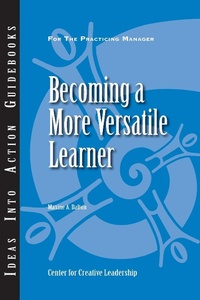
Becoming a More Versatile Learner
Published on 1. March 1998
Book
Paperback/Softback
28 pages
978-1-882197-38-5 (ISBN)
Description
On-the-job experiences are crucial for managerial development, and managers learn the most when they approach them with a variety of learning tactics. Of the four most commonly used tactics - feeling, action, thinking, and accessing others - people typically employ only one or two, thus limiting their learning and eventually their performance. This guidebook describes the four tactics in detail, giving examples of how they can be used. It also provides information on how to identify preferred tactics and how to develop nonpreferred ones.
More details
Series
Language
English
Place of publication
Greensboro
United States
Target group
College/higher education
Professional and scholarly
Product notice
Paperback (trade)
Unsewn / adhesive bound
Dimensions
Height: 229 mm
Width: 152 mm
Thickness: 2 mm
Weight
82 gr
ISBN-13
978-1-882197-38-5 (9781882197385)
Copyright in bibliographic data and cover images is held by Nielsen Book Services Limited or by the publishers or by their respective licensors: all rights reserved.
Schweitzer Classification
Other editions
Additional editions
Center for Creative Leadership (CCL) | Maxine Dalton
Becoming a More Versatile Learner
E-Book
09/2011
Pfeiffer
€10.99
Available for download
Center for Creative Leadership (CCL) | Maxine Dalton
Becoming a More Versatile Learner
E-Book
07/2011
Pfeiffer
€10.99
Available for download
Maxine Dalton
Becoming a More Versatile Learner
E-Book
03/1998
Center for Creative Leadership
€15.49
Available for download
Persons
This series of guidebooks draws on the practical knowledge that theCenter for Creative Leadership (CCL) has generated, sinceits inception in 1970, through its research and educationalactivity conducted in partnership with hundreds of thousands ofmanagers and executives. Much of this knowledge is shared-in a waythat is distinct from the typical university department, professional association, or consultancy. CCL is not simply acollection of individual experts, although the individualcredentials of its staff are impressive; rather it is a community, with its members holding certain principles in common and workingtogether to understand and generate practical responses to today'sleadership and organizational challenges.
The purpose of the series is to provide managers with specificadvice on how to complete a developmental task or solve aleadership challenge. In doing that, the series carries out CCL'smission to advance the understanding, practice, and development ofleadership for the benefit of society worldwide.
The purpose of the series is to provide managers with specificadvice on how to complete a developmental task or solve aleadership challenge. In doing that, the series carries out CCL'smission to advance the understanding, practice, and development ofleadership for the benefit of society worldwide.
Maxine A. Dalton is a research scientist at the Centerfor Creative Leadership and program manager of the Tools forDeveloping Successful Executives program. Her research interestsinclude adult development and learning in domestic andinternational organizations. Dalton has published widely, including"Best Practices: Five Rationales for Using 360-DegreeFeedback in Organizations" in Maximizing the Value of360-Degree Feedback: A Process for Successful Individual andOrganizational Development (Jossey-Bass, 1998). She holds aPh.D. in industrial/organizational psychology from the Universityof South Florida.