

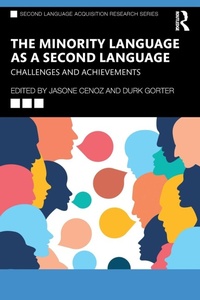
The Minority Language as a Second Language
Challenges and Achievements
1st Edition
Published on 22. December 2023
Book
Paperback/Softback
218 pages
978-1-032-28999-1 (ISBN)
Description
This innovative collection is the first of its kind to showcase global perspectives on learning minority languages as second languages, offering unique insights into their acquisition and specific characteristics and raising greater awareness around other languages and contexts where SLA occurs.
The volume examines how minority languages are acquired as second languages across a range of geographic settings where these languages are unique minorities; that is, they are spoken in one or more states where they have a minority status. International case studies explore particular features of these languages as well as the challenges of teaching and learning them, including standardization, legal recognition at all educational levels, the dissemination of printed and digital materials and more or less limited language use in the local community. Highlighted languages include Ashaninka, Basque, Frisian, Hawaiian, Irish, Isthmus Zapotec, Quechua Chanka, Tonga and Welsh. Each chapter adopts a consistent structure, with a brief introduction to the sociolinguistic landscape, followed by sections on language use in education, research studies, reflections and discussions related to the learning of minority languages as second languages and the implication of these processes for the revitalization of minority languages.
Breaking new ground in second language acquisition research, this book is an indispensable resource for advanced students and researchers in SLA, multilingual education, bilingualism and sociolinguistics.
The volume examines how minority languages are acquired as second languages across a range of geographic settings where these languages are unique minorities; that is, they are spoken in one or more states where they have a minority status. International case studies explore particular features of these languages as well as the challenges of teaching and learning them, including standardization, legal recognition at all educational levels, the dissemination of printed and digital materials and more or less limited language use in the local community. Highlighted languages include Ashaninka, Basque, Frisian, Hawaiian, Irish, Isthmus Zapotec, Quechua Chanka, Tonga and Welsh. Each chapter adopts a consistent structure, with a brief introduction to the sociolinguistic landscape, followed by sections on language use in education, research studies, reflections and discussions related to the learning of minority languages as second languages and the implication of these processes for the revitalization of minority languages.
Breaking new ground in second language acquisition research, this book is an indispensable resource for advanced students and researchers in SLA, multilingual education, bilingualism and sociolinguistics.
More details
Series
Language
English
Place of publication
London
United Kingdom
Publishing group
Taylor & Francis Ltd
Target group
College/higher education
Postgraduate and Undergraduate Advanced
Illustrations
26 s/w Abbildungen, 2 s/w Photographien bzw. Rasterbilder, 24 s/w Zeichnungen, 22 s/w Tabellen
22 Tables, black and white; 24 Line drawings, black and white; 1 Halftones, black and white; 25 Illustrations, black and white
Dimensions
Height: 229 mm
Width: 152 mm
Thickness: 13 mm
Weight
340 gr
ISBN-13
978-1-032-28999-1 (9781032289991)
Copyright in bibliographic data and cover images is held by Nielsen Book Services Limited or by the publishers or by their respective licensors: all rights reserved.
Schweitzer Classification
Other editions
Additional editions
E-Book
12/2023
1st Edition
Taylor & Francis
€55.49
Available for download
Book
12/2023
1st Edition
Routledge
€206.30
Shipment within 10-20 days
E-Book
12/2023
1st Edition
Taylor & Francis
€55.49
Available for download
Persons
Jasone Cenoz is a member of the Advisory Board for the Organization of Ibero-American States (Organizacion de Estados Iberoamericanos) and former Professor of Education at the University of the Basque Country UPV/EHU. She has been AILA Publications Coordinator and President of the International Association of Multilingualism.
Durk Gorter is former Ikerbasque Research Professor at the University of the Basque Country, Spain. Among his recent publications are Pedagogical Translanguaging (2021) and A Panorama of Linguistic Landscape Studies (2023), both co-authored with Jasone Cenoz. He has been the Editor-in-Chief of the journal Language, Culture and Curriculum.
Durk Gorter is former Ikerbasque Research Professor at the University of the Basque Country, Spain. Among his recent publications are Pedagogical Translanguaging (2021) and A Panorama of Linguistic Landscape Studies (2023), both co-authored with Jasone Cenoz. He has been the Editor-in-Chief of the journal Language, Culture and Curriculum.
Content
Editors and Contributors
Chapter 1. Second language acquisition and minority languages
Jasone Cenoz and Durk Gorter
Chapter 2. Power to the minorities: Ndebele L1-speaking teachers in Tonga-speaking communities in Zimbabwe
Busani Maseko and Dion Nkomo
Chapter 3. The acquisition and use of Irish as a minority language
Padraig O Duibhir and John Harris
Chapter 4. Legitimising the 'bilingual': Identity issues among L2 Welsh-speaking teenagers in English-medium schools in Wales
Nia Mererid Parry and Enlli Mon Thomas
Chapter 5. Learning of indigenous languages in university settings: A Decolonizing practice
Vilma Huerta Cordova, Mario E. Lopez-Gopar, Kiara Rios Rios, Ariadna Teresa Lartigue Mendoza and Ana Edith Lopez Cruz,
Chapter 6. Learning indigenous languages as a second language in Bilingual Intercultural Education programs in Peru
Karina Sullon and Elizabet Arocena
Chapter 7. Language proficiency and language use in Basque as a first or second language
Inaki Martinez de Luna Perez de Arriba, Maialen Inarra Arregi and Pablo Suberbiola Unanue
Chapter 8. Potential new speakers of Frisian in educational settings - implicit and explicit attitudes in learning a minority language
Sannah Debreczeni, Joana Duarte and Mirjam Guenther-van der Meij
Chapter 9. Building on the strength of identity in revitalizing Hawaiian on a foundation of second language learners
William H. Wilson and Kauanoe Kamana
Index
Chapter 1. Second language acquisition and minority languages
Jasone Cenoz and Durk Gorter
Chapter 2. Power to the minorities: Ndebele L1-speaking teachers in Tonga-speaking communities in Zimbabwe
Busani Maseko and Dion Nkomo
Chapter 3. The acquisition and use of Irish as a minority language
Padraig O Duibhir and John Harris
Chapter 4. Legitimising the 'bilingual': Identity issues among L2 Welsh-speaking teenagers in English-medium schools in Wales
Nia Mererid Parry and Enlli Mon Thomas
Chapter 5. Learning of indigenous languages in university settings: A Decolonizing practice
Vilma Huerta Cordova, Mario E. Lopez-Gopar, Kiara Rios Rios, Ariadna Teresa Lartigue Mendoza and Ana Edith Lopez Cruz,
Chapter 6. Learning indigenous languages as a second language in Bilingual Intercultural Education programs in Peru
Karina Sullon and Elizabet Arocena
Chapter 7. Language proficiency and language use in Basque as a first or second language
Inaki Martinez de Luna Perez de Arriba, Maialen Inarra Arregi and Pablo Suberbiola Unanue
Chapter 8. Potential new speakers of Frisian in educational settings - implicit and explicit attitudes in learning a minority language
Sannah Debreczeni, Joana Duarte and Mirjam Guenther-van der Meij
Chapter 9. Building on the strength of identity in revitalizing Hawaiian on a foundation of second language learners
William H. Wilson and Kauanoe Kamana
Index