

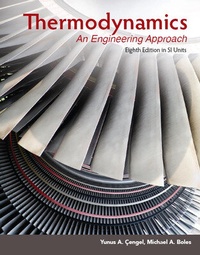
Thermodynamics in SI Units
An Engineering Approach
8th Edition
Published on 16. September 2014
Book
Paperback/Softback
992 pages
978-981-4595-29-2 (ISBN)
Description
Updated: 06/22/2014 - peisiew_yeo Thermodynamics, An Engineering Approach, eighth edition, covers the basic principles of thermodynamics while presenting a wealth of real-world engineering examples so students get a feel for how thermodynamics is applied in engineering practice. This text helps students develop an intuitive understanding by emphasizing the physics and physical arguments. Cengel and Boles explore the various facets of thermodynamics through careful explanations of concepts and use of numerous practical examples and figures, having students develop necessary skills to bridge the gap between knowledge and the confidence to properly apply their knowledge.
Thermodynamics is now presented in full, four-color design. The illustrations and photographs are now more realistic and offer increased understanding to the student. Some of the figures and photographs in the text are intended to serve as a means of emphasizing key concepts that would otherwise go unnoticed.
This edition includes over 500 new problems and a significant number of the existing problems are modified. An important change is the update of the R-134a tables to make property values consistent with those from the latest version of EES (Engineering Equasion Solver). All the solved examples and end-of-chapter problems dealing with R-134a are modified to reflect this change.
Thermodynamics is now presented in full, four-color design. The illustrations and photographs are now more realistic and offer increased understanding to the student. Some of the figures and photographs in the text are intended to serve as a means of emphasizing key concepts that would otherwise go unnoticed.
This edition includes over 500 new problems and a significant number of the existing problems are modified. An important change is the update of the R-134a tables to make property values consistent with those from the latest version of EES (Engineering Equasion Solver). All the solved examples and end-of-chapter problems dealing with R-134a are modified to reflect this change.
More details
Other editions
New editions
Yunus Cengel | Michael Boles | Mehmet Kanoglu
Thermodynamics: An Engineering Approach ISE
Book
03/2023
10th Edition
McGraw-Hill Education
€72.75
Available immediately

CENGEL YUNUS
SW: Thermodynamics: An Engineering Approach, SI version with Connect with LearnSmart 360 days Card
Book
09/2014
8th Edition
McGraw-Hill Inc.,US
€70.27
Article is exhausted; no reprint
Persons
Yunus A. i?engel is Professor Emeritus of Mechanical Engineering at the University of Nevada, Reno. He received his B.S. in mechanical engineering from Istanbul Technical University and his M.S. and Ph.D. in mechanical engineering from North Carolina State University. His areas of interest are renewable energy, energy efficiency, energy policies, heat transfer enhancement, and engineering education. He served as the director of the Industrial Assessment Center (IAC) at the University of Nevada, Reno, from 1996 to 2000. He has led teams of engineering students to numerous manufacturing facilities in Northern Nevada and California to perform industrial assessments, and has prepared energy conservation, waste minimization, and productivity enhancement reports for them. He has also served as an advisor for various government organizations and corporations.
Dr. i?engel is the recipient of several outstanding teacher awards, and he has received the ASEE Meriam/Wiley Distinguished Author Award for excellence in authorship in 1992 and again in 2000. Dr. i?engel is a registered Professional Engineer in the State of Nevada, and is a member of the American Society of Mechanical Engineers (ASME) and the American Society for Engineering Education (ASEE).
New Page 1 Michael A. Boles is Associate Professor of Mechanical and Aerospace Engineering at North Carolina State University (NCSU), where he earned his Ph.D. in mechanical engineering and is an Alumni Distinguished Professor. Dr. Boles has received numerous awards and citations for excellence as an engineering educator. He is a past recipient of the SAE Ralph R. Teetor Education Award and has been twice elected to the NCSU Academy of Outstanding Teachers. The NCSU ASME student section has consistently recognized him as the outstanding teacher of the year and the faculty member having the most impact on mechanical engineering students. Dr. Boles specializes in heat transfer and has been involved in the analytical and numerical solution of phase change and drying of porous media. He is a member of the American Society of Mechanical Engineers, the American Society for Engineering Education, and Sigma Xi. Dr. Boles received the ASEE Meriam/Wiley Distinguished Author Award in 1992 for excellence in authorship.
Dr. i?engel is the recipient of several outstanding teacher awards, and he has received the ASEE Meriam/Wiley Distinguished Author Award for excellence in authorship in 1992 and again in 2000. Dr. i?engel is a registered Professional Engineer in the State of Nevada, and is a member of the American Society of Mechanical Engineers (ASME) and the American Society for Engineering Education (ASEE).
New Page 1 Michael A. Boles is Associate Professor of Mechanical and Aerospace Engineering at North Carolina State University (NCSU), where he earned his Ph.D. in mechanical engineering and is an Alumni Distinguished Professor. Dr. Boles has received numerous awards and citations for excellence as an engineering educator. He is a past recipient of the SAE Ralph R. Teetor Education Award and has been twice elected to the NCSU Academy of Outstanding Teachers. The NCSU ASME student section has consistently recognized him as the outstanding teacher of the year and the faculty member having the most impact on mechanical engineering students. Dr. Boles specializes in heat transfer and has been involved in the analytical and numerical solution of phase change and drying of porous media. He is a member of the American Society of Mechanical Engineers, the American Society for Engineering Education, and Sigma Xi. Dr. Boles received the ASEE Meriam/Wiley Distinguished Author Award in 1992 for excellence in authorship.
Content
CONTENTS
Chapter 1 INTRODUCTION AND BASIC CONCEPTS
Chapter 2 ENERGY, ENERGY TRANSFER, AND GENERAL ENERGY ANALYSIS
Chapter 3PROPERTIES OF PURE SUBSTANCES
Chapter 4ENERGY ANALYSIS OF CLOSED SYSTEMS
Chapter 5MASS AND ENERGY ANALYSIS OF CONTROL VOLUMES
Chapter 6THE SECOND LAW OF THERMODYNAMICS
Chapter 7ENTROPY
Chapter 8EXERGY
Chapter 9GAS POWER CYCLES
Chapter 10VAPOR AND COMBINED POWER CYCLES
Chapter 11REFRIGERATION CYCLES
Chapter 12THERMODYNAMIC PROPERTY RELATIONS
Chapter 13GAS MIXTURES
Chapter 14GAS-VAPOR MIXTURES AND AIR-CONDITIONING
Chapter 15CHEMICAL REACTIONS
Chapter 16CHEMICAL AND PHASE EQUILIBRIUM
Chapter 17COMPRESSIBLE FLOW
Chapter 18 RENEWABLE ENERGY(Web Chapter)
AppendixPROPERTY TABLES AND CHARTS
Index
Chapter 1 INTRODUCTION AND BASIC CONCEPTS
Chapter 2 ENERGY, ENERGY TRANSFER, AND GENERAL ENERGY ANALYSIS
Chapter 3PROPERTIES OF PURE SUBSTANCES
Chapter 4ENERGY ANALYSIS OF CLOSED SYSTEMS
Chapter 5MASS AND ENERGY ANALYSIS OF CONTROL VOLUMES
Chapter 6THE SECOND LAW OF THERMODYNAMICS
Chapter 7ENTROPY
Chapter 8EXERGY
Chapter 9GAS POWER CYCLES
Chapter 10VAPOR AND COMBINED POWER CYCLES
Chapter 11REFRIGERATION CYCLES
Chapter 12THERMODYNAMIC PROPERTY RELATIONS
Chapter 13GAS MIXTURES
Chapter 14GAS-VAPOR MIXTURES AND AIR-CONDITIONING
Chapter 15CHEMICAL REACTIONS
Chapter 16CHEMICAL AND PHASE EQUILIBRIUM
Chapter 17COMPRESSIBLE FLOW
Chapter 18 RENEWABLE ENERGY(Web Chapter)
AppendixPROPERTY TABLES AND CHARTS
Index