

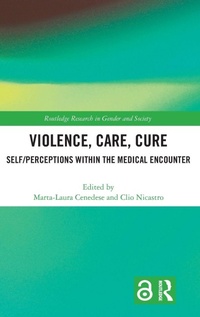
Violence, Care, Cure
Self/perceptions within the Medical Encounter
1st Edition
Published on 7. May 2025
Book
Hardback
252 pages
978-1-032-66014-1 (ISBN)
Description
This book explores the notions of violence, care, and cure within the medical encounter and seeks to foreground the ways in which, whether individually or as a triad, they are prone to ambiguous interpretations. The chapters of this book attend to the complex interlacing of these three key terms and what to make of their entanglement by offering historical, practical, philosophical, personal, and aesthetic analyses of different medical scenes, objects, and concepts.
Besides the three main concepts that give the collection its title, the volume deals with bodily experience, medical neglect or scepticism, pain and suffering, diagnosis and recovery, and epistemic injustice, through the lens of, among others, biopolitics, ethics, gender medicine, and critical medical humanities. Altogether, the chapters pay particular attention to the role of images and other narratives, including social media platforms. The case studies in this collection invite the reader to observe medical encounters that take place in and are shaped by a variety of both material and 'immaterial' spaces, from the consulting room to the antechamber of medical bureaucracy, and from artistic venues to biopolitical discourses. Taken together, this book argues that a hermeneutic of violence, care, and cure is inseparable from individual and collective perceptions of the medical encounter; that is, it is inextricable from an understanding of the tensions and consensus that surge among perceptions orchestrated by both internal (subjective) and external (social, cultural, political) 'gazes'. Moreover, the volume aims to provide, both directly and indirectly, a meta-eflection on the disciplines that fall under the umbrella of 'medical and health humanities', interrogating the field's potential to unearth systemic bias, to open different possibilities of existence, and to make visible the complexity of its research objects, as well as to caution against their possible pitfalls.
By bringing together different methodological approaches, this volume provides its readers with conceptual resources for thinking about the intersections of violence, care, and cure. By providing a space where the voices of both emerging and established scholars mingle and respond to one another, this book will be essential reading for anyone across the social sciences and humanities interested in the sociology of health and medicine, the medical humanities, and gender studies.
Besides the three main concepts that give the collection its title, the volume deals with bodily experience, medical neglect or scepticism, pain and suffering, diagnosis and recovery, and epistemic injustice, through the lens of, among others, biopolitics, ethics, gender medicine, and critical medical humanities. Altogether, the chapters pay particular attention to the role of images and other narratives, including social media platforms. The case studies in this collection invite the reader to observe medical encounters that take place in and are shaped by a variety of both material and 'immaterial' spaces, from the consulting room to the antechamber of medical bureaucracy, and from artistic venues to biopolitical discourses. Taken together, this book argues that a hermeneutic of violence, care, and cure is inseparable from individual and collective perceptions of the medical encounter; that is, it is inextricable from an understanding of the tensions and consensus that surge among perceptions orchestrated by both internal (subjective) and external (social, cultural, political) 'gazes'. Moreover, the volume aims to provide, both directly and indirectly, a meta-eflection on the disciplines that fall under the umbrella of 'medical and health humanities', interrogating the field's potential to unearth systemic bias, to open different possibilities of existence, and to make visible the complexity of its research objects, as well as to caution against their possible pitfalls.
By bringing together different methodological approaches, this volume provides its readers with conceptual resources for thinking about the intersections of violence, care, and cure. By providing a space where the voices of both emerging and established scholars mingle and respond to one another, this book will be essential reading for anyone across the social sciences and humanities interested in the sociology of health and medicine, the medical humanities, and gender studies.
Reviews / Votes
"This thought-provoking and rich edited volume explores the concepts of violence, care and cure as part of the growing interdisciplinary scholarship on the medical encounter. Contributions by leading and emerging scholars from an impressive range of disciplines engage the reader in historical, practical, philosophical and creative reflections that open up new dimensions of research across the fields of medicine and humanities. An eye-opening read for scholars and professionals interested in new and self-reflective approaches to the study and practice of medicine through the humanities and vice versa."Heike Bartel, Professor of German Studies and Health Humanities, The University of Nottingham, UK
"In healthcare and medicine, efforts to care and cure are entangled with violence in complex ways. The contributions in this book highlight the potential of medical humanities to uncover systemic biases and broaden our understanding of medical encounters. The volume is an essential contribution to scholarship, opening new avenues for research and reflection."
Anna Ovaska, Research Fellow in Narrative Studies, Tampere University, Finland
More details
Series
Language
English
Place of publication
London
United Kingdom
Publishing group
Taylor & Francis Ltd
Target group
College/higher education
Postgraduate
Illustrations
16 s/w Zeichnungen, 24 s/w Abbildungen, 8 s/w Photographien bzw. Rasterbilder
16 Line drawings, black and white; 8 Halftones, black and white; 24 Illustrations, black and white
Dimensions
Height: 240 mm
Width: 161 mm
Thickness: 19 mm
Weight
578 gr
ISBN-13
978-1-032-66014-1 (9781032660141)
Copyright in bibliographic data and cover images is held by Nielsen Book Services Limited or by the publishers or by their respective licensors: all rights reserved.
Schweitzer Classification
Other editions
Additional editions
Marta-Laura Cenedese | Clio Nicastro
Violence, Care, Cure
Self/perceptions within the Medical Encounter
E-Book
05/2025
1st Edition
Routledge
€56.99
Available for download
Marta-Laura Cenedese | Clio Nicastro
Violence, Care, Cure
Self/perceptions within the Medical Encounter
E-Book
05/2025
1st Edition
Routledge
€56.99
Available for download
Persons
Marta-Laura Cenedese is UKRI (MSCA Horizon Guarantee) Postdoctoral Fellow at the Institute for Medical Humanities at Durham University. Marta is a literary scholar specialising in postcolonial literatures, memory studies, critical medical humanities, queer death studies, and decolonial feminism. She is the author of Irene Nemirovsky's Russian Influences: Tolstoy, Dostoevsky and Chekhov (2021) and editor of Written on the Body: Narrative (Re)constructions of Violence(s) (2023). Her research has been published in Comparative Literature, Storyworlds, Journal of Medical Humanities, Modern and Contemporary France, and elsewhere. Marta was an associated researcher at the Centre Marc Bloch Berlin (2020-2024) and has been a visiting fellow at the Dahlem Humanities Center, Humboldt University Berlin (2020) and at the Centre d'Histoire, Sciences-o Paris (2023).
Clio Nicastro is a researcher in Philosophy, Cultural Studies, and Film Studies affiliated with Bard College Berlin. She studied philosophy at the University of Palermo, where she completed her PhD in Aesthetics and Theory of Arts. She was DAAD postdoctoral fellow as well as fellow at the ICI Berlin Institute for Cultural Inquiry, where she held an additional one-year postdoctoral position research thanks to a VolkswagenStiftung grant. She is the author of La Dialettica del Denkraum in Aby Warburg (2022) as well as the co-editor with Cristina Baldacci and Arianna Sforzini of the volume Over and Over and Over again. Reenactment Strategies in Contemporary Arts and Theory (2022). She is a member of the board of directors of the Harun Farocki Institut.
Clio Nicastro is a researcher in Philosophy, Cultural Studies, and Film Studies affiliated with Bard College Berlin. She studied philosophy at the University of Palermo, where she completed her PhD in Aesthetics and Theory of Arts. She was DAAD postdoctoral fellow as well as fellow at the ICI Berlin Institute for Cultural Inquiry, where she held an additional one-year postdoctoral position research thanks to a VolkswagenStiftung grant. She is the author of La Dialettica del Denkraum in Aby Warburg (2022) as well as the co-editor with Cristina Baldacci and Arianna Sforzini of the volume Over and Over and Over again. Reenactment Strategies in Contemporary Arts and Theory (2022). She is a member of the board of directors of the Harun Farocki Institut.
Content
1. Introduction: Violence, Care, Cure: (Self-)Perceptions Within the Medical Encounter Musing 1: Narrative Medicine, Racial Justice and The Black Maternal Mortality Crisis Part 1: Medical Histories and Biopolitics 2. Touching Matters of Care: A Visual Approach to Care and Violence in Dr Marie Stopes' Birth Control Campaign 3. Politics In the Time of Cholera: COVID, Table Manners, and Bio-Politics 4. Bio-Story: Michel Foucault and The History of Social Medicine Musing 2: Counteracting Psychiatric Violence Through Critical Heritage Studies and Cooperation Part 2: Unsettling and Working Through Practices and Languages of Cure 5. The 'Interpretation Workshop' As Artistic Research: A Methodological Approach to Original Biographical National Socialist Writings 6. 'The Way Out Is Via the Door': R.D. Laing and the Cure from The Family 7. 'Io Sono Matta': Psychiatric Violence, Militant Madness, and Sexual Difference in Alberto Grifi's 'Anthropology of Disobedience' 8. The Denied Poetics of Global Psychiatry and Frantz Fanon's Poetisation of Science Musing 3: Fanon, Epistemic Injustice, and the Colonial Medical Encounter Part 3: Agency in Illness and Ethics of Suffering 9. Narrative Autonomy to The Test of Illness 10. Plumbing The Perpetual Loss of Paradise: Susan Taubes and Sacred Suffering 11. Almodovar's Anatomies Musing 4: On Care and Violence in Medical Humanities Research Collaborations Part 4: Anatomy of a Transformation 12. T For Trans: An Outraged Investigation of Non-Binary Medical Transition in Germany 13. I Am Not My MRI 14. Surprised By the Night: On the Traversal of a Dysphoric Phantasy 15. Afterword: Moral Value in Medicine: Violence, Cure, and Care