

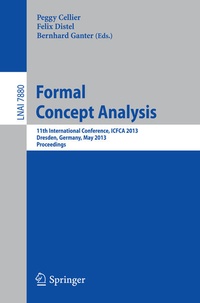
Formal Concept Analysis
11th International Conference, ICFCA 2013, Dresden, Germany, May 21-24, 2013, Proceedings
Published on 17. May 2013
Book
Paperback/Softback
X, 267 pages
978-3-642-38316-8 (ISBN)
Description
This book constitutes the refereed proceedings of the 11th International Conference on Formal Concept Analysis, ICFCA 2013, held in Dresden, Germany, in May 2013.
The 15 regular papers presented in this volume were carefully reviewed and selected from 46 submissions. The papers present current research from a thriving theoretical community and a rapidly expanding range of applications in information and knowledge processing including data visualization and analysis (mining), knowledge management, as well as Web semantics, and software engineering. In addition the book contains a reprint of the first publication in english describing the seminal stem-base construction by Guigues and Duquenne; and a position paper pointing out potential future applications of FCA.
More details
Series
Edition
2013 ed.
Language
English
Place of publication
Berlin
Germany
Publishing group
Springer Berlin
Target group
Professional and scholarly
Research
Illustrations
57 s/w Abbildungen
X, 267 p. 57 illus.
Dimensions
Height: 235 mm
Width: 155 mm
Thickness: 16 mm
Weight
429 gr
ISBN-13
978-3-642-38316-8 (9783642383168)
DOI
10.1007/978-3-642-38317-5
Schweitzer Classification
Other editions
Additional editions
Peggy Cellier | Felix Distel | Bernhard Ganter
Formal Concept Analysis
11th International Conference, ICFCA 2013, Dresden, Germany, May 21-24, 2013, Proceedings
E-Book
05/2013
Springer
€48.14
Available for download
Content
Contextual Implications between Attributes and Some Representation
Properties for Finite Lattices.- Mathematical Morphology Operators over Concept Lattices.- Dismantlable Lattices in the Mirror.- Towards an Error-Tolerant Construction of EL?-Ontologies from Data Using Formal Concept Analysis.- Using Pattern Structures for Analyzing Ontology-Based Annotations of Biomedical Data.- Formal Concept Analysis via Atomic Priming.- Applications of Ordinal Factor Analysis.- Tri-ordinal Factor Analysis.- Formal F-contexts and Their Induced Implication Rule Systems.- User-Friendly Fuzzy FCA.- Proper Mergings of Stars and Chains Are Counted by Sums of Antidiagonals in Certain Convolution Arrays.- Modeling Ceteris Paribus Preferences in Formal Concept Analysis.- Concept-Forming Operators on Multilattices.- Using FCA to Analyse How Students Learn to Program.- Soundness and Completeness of Relational Concept Analysis.- Contextual Uniformities.- Fitting Pattern Structures to Knowledge Discovery in Big Data.