

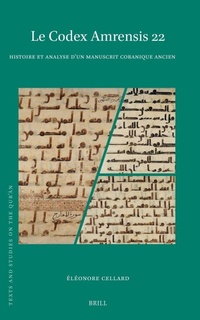
Le Codex Amrensis 22
Histoire et analyse d'un manuscrit coranique ancien
Published on 4. June 2026
Book
Hardback
244 pages
978-90-04-72196-8 (ISBN)
Description
Le Codex Amrensis 22 est un manuscrit aux dimensions monumentales - parfois identifie comme l'exemplaire portant le sang du calife ?Uthman - qui compte parmi les temoins coraniques anciens les plus importants. Disperses depuis longtemps entre Paris, Le Caire, Gotha, Istanbul et Detroit, ses feuillets conserves sont reunis ici pour la premiere fois et examines de maniere exhaustive. Leurs strates materielles revelent differentes phases de production, et cette etude met en lumiere, de facon inedite, les liens entre des folios aujourd'hui repartis entre plusieurs institutions. S'appuyant sur l'analyse materielle, la datation radiocarbone et les sources historiques, cette recherche replace le manuscrit dans ses contextes chronologique, geographique et socioculturel, montrant comment, au fil des siecles, diverses communautes et institutions ont preserve, restaure et reinterprete cet artefact coranique.
The Codex Amrensis 22 is a manuscript of monumental dimensions - and sometimes identified with the copy said to bear the blood of Caliph ?Uthman - which ranks among the most significant early Qur?anic witnesses. Long dispersed across collections in Paris, Cairo, Gotha, Istanbul, and Detroit, its surviving leaves are examined here together for the first time in a comprehensive manner. Their layered features reveal distinct stages of production, and this study highlights, in an unprecedented way, the links between folios scattered across institutions. Drawing on material examination, radiocarbon dating, and historical testimony, this study situates the manuscript within its chronological, geographical, and sociocultural settings, revealing how, over the centuries, different communities and institutions have preserved, restored, and reinterpreted this Qur?anic artefact.
The Codex Amrensis 22 is a manuscript of monumental dimensions - and sometimes identified with the copy said to bear the blood of Caliph ?Uthman - which ranks among the most significant early Qur?anic witnesses. Long dispersed across collections in Paris, Cairo, Gotha, Istanbul, and Detroit, its surviving leaves are examined here together for the first time in a comprehensive manner. Their layered features reveal distinct stages of production, and this study highlights, in an unprecedented way, the links between folios scattered across institutions. Drawing on material examination, radiocarbon dating, and historical testimony, this study situates the manuscript within its chronological, geographical, and sociocultural settings, revealing how, over the centuries, different communities and institutions have preserved, restored, and reinterpreted this Qur?anic artefact.
More details
Series
Language
French
Place of publication
Leiden
Netherlands
Target group
Professional and scholarly
Dimensions
Height: 241 mm
Width: 160 mm
Thickness: 18 mm
Weight
533 gr
ISBN-13
978-90-04-72196-8 (9789004721968)
Copyright in bibliographic data and cover images is held by Nielsen Book Services Limited or by the publishers or by their respective licensors: all rights reserved.
Schweitzer Classification
Person
Eleonore Cellard, docteur en langues, litteratures et civilisations arabes (2015, INALCO/EPHE, Paris), est specialiste d'histoire, de paleographie et de codicologie des manuscrits coraniques anciens. Elle a publie Codex Amrensis 1 (Brill, 2018) ainsi que de nombreux articles consacres aux manuscrits du Coran des debuts de l'islam.
Eleonore Cellard, Ph.D. in Arabic Language, Literature, and Civilizations (2015, INALCO/EPHE, Paris), is a specialist in the history, palaeography, and codicology of early Qur'anic manuscripts. She has published Codex Amrensis 1 (Brill, 2018) as well as numerous articles on Qur'anic manuscripts from the early centuries of Islam.
Eleonore Cellard, Ph.D. in Arabic Language, Literature, and Civilizations (2015, INALCO/EPHE, Paris), is a specialist in the history, palaeography, and codicology of early Qur'anic manuscripts. She has published Codex Amrensis 1 (Brill, 2018) as well as numerous articles on Qur'anic manuscripts from the early centuries of Islam.