

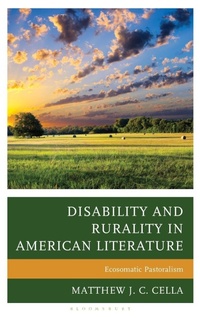
Disability and Rurality in American Literature
Ecosomatic Pastoralism
Published on 16. April 2026
Book
Hardback
226 pages
978-1-6669-6512-4 (ISBN)
Description
Matthew J.C. Cella examines the ways in which contemporary American writers deploy disability in order to deconstruct American pastoralism.
An essential tenet of pastoralism is that encounters with rural landscapes quicken the human imagination by heightening awareness of and appreciation for the natural world. This study examines the counterpart to this formulation by underscoring the ways in which disability-as concept and experience-complicates pastoralism's exaltation of rurality and rural experience. The texts examined in this book ultimately push back against the conventional pastoral ideal by exposing the ways in which dominant social constructions of rurality work to create disability. Additionally, many of the writers Cella analyzes contribute to a counter-rurality that is ultimately more complex and inclusive than what is featured in conventional American pastoralism. Ecosomatic pastoralism emphasizes the importance of locating an alignment between embodiment and emplacement through the space found between individual bodies and the landscapes they inhabit as well as the human and nonhuman bodies they interact with. Ultimately, this book examines literary texts that challenge notions of rurality that proclaim that certain ways of being-in-the-world are more "natural" than others.
An essential tenet of pastoralism is that encounters with rural landscapes quicken the human imagination by heightening awareness of and appreciation for the natural world. This study examines the counterpart to this formulation by underscoring the ways in which disability-as concept and experience-complicates pastoralism's exaltation of rurality and rural experience. The texts examined in this book ultimately push back against the conventional pastoral ideal by exposing the ways in which dominant social constructions of rurality work to create disability. Additionally, many of the writers Cella analyzes contribute to a counter-rurality that is ultimately more complex and inclusive than what is featured in conventional American pastoralism. Ecosomatic pastoralism emphasizes the importance of locating an alignment between embodiment and emplacement through the space found between individual bodies and the landscapes they inhabit as well as the human and nonhuman bodies they interact with. Ultimately, this book examines literary texts that challenge notions of rurality that proclaim that certain ways of being-in-the-world are more "natural" than others.
More details
Language
English
Place of publication
United States
Publishing group
Bloomsbury Publishing Plc
Target group
Professional and scholarly
Dimensions
Height: 235 mm
Width: 157 mm
Thickness: 17 mm
Weight
485 gr
ISBN-13
978-1-6669-6512-4 (9781666965124)
Copyright in bibliographic data and cover images is held by Nielsen Book Services Limited or by the publishers or by their respective licensors: all rights reserved.
Schweitzer Classification
Other editions
Additional editions
E-Book
02/2026
1st Edition
Bloomsbury Academic
€91.49
Available for download
E-Book
02/2026
1st Edition
Bloomsbury Academic
€91.49
Available for download
Person
Matthew J.C. Cella is Professor of English and Director of the Interdisciplinary Minor Program in Disability Studies at Shippensburg University of Pennsylvania.
Content
Introduction: Embodiment and Emplacement and the Disability-Rurality Nexus
1. Denied Rural: Disability and Race in Contemporary Slave Narratives
2. Deficient Rural: Disability and the Myth of the Frontier in Great Plains Fiction
3. Stolen Rural and Anti-Colonial Discourse in Louise Erdrich's Pillager Novels
4. Therapeutic Rural and Institutionalization in Rudolfo Anaya's Tortuga and Marge Piercy's The Woman at the Edge of Time
5. Retrofit Rural: Embodiment and Emplacement in Disability Memoirs
References
1. Denied Rural: Disability and Race in Contemporary Slave Narratives
2. Deficient Rural: Disability and the Myth of the Frontier in Great Plains Fiction
3. Stolen Rural and Anti-Colonial Discourse in Louise Erdrich's Pillager Novels
4. Therapeutic Rural and Institutionalization in Rudolfo Anaya's Tortuga and Marge Piercy's The Woman at the Edge of Time
5. Retrofit Rural: Embodiment and Emplacement in Disability Memoirs
References